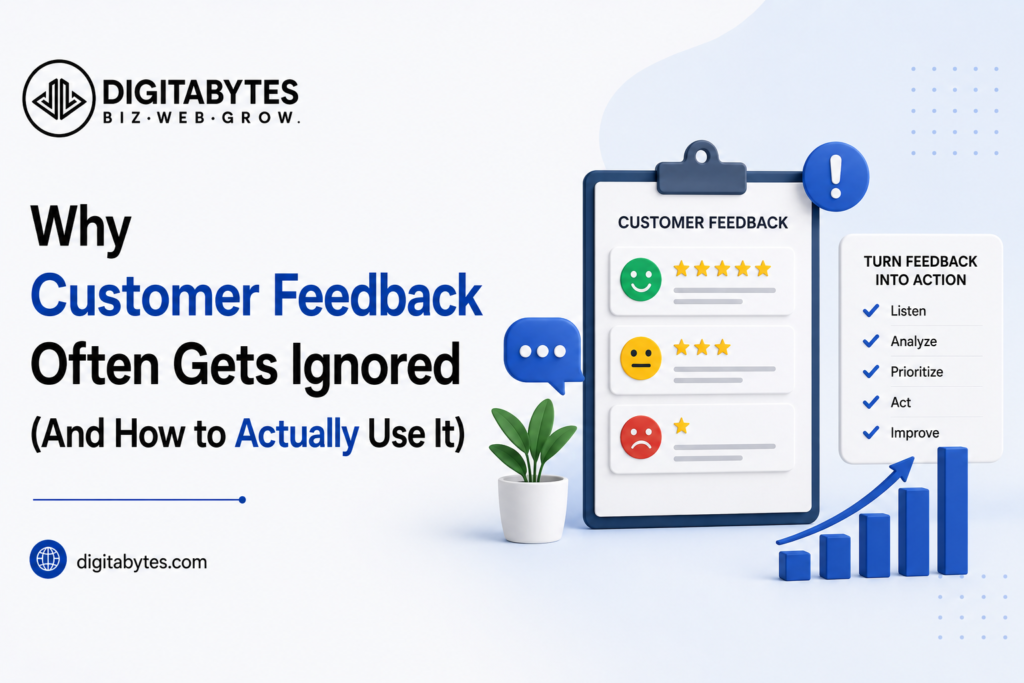
Why Customer Feedback Often Gets Ignored (And How to Actually Use It)
Plenty of businesses collect customer feedback diligently — surveys, review responses, support tickets — and then let most of it sit unused. It’s not usually a lack of care. It’s that feedback tends to pile up faster than anyone has a clear process for reviewing and acting on it, so it quietly gets deprioritized in favor of more immediate tasks.
Feedback Gets Collected Without a Clear Next Step
A common pattern: a business sends out a survey, gets a decent response rate, reviews the results once, and then moves on without ever revisiting it or assigning specific action items. Collecting feedback without a defined process for what happens next means most of it never actually influences anything, regardless of how much useful information it contained.
Building in a specific step after collection, reviewing results as a team and assigning at least one concrete action, makes it far more likely feedback actually leads somewhere.
Negative Feedback Gets More Attention Than Patterns
Businesses often react strongly to a single negative piece of feedback while missing broader patterns across many smaller comments that, together, point to something worth addressing. One angry customer doesn’t necessarily represent a systemic issue. Ten separate customers mentioning the same minor frustration probably does. Looking for patterns across feedback, rather than reacting to individual comments in isolation, usually reveals more useful insight.
Feedback Sits With the Wrong Person
If customer feedback lands with someone who doesn’t have the authority or bandwidth to actually act on it, it tends to go nowhere regardless of how useful it is. Making sure feedback actually reaches whoever is responsible for the relevant area of the business, rather than sitting in a general inbox nobody regularly reviews, significantly increases the chance it gets used.
There’s No Follow-Up With the Customer
Even when feedback does lead to a change, customers who originally gave that feedback rarely hear about it. A simple follow-up, letting someone know their input led to an actual change, does two things: it closes the loop for that customer, and it signals to others that feedback given to your business genuinely gets considered, which encourages more people to share it in the future.
Feedback Is Treated as One-Time, Not Ongoing
Surveys and feedback collection sometimes happen as an occasional project rather than an ongoing habit. Reviewing feedback regularly, rather than in occasional large batches, makes it easier to spot emerging patterns early and adjust before a small issue grows into a larger, more visible problem.
Positive Feedback Gets Underused Too
Businesses often focus feedback review entirely on complaints while overlooking what positive feedback reveals. Consistent praise about a specific feature, service detail, or aspect of the customer experience points to genuine strengths worth highlighting more prominently in marketing or expanding further, rather than being treated as simply nice to hear.
A Practical Process for Actually Using Feedback
- Set a regular schedule for reviewing collected feedback, rather than letting it accumulate indefinitely.
- Look for patterns across multiple pieces of feedback, not just individual complaints or compliments.
- Assign at least one specific action item after each review, even if it’s small.
- Route feedback to whoever actually has the ability to act on it.
- Follow up with customers when their feedback leads to a real change.
The Bottom Line
Feedback that gets collected but never reviewed with a clear next step rarely leads to any actual improvement. A team like Digitabytes typically treats feedback review as a recurring habit rather than a one-time project, since patterns become much clearer with regular attention. Building a simple, consistent process around reviewing and acting on feedback tends to reveal far more value than the collection process alone ever provides.