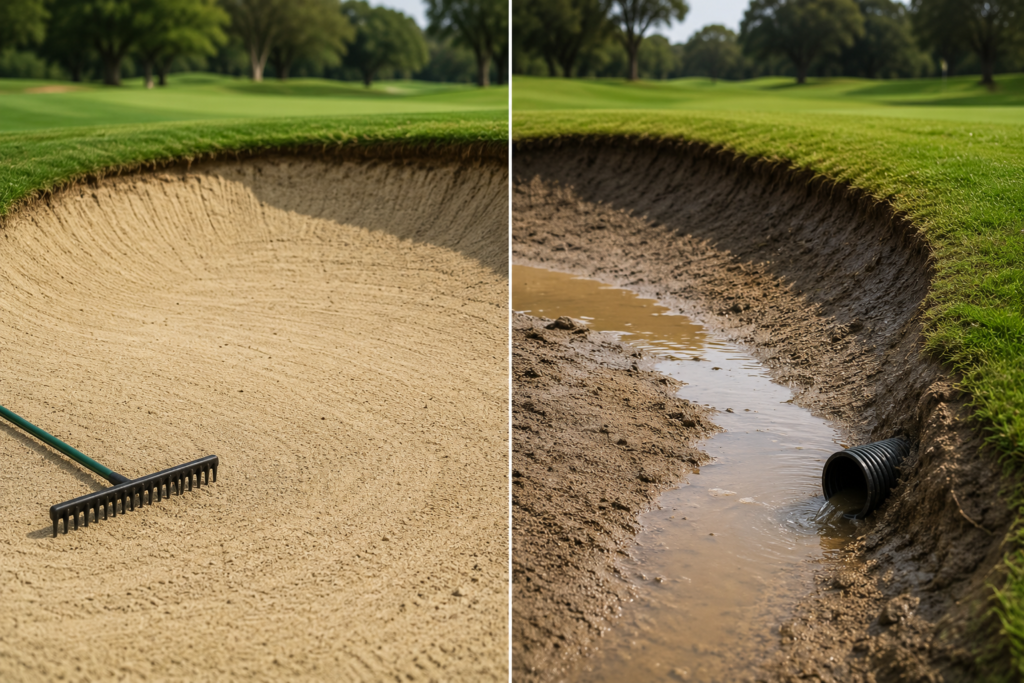
Some bunker problems are easy to spot. Others? Not so much. You walk up to the bunker, notice standing water, soggy sand, or a surface that feels hard and uneven, and the big question pops up… what is actually causing this mess?
Is the sand the problem, or is the drainage system underneath not doing its job?
For crews searching for golf course sand near me in Los Angeles, figuring that out before replacing anything can save a lot of wasted time, material, and frustration. After all, pulling out perfectly usable bunker sand will not fix a drainage issue. And repairing drains will not solve a bunker filled with poor-quality or contaminated sand.
So, where do we start? Usually with a little digging… literally and figuratively.
Start by Looking at When the Problem Shows Up
Timing can tell us a lot.
Does the bunker stay wet for days after irrigation or rain? Does water collect in the same area every single time? That can point toward a drainage problem. The water may not be moving away properly beneath the sand.
On the other hand, maybe the bunker does not hold standing water, but the sand feels heavy, compacted, or crusty. That could be more about the sand itself.
A bunker that only looks bad after heavy watering is different from one that constantly feels wet underneath. Small details like this matter.
Dig Below the Surface
Sometimes the top layer tells a completely different story than what is happening underneath.
A bunker can look dry on top but feel soaked just a few inches down. We have all seen something similar… everything seems fine until a rake or shovel goes deeper. Ugh.
When crews dig into the bunker, they should look for signs of:
- Water sitting beneath the sand
- Dark, wet patches in one specific area
- Sand that feels packed into a dense layer
- Fine material building up near the bottom
- Water struggling to move through the bunker
If moisture is trapped beneath a large area, the drainage system may need attention. If only the sand itself is dense and slow to dry, the material could be the bigger issue.
Check Whether the Sand Has Changed Over Time
Fresh bunker sand does not always stay the same forever. Foot traffic, weather, soil movement, leaves, and fine particles can slowly change how it performs.
Over time, sand may become mixed with dirt or very fine material. Once that happens, water may have a harder time moving through it. The bunker can start feeling firmer, heavier, and slower to dry.
This is where crews need to take a close look at the actual sand instead of blaming the drainage right away.
Grab a handful. Does it feel clean and loose, or sticky and compacted? Does it contain visible dirt or fine particles? Sometimes the answer is sitting right there in your hand.
Watch Where the Water Collects
Here is another simple clue… location.
If water repeatedly collects in one corner or along one edge, the issue may be connected to drainage layout, blocked outlets, or a low area beneath the bunker.
But if the entire bunker stays wet and slow-draining, the sand layer may be too compacted or contaminated across a wider area.
Patterns are useful. Random wet spots can tell one story. The same puddle showing up again and again tells another.
Do Not Replace Everything Too Quickly
It is tempting to see a bad bunker and think, “Let us just replace the sand.”
Sometimes that works. Sometimes it turns into an expensive do-over.
Before ordering new material, crews should inspect both the sand and the drainage beneath it. A quick check can help narrow down where the real problem starts.
For golf courses looking for golf course sand near me in Los Angeles, it also helps to choose material suited for bunker use rather than simply using whatever sand is available. The right sand can make maintenance easier and help the bunker perform more consistently.
At Western Materials, we understand that a bunker problem is not always just a sand problem. Sometimes the material needs replacing. Sometimes the water has nowhere to go. And sometimes… yep, it is a little of both.
The key is finding the cause first, then fixing the right thing.
FAQs
1. How can we tell if bunker sand is causing poor drainage?
If the sand feels dense, contains too many fine particles, or stays wet across most of the bunker, the sand itself may be slowing water movement.
2. Can a drainage problem affect only one part of a bunker?
Yes. Water may collect repeatedly in one area if there is a blocked drain, low spot, or problem with the drainage layout beneath that section.
3. Should we replace bunker sand if water keeps pooling?
Not always. It is better to inspect the drainage system first. Replacing the sand will not solve a blocked or damaged drain.
4. Why does bunker sand become compacted?
Foot traffic, maintenance equipment, moisture, and fine particles can slowly cause the sand to pack down and feel firmer over time.
5. Can poor-quality sand make bunker maintenance harder?
Yes. Sand that holds too much moisture, becomes compacted easily, or contains excess fine material can create more maintenance work and inconsistent playing conditions.