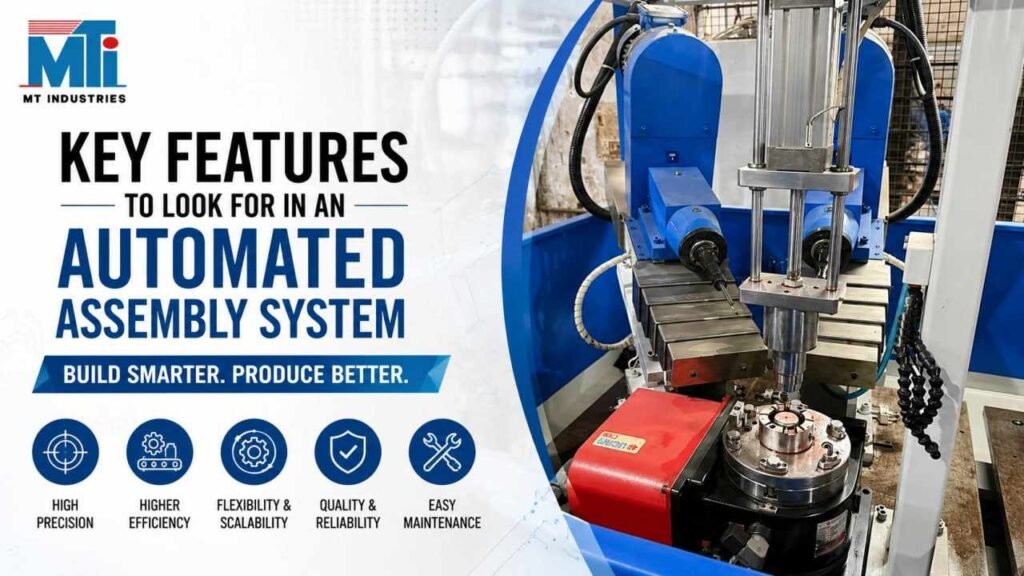
Manufacturers are under constant pressure to improve production speed, maintain consistent quality, reduce operating costs, and respond quickly to changing customer requirements. An Automated Assembly System can address many of these challenges by combining machines, robotics, tooling, sensors, controls, and inspection technologies into a coordinated production process.
However, not every automated system delivers the same level of performance. Choosing equipment only on the basis of speed or price can lead to problems with maintenance, product quality, flexibility, and long-term operating costs. The right system should match the product design, production volume, required accuracy, available floor space, and future manufacturing needs.
What Is an Automated Assembly System?
An Automated Assembly System is a manufacturing setup designed to assemble components with minimal manual intervention. Depending on the application, it may use automatic feeding systems, robotic handling, pneumatic or servo-driven mechanisms, sensors, vision inspection, programmable controls, and specialized assembly tooling.
The system can perform operations such as:
- Component feeding and orientation
- Part positioning
- Press fitting
- Screwdriving
- Riveting
- Welding
- Component insertion
- Adhesive dispensing
- Testing and inspection
- Automatic product transfer
- Finished-part sorting
The objective is not simply to replace manual labor. A well-designed system creates a repeatable, measurable, and controlled manufacturing process.
1. High Precision and Repeatability
Precision should be one of the first factors to evaluate when selecting an Automated Assembly System.
Small positioning errors can cause improper component fitting, dimensional problems, or product failures. A reliable system should maintain consistent positioning and assembly parameters throughout production.
Important specifications to examine include:
- Positioning accuracy
- Repeatability
- Tooling precision
- Component tolerance compatibility
- Cycle-to-cycle consistency
For high-precision applications, servo-controlled mechanisms and properly designed fixtures can provide better control than basic mechanical arrangements.
An Industrial Assembly Machine should also be designed around the actual tolerances of the components rather than relying solely on theoretical machine specifications.
2. Production Speed and Cycle Time
Production speed directly affects manufacturing capacity. A suitable Assembly Line Machine should achieve the required cycle time without compromising assembly quality.
Instead of looking only at maximum machine speed, manufacturers should evaluate the complete production cycle. Feeding, positioning, assembly, inspection, transfer, and product discharge all contribute to the final cycle time.
For example, if a machine performs an assembly operation in five seconds but requires several additional seconds for part loading and inspection, the effective cycle time will be higher.
Ask the manufacturer for:
- Target cycle time
- Expected production output
- Machine availability
- Changeover time
- Feeding speed
- Inspection time
These figures provide a more realistic picture of production capacity.
3. Flexible Part Handling
Modern manufacturing often involves multiple product variants. A rigid machine designed for only one component may become difficult to justify when product requirements change.
A flexible Automated Assembly System should allow manufacturers to accommodate different component sizes, configurations, or product variants where practical.
Features such as adjustable fixtures, programmable controls, interchangeable tooling, and configurable feeding systems can improve flexibility.
Before purchasing, determine:
Can the machine handle future product variants without requiring a complete redesign?
This question can have a major impact on the long-term value of the equipment.
4. Reliable Component Feeding
Automatic feeding is a critical part of assembly automation. Even a highly accurate assembly mechanism cannot maintain production if components are supplied inconsistently.
Depending on the component, the system may use:
- Vibratory bowl feeders
- Step feeders
- Belt feeders
- Flexible feeding systems
- Conveyor-based feeding
- Robotic part handling
The feeding method should match the shape, size, material, and surface characteristics of the component.
Poor feeding design can cause jams, incorrect orientation, machine stoppages, and unnecessary operator intervention. Therefore, manufacturers should evaluate feeding reliability as carefully as the main assembly operation.
5. Advanced Sensors and Inspection
Quality control should be integrated into the production process wherever practical.
Sensors can verify whether components are present, correctly positioned, or assembled properly. More advanced systems can use cameras and machine vision to identify defects or verify dimensions and orientations.
A modern Automated Assembly System may include:
- Presence sensors
- Position sensors
- Pressure monitoring
- Force monitoring
- Vision inspection
- Dimensional verification
- Barcode or identification systems
- Automatic reject mechanisms
In-process inspection helps identify problems earlier instead of discovering defective products after the entire production batch has been completed.
6. PLC and Control System
The control architecture determines how effectively the machine coordinates its different operations.
A programmable logic controller (PLC) can manage sequences involving sensors, actuators, motors, safety devices, and inspection systems.
When evaluating an Industrial Assembly Machine, consider whether its control system provides:
- User-friendly operator controls
- Clear alarm messages
- Production monitoring
- Parameter adjustment
- Fault diagnostics
- Recipe or program management
- Data logging capabilities
A well-designed human-machine interface (HMI) can also make troubleshooting and changeovers easier for operators.
7. Robust Machine Construction
An automated machine must withstand continuous industrial operation. Structural rigidity, component quality, guarding, and mechanical design all influence machine reliability.
The frame should be suitable for the forces and vibrations generated during assembly. Critical mechanical components should also be selected according to the expected operating cycle and load.
MT Industries, for example, approaches industrial machine design with attention to application requirements rather than treating every production environment as identical. This type of application-specific thinking is important when evaluating automation equipment.
8. Easy Maintenance and Accessibility
Automation does not eliminate maintenance. In fact, maintenance planning becomes especially important because an unexpected machine stoppage can affect an entire production line.
Look for an Automated Assembly System with accessible components and clearly defined maintenance points.
Useful features include:
- Easy access to wear components
- Lubrication points
- Replaceable tooling
- Diagnostic systems
- Preventive maintenance indicators
- Accessible electrical panels
- Clearly documented maintenance procedures
Manufacturers should also ask about the availability of replacement parts and technical support before making a purchase decision.
9. Safety Features
Machine safety should never be treated as an optional feature.
A properly designed Assembly Line Machine should incorporate appropriate safeguarding based on its operating risks. Depending on the application, this can include guards, interlocks, emergency stops, safety sensors, and controlled access points.
The system should also be assessed against applicable workplace and machinery safety requirements in the region where it will be installed.
Operators need clear procedures for normal operation, maintenance, troubleshooting, and emergency situations.
10. Integration With Existing Production Equipment
Many factories do not install automation as a completely isolated process. The new system may need to communicate with conveyors, testing equipment, packaging machines, material-handling systems, or existing production lines.
Therefore, integration capability is an important selection criterion.
Before installation, check:
- Electrical compatibility
- Communication protocols
- Conveyor interfaces
- Product transfer requirements
- PLC communication
- Data connectivity
- Available floor space
- Utility requirements
MT Industries can be considered when manufacturers need equipment designed around specific production requirements and integration considerations.
11. Quick Changeover Capability
If a factory produces multiple product variants, changeover time can significantly affect overall productivity.
An Automated Assembly System should ideally allow operators to change tooling, fixtures, programs, or feeding arrangements efficiently.
Quick-change fixtures and stored machine recipes can reduce setup time and make production scheduling more flexible.
For high-mix manufacturing environments, a slightly slower machine with fast changeovers may sometimes deliver better overall productivity than a very fast machine designed for only one product.
12. Data Monitoring and Traceability
Modern manufacturing increasingly depends on production data.
A capable system can provide information about:
- Production quantity
- Cycle time
- Machine downtime
- Fault frequency
- Reject rates
- Maintenance events
- Product identification
Traceability can be particularly important for industries where manufacturers need to determine when and how a component was assembled.
MT Industries’ experience with industrial automation also highlights why machine selection should consider not only mechanical performance but the broader production environment.
13. Scalability for Future Production
A machine should solve today’s production problem without creating tomorrow’s limitation.
When selecting an Industrial Assembly Machine, consider whether it can be upgraded with additional stations, inspection systems, feeding mechanisms, or automation features.
Scalability is especially valuable when production demand is expected to increase.
Before purchasing, ask:
Can this system be expanded if production requirements change?
The answer can influence the total lifecycle value of the investment.
How to Choose the Right Automated Assembly System
There is no universal machine configuration suitable for every manufacturing application. The selection process should begin with the product and production requirements.
Evaluate these factors:
- Product dimensions and tolerances
- Required production volume
- Target cycle time
- Number of product variants
- Assembly operations
- Required inspection methods
- Available floor space
- Operator requirements
- Maintenance capabilities
- Future production plans
A manufacturer should also conduct a total cost evaluation rather than comparing only the initial purchase price. Energy consumption, tooling, maintenance, downtime, spare parts, changeovers, and expected service life can all influence the true cost of ownership.
Why the Right Features Matter
An Automated Assembly System is a long-term manufacturing investment. Its value depends on more than automation alone. Precision, feeding reliability, inspection, safety, flexibility, maintainability, controls, and integration all contribute to the system’s real-world performance.
For manufacturers working with MT Industries or another automation supplier, clearly defining production requirements before machine design can help ensure that the final solution matches the application.
The best system is not necessarily the fastest or most expensive option. It is the one that consistently delivers the required quality and production output while remaining practical to operate, maintain, and adapt.
Frequently Asked Questions
1. What is the main benefit of an Automated Assembly System?
The main benefit is consistent and repeatable production with reduced manual intervention. Depending on the application, automation can improve throughput, assembly accuracy, quality control, and process consistency.
2. How do I choose an Automated Assembly System?
Start by assessing product specifications, production volume, target cycle time, assembly operations, component tolerances, inspection requirements, and future product variants. Then compare machine capabilities against these requirements.
3. What is the difference between an Industrial Assembly Machine and an Assembly Line Machine?
An Industrial Assembly Machine may perform a specific automated assembly operation or a defined group of operations. An Assembly Line Machine generally forms part of a larger sequential production process in which different stations perform different tasks.
4. Can an Automated Assembly System handle multiple products?
Yes, many systems can be designed for multiple product variants. The level of flexibility depends on tooling, fixtures, feeding mechanisms, controls, and the differences between the products.
5. Is an Automated Assembly System suitable for small manufacturers?
It can be, provided the production volume, labor requirements, quality demands, and expected return on investment justify automation. A detailed production and cost analysis should be completed before investing.
For More Information Click Here:- https://mtindustries.in/service-assembly