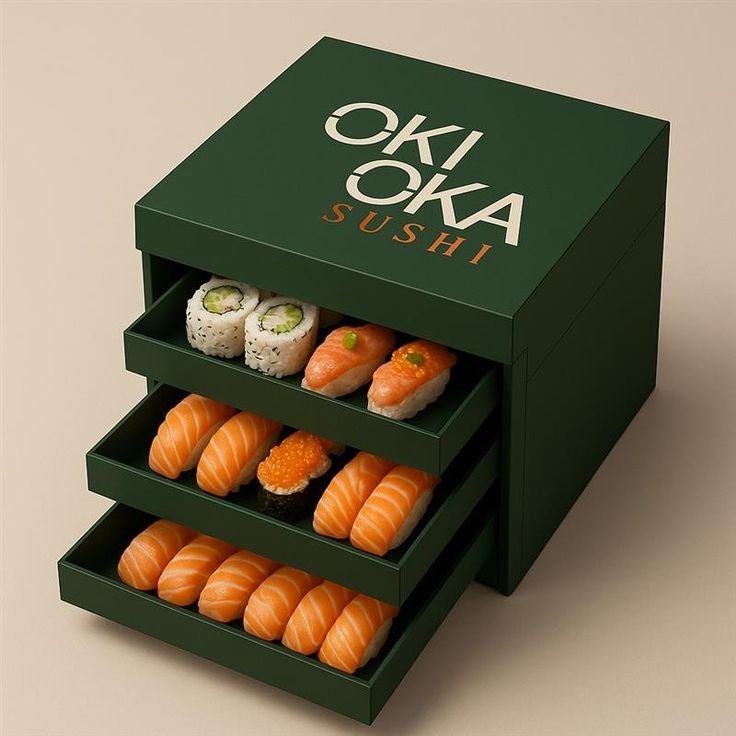
Sushi is a food where appearance matters almost as much as the meal itself. Carefully arranged rolls, nigiri, sashimi, and other items can lose their visual appeal when packaging is poorly designed. Sushi boxes provide restaurants and food businesses with a practical way to organize, protect, and present sushi for takeaway, catering, and delivery.
The right package needs to accommodate the food without crushing delicate pieces or allowing them to shift excessively. At the same time, it should provide a clean presentation when the customer opens the package. Depending on the restaurant’s needs, sushi packaging can include simple cartons, compartment-style containers, window boxes, or custom-printed designs.
What Are Sushi Boxes?
Sushi boxes are food packaging containers specifically designed to hold and transport sushi products. They can be made in different sizes, shapes, and materials depending on the type and quantity of sushi being served.
Some designs provide a single open area for arranged sushi, while others use compartments to separate different foods. A transparent window can also be added to selected packaging styles so customers can see the contents without opening the box.
The structure should ultimately match the food being packaged, the restaurant’s service model, and the expected handling conditions.
Why Is the Right Sushi Packaging Important?
Sushi can be delicate, and presentation can change quickly if pieces move around during transportation. A suitable Sushi Boxes With Window helps keep the arrangement organized while providing protection around the food.
For takeaway and delivery orders, packaging also needs to remain practical during handling. A secure closure can help keep the box closed, while an appropriately sized interior can reduce unnecessary movement.
Good packaging also creates a cleaner experience for customers when they open their order.
Sushi Boxes With Windows
A window can provide immediate visibility of the sushi arrangement.
Customers can see the rolls, toppings, colors, and overall presentation without opening the package. This can be particularly useful for takeaway displays, catering orders, and restaurant counters.
The window material should be selected appropriately for food packaging, and businesses should verify that the complete package meets their applicable food-contact requirements.
Custom Sushi Boxes
Custom sushi boxes can be designed around the specific products and presentation style of a restaurant.
A business can choose the dimensions, shape, printing, compartments, window placement, and other structural elements. This is useful when standard packaging does not provide the desired fit or presentation.
Custom packaging can also help restaurants create a recognizable identity across their takeaway orders.
Printed Sushi Boxes for Restaurants
Printed sushi packaging can display a restaurant’s logo, colors, patterns, illustrations, or other brand elements.
A simple logo can create a clean and professional appearance, while a more detailed design can reflect the restaurant’s overall visual identity.
The design should still leave enough clean space for practical information such as storage instructions, contact information, or other applicable details.
Sushi Takeout Boxes
Takeout packaging needs to balance convenience with food presentation.
The box should be easy for staff to pack quickly and simple for customers to open. A secure closure is useful for transportation, while a stable base can help keep sushi arranged during handling.
For restaurants serving different portions, multiple box sizes may be more practical than using one large container for every order.
Sushi Delivery Boxes
Delivery adds additional handling to the packaging process. Orders can be moved between preparation areas, bags, vehicles, and customers before they are opened.
A well-fitted box can help minimize unnecessary movement inside the package. The exterior should also be strong enough to maintain its shape under normal handling.
Restaurants should test their packaging with actual delivery orders to see how the food and box perform under realistic conditions.
Sushi Boxes for Catering
Catering orders often contain larger quantities and multiple varieties of sushi.
Larger boxes can be divided into sections to organize different types of rolls, nigiri, sashimi, or accompaniments. Clear visibility can also help guests identify the contents quickly.
For catered events, custom printing can provide an additional branding opportunity while keeping the presentation coordinated with other event materials.
Sushi Boxes for Different Portions
The ideal box size depends on the number and type of sushi pieces being packaged.
A small individual order may only require a compact box, while family portions and catering orders need more space.
The height of the packaging also matters. It should provide enough clearance for toppings and garnishes without allowing excessive empty space that could increase movement during transport.
Sushi Boxes With Compartments
Compartments can help separate different types of food within the same package.
For example, a restaurant may use sections for rolls, nigiri, sauces, or other items. This can make the package easier to organize and can help prevent different foods from becoming mixed together.
The number and dimensions of compartments should be based on the restaurant’s menu rather than using a generic configuration.
Sushi Packaging Materials
Sushi packaging can be produced using different materials, including paperboard, kraft-based materials, and food-service containers made from other suitable materials.
Paper-based boxes can provide strong opportunities for branding and printing. Other container formats may be selected where specific moisture, grease, or structural requirements exist.
Businesses should select materials based on the actual food, temperature, moisture, storage, and transportation conditions.
Food-Safe Sushi Packaging
Food safety should be considered when selecting any sushi container.
Materials, coatings, inks, adhesives, and other components should be suitable for their intended food-contact application where applicable. Businesses should also follow local food packaging and handling requirements.
Because sushi can involve raw and prepared ingredients, restaurants should consider packaging as part of their broader food-safety and handling procedures.
Custom Sushi Boxes With Branding
A sushi box can become an important part of a restaurant’s visual identity.
Matching the box with menus, takeaway bags, chopstick sleeves, napkins, stickers, and other packaging can create a consistent brand experience.
For smaller restaurants, even a simple logo and recognizable color scheme can make the package feel more professional without requiring an overly complicated design.
Sustainable Sushi Packaging
Many food businesses are looking for packaging options that reduce unnecessary material use.
Paper-based and appropriately sized packaging may be considered depending on the restaurant’s requirements. However, sustainability depends on the complete package, including coatings, windows, inserts, adhesives, and other components.
Businesses should also consider local waste and recycling systems when evaluating packaging choices.
Wholesale Sushi Boxes
Wholesale sushi boxes are useful for restaurants and food businesses with regular takeaway or delivery volumes.
Buying packaging in larger quantities can help maintain consistency and reduce the frequency of individual orders. Restaurants should select quantities according to actual usage and available storage space.
If the menu changes regularly, businesses may prefer a smaller number of versatile box sizes rather than maintaining excessive packaging inventory.
How to Choose the Right Sushi Box
Begin by identifying the foods that will go inside the package. Consider the number of pieces, their dimensions, toppings, sauces, and any additional items.
Next, consider how the order will be handled. Takeout and delivery orders may require stronger closures or additional internal stability.
Finally, consider presentation. If customers need to see the sushi before opening the box, a window may be useful. If branding is important, ensure there is sufficient printable surface for the logo and other design elements.
How Much Do Sushi Boxes Cost?
Sushi box pricing depends on size, material, structure, quantity, printing, windows, compartments, finishing, and shipping.
Simple unprinted boxes generally have different production requirements from fully custom boxes with printed branding, windows, or specialized inserts.
For an accurate comparison, restaurants should provide the required dimensions, estimated quantity, material preference, and desired features.
Final Thoughts
Sushi boxes need to do more than contain food. They should help maintain the arrangement, protect delicate pieces, support convenient transportation, and present the meal attractively when the customer opens the package.
Restaurants can choose from different sizes, structures, materials, compartments, windows, and branding options according to their menu and service model.
Whether the requirement is individual takeaway packaging, delivery containers, catering boxes, or branded restaurant packaging, the best sushi box is one that combines practical food protection with a clean and appealing presentation.
Frequently Asked Questions
What are sushi boxes used for?
Sushi boxes are used to package sushi for takeaway, delivery, catering, retail display, and other food-service applications.
Can sushi boxes have windows?
Yes. Some sushi packaging designs include transparent windows that allow customers to see the food without opening the package.
Can sushi boxes be customized with a logo?
Yes. Custom sushi boxes can feature restaurant logos, brand colors, patterns, illustrations, and other suitable artwork.
Are sushi boxes available in different sizes?
Yes. Sushi boxes can be produced or selected in different sizes for individual servings, larger orders, family portions, and catering.
Can sushi boxes have compartments?
Yes. Compartment-style packaging can help separate different sushi varieties and other items included in an order.
Are sushi boxes suitable for delivery?
Yes, provided the box is appropriately designed for the food and expected handling conditions. Restaurants should test packaging with actual delivery orders.
What materials are used for sushi boxes?
Common options can include paperboard, kraft-based materials, and other food-service packaging materials selected according to the product requirements.
Are sushi boxes food-safe?
Food packaging should use materials and components appropriate for the intended food-contact application. Businesses should verify supplier specifications and applicable local requirements.
Can sushi boxes be printed?
Yes. Printed sushi boxes can display logos, restaurant branding, graphics, colors, and other design elements.
Are sushi boxes available wholesale?
Yes. Wholesale packaging is suitable for restaurants, catering companies, food businesses, and other operations with regular sushi orders.
How do I choose the right sushi box size?
Consider the number of sushi pieces, their dimensions, toppings, sauces, and how much space is needed to prevent unnecessary movement.
Are sushi boxes environmentally friendly?
The environmental characteristics depend on the materials and complete construction. Paper-based options may be suitable for some businesses, but coatings, windows, adhesives, and local recycling systems should also be considered.
How much do sushi boxes cost?
Pricing depends on dimensions, material, structure, printing, windows, compartments, quantity, and shipping.
Should I test sushi packaging before ordering in bulk?
Yes. Testing allows restaurants to check the food fit, presentation, closure, stacking, handling, and performance during takeaway or delivery before purchasing larger quantities.