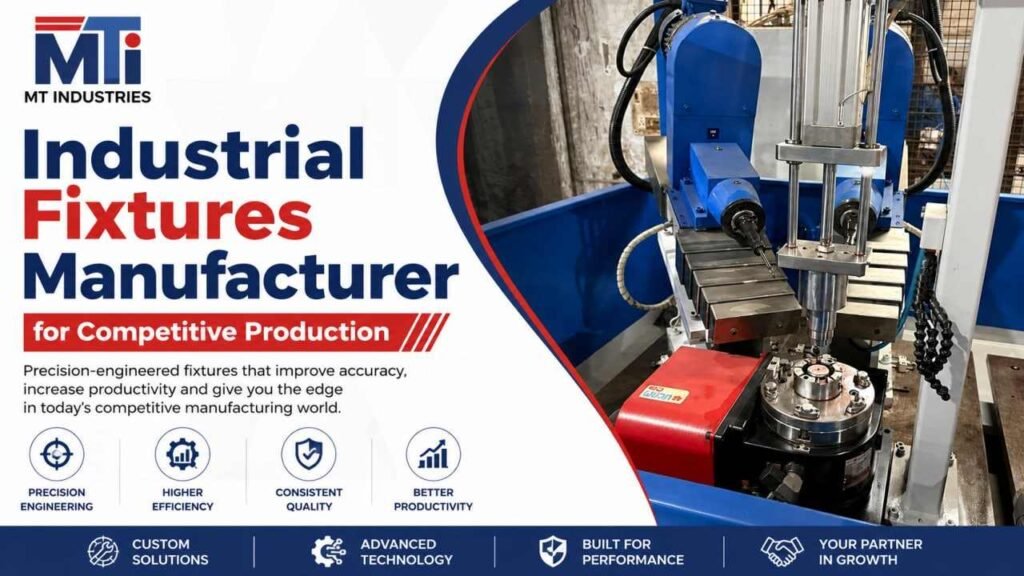
In modern manufacturing, productivity depends on more than advanced machinery. Precision, consistency, repeatability, and efficient workflows all play an important role in maintaining competitive production. One of the key components that supports these goals is the industrial fixture. A well-designed fixture can hold, position, locate, or support a workpiece accurately during machining, assembly, inspection, welding, drilling, and other industrial processes.
Choosing the right Industrial Fixtures Manufacturer is therefore an important decision for manufacturers looking to improve production performance. A reliable manufacturer can develop fixtures according to specific component dimensions, machine requirements, production volumes, and operational needs.
What Are Industrial Fixtures?
Industrial fixtures are specialized devices used to securely position and hold a workpiece during a manufacturing operation. Unlike general-purpose tools, fixtures are usually designed for a particular component, machine, or production process.
Their primary purpose is to maintain the correct position of a workpiece while allowing the manufacturing operation to be performed accurately and consistently.
Depending on the application, industrial fixtures may be used for:
- Machining and CNC operations
- Drilling and tapping
- Welding and fabrication
- Assembly operations
- Component inspection
- Grinding and finishing
- Automotive component manufacturing
- Aerospace component production
- Heavy engineering applications
A properly engineered fixture reduces unnecessary movement, improves operator convenience, and helps maintain consistent production quality.
Why Industrial Fixtures Matter for Competitive Production
Manufacturers constantly look for ways to produce high-quality components faster while controlling operational costs. Industrial fixtures can contribute significantly to this objective.
1. Improved Production Accuracy
A fixture keeps the workpiece in a predetermined position. This reduces positioning errors and helps maintain dimensional consistency between components.
For high-volume production, even a small positioning variation can result in quality problems. Properly designed fixtures provide repeatable positioning and support more consistent manufacturing results.
2. Faster Workpiece Loading and Unloading
Production time is not limited to machining or processing time. Loading, positioning, clamping, and unloading can also consume significant time.
A customized fixture can simplify these steps. Features such as quick clamping mechanisms, guided positioning, and accessible loading points can help reduce handling time and improve overall cycle efficiency.
3. Better Repeatability
Repeatability in manufacturing is essential when producing hundreds or thousands of similar components. A fixture allows the workpiece to be positioned in the same manner for each production cycle.
This reduces dependency on manual positioning skills and helps manufacturers achieve more consistent results.
4. Reduced Production Errors
Incorrect positioning can lead to drilling errors, machining inaccuracies, improper assembly, or component rejection. By providing controlled positioning, a fixture helps minimize these avoidable errors.
This can contribute to lower scrap rates and better utilization of raw materials.
5. Improved Operator Productivity
Ergonomically designed fixtures can make repetitive manufacturing operations easier for operators. When components can be loaded, located, and clamped efficiently, operators can spend more time on productive manufacturing activities.
The fixture should also provide sufficient accessibility and avoid unnecessary physical effort wherever possible.
How to Choose the Right Industrial Fixtures Manufacturer
Selecting an Industrial Fixtures Manufacturer requires more than comparing prices. Manufacturers should evaluate technical expertise, customization capabilities, material selection, quality control, and after-sales support.
Understand Your Application Requirements
Before approaching a manufacturer, clearly define the application. Consider:
- Component dimensions and geometry
- Material of the workpiece
- Required tolerances
- Machine type
- Production volume
- Operation being performed
- Clamping requirements
- Loading and unloading method
- Required cycle time
Providing accurate technical information allows the manufacturer to develop a more suitable fixture solution.
Check Customization Capabilities
Many industrial applications require fixtures designed around specific components and machines. A manufacturer with strong custom fixture design capabilities can modify the fixture according to the production environment rather than forcing the application to fit a standard design.
MT Industries, for example, works around application-specific manufacturing requirements when developing industrial solutions, making customization an important consideration for companies evaluating fixture suppliers.
Evaluate Material and Build Quality
The fixture material should be selected according to the application, operating conditions, expected loads, and required service life.
Depending on the application, fixtures may incorporate different grades of steel, alloy components, hardened elements, precision locating components, and other engineered materials.
Build quality also matters. Poorly manufactured fixture components can introduce unwanted movement, wear, or dimensional variation.
Important Features of a High-Quality Industrial Fixture
A good fixture should be designed around the manufacturing process rather than simply holding a component in place.
Some important characteristics include:
Accurate locating: The workpiece should return to the required position consistently.
Secure clamping: Clamping should prevent unwanted movement without unnecessarily damaging the component.
Accessibility: Cutting tools, drills, welding equipment, inspection tools, or assembly components should have sufficient access.
Repeatability: The fixture should provide consistent positioning over repeated production cycles.
Durability: Components exposed to frequent loading, vibration, heat, or mechanical stress should be designed for appropriate service conditions.
Ease of maintenance: Wear components and frequently serviced parts should be accessible for inspection and replacement.
Industrial Fixtures and Automation
The relationship between industrial fixtures and automation is becoming increasingly important. Automated production systems require predictable component positioning because machines and robots operate according to predefined movements.
A properly designed fixture can provide the reference points required for automated loading, machining, inspection, or assembly.
For example, an automated system may require a component to enter the workstation in a precise orientation. A fixture can help establish that orientation and reduce variation between production cycles.
Fixtures can therefore support the integration of:
- CNC machining systems
- Robotic handling
- Automated assembly
- Automated inspection
- Drilling and tapping systems
- Special-purpose machines
- Production line automation
How Fixtures Can Reduce Manufacturing Costs
The cost of a fixture should not be evaluated only by its purchase price. Manufacturers should consider its impact on the entire production process.
A suitable fixture can potentially reduce costs by improving cycle time, material utilization, repeatability, labor efficiency, and product quality.
For example, if a fixture reduces setup time by allowing faster and more consistent workpiece positioning, the accumulated savings can become significant in high-volume production.
Similarly, reducing component rejection can lower material waste and rework expenses.
Common Mistakes When Selecting Industrial Fixtures
Manufacturers can face problems when fixture selection is based only on initial cost.
One common mistake is ignoring the production volume. A fixture designed for low-volume manufacturing may not be appropriate for continuous high-volume production.
Another mistake is overlooking operator ergonomics. A technically functional fixture may still create unnecessary loading or clamping difficulties.
Manufacturers should also avoid inadequate tolerance planning. The fixture must be capable of maintaining the positioning accuracy required by the final component.
Finally, future production requirements should be considered. If component designs or production volumes are expected to change, a modular or adaptable fixture design may provide greater long-term value.
Industrial Fixtures for Different Manufacturing Applications
The right fixture configuration depends heavily on the manufacturing process.
Machining fixtures are designed to maintain workpiece stability during cutting operations.
Drilling fixtures help position components accurately and can guide drilling operations where required.
Welding fixtures hold multiple components in their intended relationship during welding and help control distortion or positional variation.
Assembly fixtures support accurate component alignment and can make repetitive assembly operations more efficient.
Inspection fixtures help position components consistently during dimensional or quality inspection.
A knowledgeable Industrial Fixtures Manufacturer should understand these application differences and develop the fixture around the specific manufacturing objective.
Why Engineering Expertise Matters
Fixture manufacturing involves more than fabrication. It requires an understanding of component geometry, manufacturing tolerances, clamping forces, machining processes, material behavior, ergonomics, and production requirements.
A technically capable manufacturer can identify potential problems during the design stage. For instance, inadequate tool clearance or an incorrect locating strategy can create production difficulties after installation.
MT Industries considers application requirements when developing industrial manufacturing solutions, helping businesses approach fixture development as an engineering process rather than simply a fabrication requirement.
How to Get Better Results From Your Fixture Manufacturer
To achieve better results, manufacturers should provide detailed information at the beginning of the project. Drawings, 3D models, component samples, machine specifications, production targets, and tolerance requirements can help the manufacturer understand the application.
It is also useful to discuss expected cycle times and future production requirements. This allows the fixture design to balance accuracy, speed, durability, accessibility, and cost.
Before final production, manufacturers should also review the fixture design and confirm that it supports the intended workflow.
Frequently Asked Questions
1. What does an Industrial Fixtures Manufacturer do?
An Industrial Fixtures Manufacturer designs and produces specialized fixtures used to position, locate, support, and clamp components during manufacturing operations. Fixtures can be developed for machining, drilling, welding, assembly, inspection, and automated production.
2. How do industrial fixtures improve production efficiency?
Industrial fixtures improve production efficiency by reducing positioning time, improving repeatability, supporting faster loading and unloading, and minimizing errors. In repetitive production, these improvements can contribute to better cycle times and reduced manufacturing costs.
3. Should I choose a standard or custom industrial fixture?
The choice depends on the application. Standard fixtures can work well for common requirements, while custom industrial fixtures are generally more suitable when components have unique geometries, tight tolerances, specialized clamping requirements, or high-volume production needs.
4. What should I consider when choosing an Industrial Fixtures Manufacturer?
Consider the manufacturer’s engineering capabilities, customization experience, manufacturing quality, material selection, tolerance control, testing procedures, delivery capability, and technical support. The manufacturer should understand your production process rather than simply supply a fixture.
5. Can industrial fixtures be used with automated manufacturing systems?
Yes. Properly designed industrial fixtures can support automated manufacturing by providing consistent component positioning and orientation. They can be integrated into CNC, robotic, assembly, inspection, drilling, tapping, and other automated systems.
Conclusion
Competitive manufacturing requires consistent quality, efficient workflows, controlled production costs, and reliable processes. Industrial fixtures can support all of these objectives by improving workpiece positioning, repeatability, operator efficiency, and process consistency.
Choosing the right Industrial Fixtures Manufacturer is therefore an important part of developing an efficient manufacturing setup. Instead of focusing only on fixture cost, manufacturers should evaluate engineering expertise, customization, durability, accuracy, ergonomics, and compatibility with existing or future production systems.
With the right fixture design and manufacturing approach, businesses can create more predictable production processes and build a stronger foundation for long-term manufacturing efficiency. MT Industries focuses on application-oriented industrial solutions, making careful fixture selection and engineering an important consideration for manufacturers seeking reliable production performance.