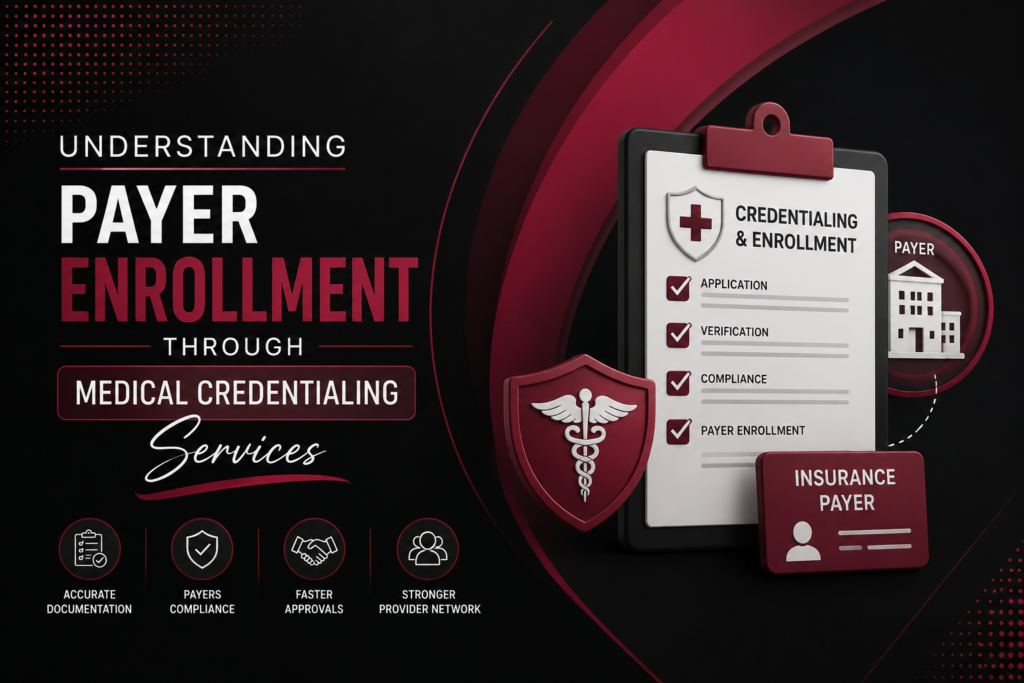
Medical Credentialing Services help healthcare providers get verified, approved, and enrolled with insurance payers so they can legally bill for patient care. In simple terms, credentialing confirms that a doctor, therapist, or clinic meets the standards required to work with insurance companies. Without this step, providers cannot receive reimbursement from payers, no matter how qualified they are.
Payer enrollment is the process that follows credentialing. It connects a verified provider to specific insurance networks like Medicare, Medicaid, or private insurers. Together, credentialing and enrollment form the foundation of a functioning medical practice. If either step is delayed or mishandled, revenue slows down almost immediately.
This article breaks down what payer enrollment really means, how it connects to credentialing, and what practices should know before starting the process.
Anyone who has worked inside a medical office knows the frustration of a new provider who is ready to see patients but cannot bill a single claim. That gap usually comes down to incomplete credentialing. Understanding the process ahead of time helps practices avoid weeks of lost revenue.
What Are Medical Credentialing Services and Why Do They Matter
Medical Credentialing Services involve verifying a provider’s education, licenses, training, work history, and malpractice record. Insurance companies require this proof before allowing a provider to join their network.
This process protects patients by confirming that only qualified professionals deliver care. It also protects the practice by preventing claim denials caused by unverified credentials.
Here’s why credentialing matters so much:
- It builds trust with insurance payers and patients
- It prevents billing delays and claim rejections
- It keeps practices compliant with state and federal regulations
- It supports long-term financial stability
Many new practices underestimate how long this process takes. In reality, credentialing can take anywhere from 60 to 120 days, depending on the payer and how complete the application is.
Providers who skip proper credentialing often face rejected claims, delayed payments, and frustrated patients who assumed their insurance would be accepted. This is why experienced practices treat credentialing as a priority rather than a formality. Getting Medical Credentialing Services right from the start prevents a chain reaction of billing problems down the line.
How Medical Billing and Credentialing Services Work Together
Medical billing and credentialing services are closely linked, even though they serve different purposes. Credentialing confirms a provider’s eligibility. Billing turns patient visits into paid claims.
If credentialing is incomplete, billing teams cannot submit clean claims. This creates a backlog that affects cash flow across the entire practice.
A well-coordinated approach usually includes:
- Verifying provider credentials before billing begins
- Matching provider information across payer systems
- Updating billing software with correct payer IDs
- Monitoring claim status after enrollment is approved
When credentialing and billing teams communicate clearly, practices avoid unnecessary denials. This is one reason many clinics choose to manage both processes together instead of treating them as separate tasks.
The Role of Medical Insurance Credentialing Services in Payer Enrollment
Medical insurance credentialing services focus specifically on getting providers approved by individual insurance companies. Each payer, whether it’s Aetna, Cigna, or a regional insurer, has its own application requirements and review timeline.
This is where payer enrollment becomes more detailed. A provider may be credentialed correctly but still face delays if the enrollment application is filled out incorrectly.
Common steps in this stage include:
- Submitting a payer-specific enrollment application
- Providing NPI, DEA, and tax identification details
- Attaching proof of malpractice insurance
- Responding quickly to payer follow-up requests
Small errors, like a mismatched address or an outdated license number, are among the most common reasons enrollment gets delayed. Reviewing every detail before submission saves significant time later.
Common Mistakes Practices Make During Credentialing Services for Medical Practices
Credentialing services for medical practices often fail not because of complex requirements, but because of avoidable mistakes. Understanding these early can save weeks of delay.
Some frequent issues include:
- Submitting outdated or missing documents
- Not tracking application status regularly
- Assuming enrollment is automatic after credentialing
- Ignoring payer-specific formatting rules
- Waiting too long to start the recredentialing process
Recredentialing is just as important as initial credentialing. Most payers require providers to recertify every two to three years. Missing this window can cause a provider to lose network status entirely.
Practices that stay organized, keep digital records updated, and follow up consistently tend to move through this process much faster than those who treat it as a one-time task.
Practical Tips to Simplify Medical Credentialing Services
Simplifying credentialing does not require complicated systems. It requires consistency, accuracy, and early planning.
A few practical tips include:
- Start the credentialing process at least three months before a provider’s start date
- Keep a master file with licenses, certifications, and malpractice documents
- Track every payer’s specific requirements separately
- Set calendar reminders for recredentialing deadlines
- Communicate directly with payer representatives when delays occur
These small habits reduce administrative stress and prevent last-minute scrambling. Many practices find that assigning one dedicated point of contact for credentialing improves accuracy and speeds up approvals.
It also helps to review payer contracts periodically. Insurance networks sometimes update their requirements, and a practice that isn’t paying attention can fall out of compliance without realizing it. Staying proactive with Medical Credentialing Services means fewer surprises and steadier reimbursement over time.
Choosing the right approach to credentialing is not just about paperwork. It directly affects how quickly a provider can start seeing patients and generating revenue. Practices that understand this connection tend to plan ahead instead of reacting to delays after they happen.
If your practice is preparing to onboard new providers or expand into new insurance networks, taking the time to understand payer enrollment now can prevent costly interruptions later.
FAQs
What is the difference between credentialing and payer enrollment?
Credentialing verifies a provider’s qualifications. Payer enrollment connects that verified provider to specific insurance networks for billing purposes.
How long does the credentialing process usually take?
Most Medical Credentialing Services take between 60 and 120 days, depending on the payer and how complete the initial application is.
Why do practices need medical billing and credentialing services together?
Billing cannot proceed correctly without completed credentialing. Coordinating both processes reduces claim denials and speeds up reimbursement.
What documents are required for medical insurance credentialing services?
Providers typically need an NPI number, DEA registration, malpractice insurance proof, licenses, and educational verification.
How often do providers need recredentialing?
Most payers require recredentialing every two to three years. Missing this deadline can result in losing network participation.