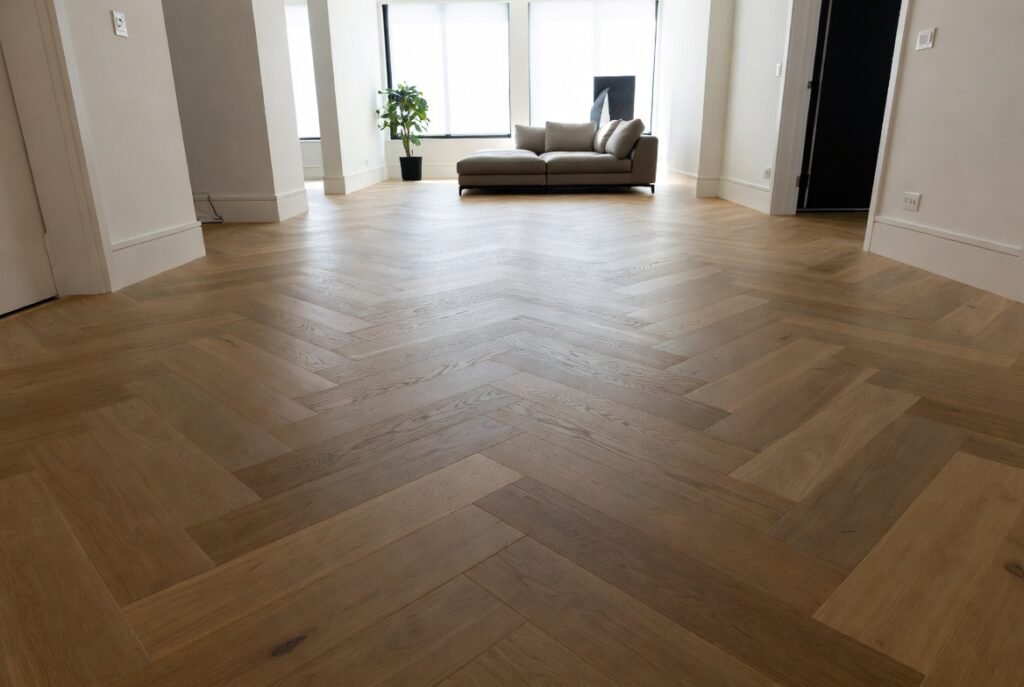
I have been paying close attention to the UK flooring market for long enough to remember when asking for herringbone in a showroom required some explanation. A customer would come in, point to a sample, describe the pattern, and the conversation would proceed from there. Today that conversation starts differently. Couples walk in having already decided the flooring. The herringbone question is not a question anymore; it has become an already decided choice. Specifically, engineered herringbone flooring.
This is a flooring that comes with a real wood top layer over a stable multi-layer core. This multilayer core is laid in the interlocking diagonal geometry that has been in continuous use across human design for the better part of two thousand years and has somehow managed to feel entirely new and trending in UK homes in 2026.
The UK has experienced sustained and consistent growth in the pattern, driven by a force more enduring than a trend cycle. Understanding what that durable factor is and determining whether engineered wood herringbone flooring is truly the right choice for your specific home are crucial steps that will assist you in making all subsequent flooring decisions quickly.
What Is Actually Driving the Demand for Engineered Herringbone Flooring in the UK
The Spatial Effect That No Straight-Lay Floor Replicates
Every wood flooring choice affects how a room feels spatially. What makes engineered wood herringbone flooring different is the specific way it achieves that effect and the fact that the effect is consistent, reproducible, and rooted in geometry rather than fashion.
Straight-lay wooden flooring directs the eye along the length of the boards. In a room where the boards run along the longest axis, the eye follows them from one end of the room to the other, emphasising the length and direction of the lay. The spatial consequence is predictable, which means rooms that are longer than their width feels more elongated, narrow hallways feel more tunnel-like, and the square rooms feel slightly arbitrary, with no obvious direction to lay the boards and any choice feeling mildly unsatisfying.
Herringbone engineered flooring does something fundamentally different. The interlocking diagonal geometry distributes the eye across the full floor surface, simultaneously pulling it in multiple directions at once rather than channelling it along a single axis. The eye travels across the width, finds the pattern, follows the diagonals, and arrives at the edges of the room having experienced the floor as a whole rather than as a series of parallel lines.
Why Engineered Construction Specifically Has Made Herringbone Accessible
The herringbone flooring conversation in UK homes is almost entirely about engineered wood herringbone flooring rather than solid wood parquet, and the reasons are practical rather than aesthetic.
Traditional solid wood parquet needs a very flat and dry subfloor, which many UK homes, especially older ones with raised wooden floors, don’t have without a lot of work. It moves considerably with seasonal humidity changes, and in a herringbone pattern where joints run in multiple directions, that movement is more visible and more disruptive than in a straight-lay floor where all joints run in one direction.
Engineered wood herringbone flooring addresses these constraints directly. The multi-layer core has grain directions that oppose each other across the layers. The opposing grain directions help prevent the flooring from moving due to humidity, so it expands and contracts much less than solid wood in the same conditions. The result is a herringbone floor that remains tight and consistent through the seasonal cycle of UK central heating rather than developing visible gaps that open and close with the seasons.
The Social Media Effect
It would be dishonest to write about why engineered wood herringbone flooring has grown in the UK without acknowledging the role of social media. The pattern photographs just brilliantly. The diagonal geometry creates strong visual lines that read clearly at every screen size. A well-installed herringbone floor in natural light with simple furniture is consistently one of the highest-performing types of interior content across Pinterest, Instagram, and the renovation-focused corners of TikTok.
However, social media exposure alone cannot sustain a trend for several years due to the natural reversal dynamic that purely visual trends undergo. Chevron had significant social media exposure and peaked relatively quickly. Likewise, grey laminate wood flooring had enormous social media exposure and is now generating as much critical commentary as admiration. But engineered wood herringbone flooring has grown consistently for several years, and the growth rate has not reversed.
The reason is straightforward: the people installing it are satisfied with it. The spatial effect delivers in real homes, under real conditions, and over real time. Word of mouth from genuinely happy homeowners sustains demand in a way that no amount of social media visibility can manufacture. The social media effect got the conversation started, but the actual performance of the floor in daily life is what keeps it going.
Is the Demand Justified?
Engineered Wood Herringbone Flooring Is Genuinely the Right Choice
After observing many flooring projects and their results, it’s clear that there are specific situations where engineered herringbone flooring is definitely the right choice.
- Hallways:
The spatial effect of herringbone engineered wood flooring is nowhere more valuable than in the narrow, elongated proportions of a typical UK hallway. The diagonal geometry pulls the eye across the width of the space rather than down its length, and the transformation from corridor to considered entrance is one of the most consistent and most remarked-upon outcomes of any flooring decision I have followed. The hallway is also the room where the floor receives the most universal viewing, which makes it the room where the investment in a quality engineered herringbone floor delivers the most return relative to the area covered.
- Dining rooms:
Herringbone parquet has historical roots in dining rooms and reception rooms of quality residential buildings, as it belongs to the architectural character of Victorian and Edwardian houses in a way that purely contemporary patterns do not. In a dining room with original cornicing and a period fireplace, engineered herringbone flooring reads as authentic rather than imposed. The pattern suits the proportions and the character of those rooms with a naturalness that straight-lay wooden flooring in the same material does not quite achieve.
- Living rooms:
Engineered wood herringbone flooring is most effective in living areas that receive ample natural light and have a floor area of approximately 16 square metres or more, extending beyond hallways and dining rooms. The pattern needs space and clear light so that the geometry reads as a coherent whole and the texture of the herringbone surface catches and diffracts it in ways that animate the floor rather than flattening it.
Summing Up
To sum up, there are several reasons why the engineered wood herringbone flooring has become one of the most sought-after flooring options in 2026 in the UK. If you too are someone planning to get the flooring done and have the herringbone flooring on your list, the trend is a sign to evaluate more closely and get it done at the earliest, as this is going to simply be one of the best flooring choices that you will ever make.