Introduction
The logistics industry in the UAE is evolving rapidly. Rising customer expectations, expanding eCommerce, complex supply chains, and increasing operational costs are pushing logistics companies to adopt smarter technologies. Businesses can no longer rely only on manual planning or traditional software to stay competitive. They need intelligent systems that can analyze data, predict outcomes, and automate decision-making.
This is where Machine Learning Solutions UAE are making a significant impact. By enabling systems to learn from historical and real-time data, machine learning helps logistics companies optimize routes, forecast demand, reduce delivery delays, improve warehouse efficiency, and enhance customer satisfaction. Instead of reacting to problems after they occur, organizations can proactively identify opportunities and risks before they affect business performance.
The UAE has also positioned itself as one of the leading technology hubs in the Middle East. Government initiatives promoting artificial intelligence, smart cities, and digital transformation have encouraged enterprises across logistics, transportation, manufacturing, and retail to invest in AI-powered solutions. Companies that embrace machine learning today are building a competitive advantage that will continue to grow over the coming years.
Whether you’re managing a fleet of delivery vehicles, overseeing warehouse operations, or coordinating international supply chains, implementing machine learning can unlock measurable improvements in productivity, operational efficiency, and profitability.
In this guide, you’ll learn how machine learning is transforming logistics across the UAE, the business benefits it delivers, real-world applications, implementation strategies, and how choosing the right technology partner can accelerate your digital transformation journey.
Why UAE Logistics Companies Are Investing in Machine Learning
The UAE has become one of the fastest-growing logistics hubs in the world. Its strategic geographic location connects Asia, Europe, and Africa, making it a preferred destination for global trade and supply chain operations. As logistics volumes continue to increase, businesses need smarter systems capable of managing growing operational complexity.
Machine learning enables logistics companies to process massive amounts of operational data and convert it into actionable business intelligence. Rather than relying on assumptions, organizations can make decisions based on predictive analytics and real-time insights.
Several factors are driving this investment across the UAE.
Government-Led Digital Transformation
The UAE government has consistently promoted artificial intelligence as a cornerstone of economic development. National AI initiatives encourage businesses to adopt intelligent technologies that improve efficiency, sustainability, and innovation across industries. This supportive ecosystem has accelerated enterprise adoption of AI solutions within logistics and transportation.
Rising Customer Expectations
Customers now expect same-day deliveries, accurate shipment tracking, and transparent communication throughout the delivery process. Meeting these expectations requires predictive systems capable of dynamically adjusting operations based on changing conditions such as weather, traffic, inventory availability, and customer demand.
Machine learning enables companies to anticipate disruptions before they occur, resulting in faster deliveries and improved customer experiences.
Increasing Operational Costs
Fuel prices, warehouse expenses, labor shortages, and transportation costs continue to pressure profit margins. Intelligent automation helps businesses optimize resource utilization, reduce waste, and improve operational efficiency without compromising service quality.
Instead of expanding operations by hiring additional staff, organizations can automate repetitive decision-making processes using AI-powered models.
Growing Data Availability
Modern logistics businesses generate enormous volumes of operational data every day through GPS systems, warehouse management platforms, ERP software, IoT sensors, barcode scanners, and customer interactions.
The challenge is no longer collecting data—it’s transforming that information into business value. Machine learning algorithms identify hidden patterns within this data, enabling companies to improve forecasting, inventory management, and operational planning.
The Role of Software Development Partnerships
Strong software development partnerships help UAE logistics companies implement machine learning solutions faster and more efficiently. By working with experienced technology partners, businesses can build scalable, data-driven systems that improve supply chain visibility, automate operations, and support long-term digital transformation.
What Are Machine Learning Solutions?
Machine learning refers to a branch of artificial intelligence that enables computer systems to learn from historical and real-time data without requiring explicit programming for every scenario.
Unlike conventional software that follows predefined rules, machine learning continuously improves its performance as it processes more information. This makes it particularly valuable for industries like logistics, where business conditions constantly change.
Machine learning solutions typically include predictive analytics, intelligent automation, anomaly detection, recommendation engines, forecasting models, image recognition, and optimization algorithms. These technologies work together to automate complex business decisions while improving operational accuracy.
For logistics companies, machine learning can analyze thousands of variables simultaneously, including delivery schedules, warehouse capacity, inventory levels, customer demand, fuel consumption, and traffic patterns. The result is faster, smarter, and more efficient operations.
Some of the most common machine learning capabilities include:
- Demand forecasting for inventory planning
- Route optimization for delivery fleets
- Predictive maintenance for transportation assets
- Warehouse automation
- Fraud detection
- Customer behavior analysis
- Dynamic pricing optimization
- Shipment delay prediction
Organizations looking for long-term digital transformation often combine machine learning with custom generative ai development services to create intelligent business systems capable of automating workflows, generating operational insights, and supporting faster decision-making.
How Machine Learning Is Transforming UAE Logistics
Machine learning is reshaping every stage of the logistics value chain. From procurement and warehousing to transportation and customer service, intelligent algorithms are helping organizations improve efficiency while reducing operational costs.
Demand Forecasting
Accurate demand forecasting has become one of the biggest competitive advantages in logistics. Machine learning analyzes historical sales, seasonal trends, customer purchasing behavior, weather conditions, and market demand to predict future inventory requirements with greater accuracy.
This helps businesses avoid both overstocking and stock shortages while improving warehouse utilization.
Intelligent Route Optimization
Traditional route planning often depends on static maps and manual scheduling. Machine learning continuously analyzes live traffic conditions, weather updates, delivery priorities, road closures, and vehicle capacity to recommend the most efficient routes.
This reduces fuel consumption, shortens delivery times, and improves customer satisfaction.
Predictive Maintenance
Unexpected vehicle breakdowns can significantly disrupt supply chains. Machine learning monitors sensor data from transportation assets to identify early signs of equipment failure before costly breakdowns occur.
Predictive maintenance minimizes downtime while extending vehicle lifespan and reducing maintenance costs.
Warehouse Automation: Smarter Operations, Better Productivity
Warehouses are at the heart of every logistics operation. As order volumes grow and customer expectations increase, manual processes can become bottlenecks. Machine learning helps warehouses become more intelligent by analyzing operational data and recommending the most efficient ways to manage inventory, workforce allocation, and order fulfillment.
AI-powered systems can identify high-demand products, optimize storage locations, and reduce the time employees spend searching for items. They can also predict peak order periods, allowing managers to allocate resources more effectively.
For organizations planning long-term digital transformation, integrating intelligent warehouse systems with machine learning integration dubai creates a connected ecosystem where inventory, transportation, and customer data work together to improve operational efficiency.
Key Benefits of Warehouse Automation
- Faster order picking and packing
- Reduced operational errors
- Improved warehouse space utilization
- Better workforce planning
- Shorter order fulfillment cycles
- Higher customer satisfaction
Inventory Optimization
Maintaining the right inventory levels is one of the biggest challenges for logistics companies. Excess inventory increases storage costs, while insufficient stock can lead to delayed deliveries and lost customers.
Machine learning analyzes historical sales, supplier performance, seasonal demand, market trends, and customer purchasing behavior to recommend optimal inventory levels.
Instead of relying on manual estimates, businesses can make informed decisions based on predictive insights, helping them reduce waste while improving product availability.
How Machine Learning Improves Inventory Management
- Forecasts future demand more accurately
- Identifies slow-moving inventory
- Reduces warehouse holding costs
- Prevents stock shortages
- Improves procurement planning
- Supports just-in-time inventory strategies
Fraud Detection and Risk Management
Supply chain fraud can significantly impact profitability and customer trust. Machine learning continuously monitors transactions and operational activities to identify unusual patterns that may indicate fraudulent behavior.
Whether it’s duplicate shipments, suspicious payment activity, inventory discrepancies, or unauthorized system access, AI models can detect anomalies much faster than manual reviews.
Early detection helps organizations minimize financial losses while improving compliance and operational security.
Improving Customer Experience Through Predictive Intelligence
Today’s logistics customers expect transparency, speed, and reliability. Machine learning enables businesses to provide proactive communication instead of reactive updates.
By analyzing shipment data and operational conditions, AI systems can predict delays before they happen and automatically notify customers with updated delivery estimates.
Businesses can also personalize customer experiences by identifying purchasing patterns and recommending relevant services.
Companies looking to combine predictive analytics with visual inspection capabilities often work with a computer vision solutions company in dubai to automate package verification, quality checks, and warehouse surveillance.
Customer Experience Improvements
- Accurate delivery estimates
- Real-time shipment tracking
- Personalized communication
- Faster issue resolution
- Reduced delivery delays
- Higher customer retention
Benefits of Machine Learning for Logistics Businesses
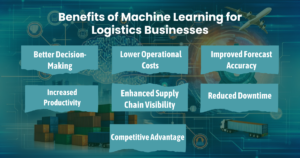
Investing in machine learning is not just about adopting new technology—it’s about creating measurable business value. From reducing costs to improving customer satisfaction, AI-driven solutions help logistics companies become more agile and competitive.
1. Better Decision-Making
Machine learning processes large volumes of operational data in real time, enabling managers to make informed decisions based on insights rather than assumptions.
2. Lower Operational Costs
AI identifies inefficiencies across transportation, warehousing, and inventory management, helping businesses reduce unnecessary expenses and maximize resource utilization.
3. Improved Forecast Accuracy
Predictive models analyze historical and live data to forecast demand, shipment volumes, and resource requirements more accurately.
4. Increased Productivity
Automation of repetitive tasks allows employees to focus on strategic initiatives, improving overall productivity across logistics operations.
5. Enhanced Supply Chain Visibility
Machine learning provides end-to-end visibility into supply chain activities, helping businesses monitor shipments, inventory, and operational performance in real time.
6. Reduced Downtime
Predictive maintenance minimizes equipment failures and vehicle breakdowns, ensuring smoother logistics operations.
7. Competitive Advantage
Organizations that leverage AI can respond more quickly to market changes, improve customer experiences, and optimize operational performance ahead of competitors.
Real-World Use Cases of Machine Learning in UAE Logistics
Machine learning is already delivering measurable results across various logistics sectors in the UAE.
E-Commerce Logistics
Online retailers use AI to forecast customer demand, optimize delivery schedules, and improve warehouse efficiency during seasonal shopping peaks.
Retail Supply Chains
Retail businesses leverage predictive analytics to maintain optimal inventory levels, reducing stock shortages while minimizing excess inventory.
Healthcare Logistics
Medical suppliers rely on machine learning to monitor temperature-sensitive shipments, predict delivery delays, and improve inventory planning for critical supplies.
Port and Freight Operations
Shipping companies analyze cargo movement, port congestion, and customs processing data to improve scheduling and reduce turnaround times.
Cold Chain Logistics
Businesses transporting food and pharmaceuticals use AI to monitor environmental conditions and ensure product quality throughout the supply chain.
Manufacturing Distribution
Manufacturers optimize procurement, warehouse management, and outbound logistics using predictive analytics to improve operational efficiency.
Machine Learning vs Traditional Automation
| Feature | Traditional Automation | Machine Learning |
| Decision-Making | Rule-Based | Learns from Data |
| Flexibility | Limited | Highly Adaptive |
| Accuracy | Fixed Rules | Improves Over Time |
| Forecasting | Basic Reporting | Predictive Analytics |
| Route Optimization | Static Planning | Real-Time Optimization |
| Maintenance | Scheduled | Predictive |
| Customer Insights | Limited | Personalized |
| Scalability | Moderate | High |
Traditional automation follows predefined rules, making it effective for repetitive tasks. Machine learning, however, continuously learns from data, adapts to changing conditions, and provides predictive insights that improve over time. For logistics businesses operating in dynamic environments, this adaptability can lead to significant gains in efficiency and service quality.
How AI Integration Works in Logistics: A Step-by-Step Process
Implementing machine learning isn’t about installing software and expecting immediate results. Successful AI integration follows a structured approach that aligns technology with business goals. For logistics companies, this ensures the solution addresses real operational challenges while delivering measurable ROI.
Step 1: Business Assessment
Every successful AI project starts with identifying business challenges. Organizations evaluate their current logistics processes, operational bottlenecks, and long-term objectives.
Some common questions include:
- Are delivery delays increasing?
- Is inventory forecasting inaccurate?
- Are warehouse operations slowing down?
- Is fuel consumption affecting profitability?
- Can customer service be improved through automation?
Answering these questions helps define clear project goals and measurable success metrics.
Step 2: Data Collection and Preparation
Machine learning models rely on high-quality data to generate accurate predictions. Logistics companies gather information from multiple sources, including:
- Warehouse Management Systems (WMS)
- Enterprise Resource Planning (ERP)
- GPS tracking systems
- IoT sensors
- Delivery management platforms
- Customer relationship management systems
- Historical shipment records
Before training begins, the data is cleaned, standardized, and organized to eliminate inconsistencies that could affect model performance.
Step 3: Model Development and Training
Once the data is prepared, AI engineers develop machine learning models tailored to specific business requirements.
Depending on the objective, models may be trained to:
- Forecast product demand
- Predict delivery delays
- Optimize transportation routes
- Detect operational anomalies
- Estimate warehouse capacity
- Improve inventory planning
The models continuously learn from historical and real-time data, becoming more accurate over time.
Step 4: Testing and Validation
Before deployment, the models are tested using real operational scenarios to evaluate their accuracy, reliability, and performance.
This stage helps businesses identify any adjustments needed before integrating AI into live logistics operations.
Step 5: Deployment
Once validated, the solution is deployed into existing business systems with minimal disruption.
Modern machine learning platforms can integrate with:
- ERP software
- Warehouse Management Systems
- Fleet Management Software
- CRM platforms
- Inventory Management Systems
- Supply Chain Management Platforms
This allows businesses to improve existing workflows without replacing their current infrastructure.
Step 6: Continuous Monitoring and Optimization
Machine learning is not a one-time implementation. As business conditions evolve, models continue learning from new data to improve performance.
Regular monitoring helps organizations:
- Improve prediction accuracy
- Adapt to market changes
- Optimize operational efficiency
- Identify new automation opportunities
- Maintain long-term ROI
Common Challenges Businesses Face During Machine Learning Adoption
Although machine learning offers significant business value, successful implementation requires careful planning. Understanding common challenges allows organizations to prepare for a smoother adoption process.
Data Quality Issues
AI models are only as effective as the data they receive. Incomplete, outdated, or inconsistent data can reduce prediction accuracy and limit business outcomes.
Organizations should prioritize data governance and quality management before implementing AI.
Legacy Infrastructure
Many logistics companies still operate using older systems that were not designed to support artificial intelligence.
Modern integration strategies allow businesses to connect AI solutions with existing platforms without requiring a complete technology overhaul.
Change Management
Employees may initially hesitate to adopt AI-powered systems due to concerns about complexity or job displacement.
Providing proper training and demonstrating how AI supports employees rather than replacing them helps improve adoption across the organization.
Data Security and Compliance
Logistics companies manage sensitive operational and customer information. AI solutions should include robust security measures such as encryption, access controls, and compliance with regional data protection regulations.
A secure implementation protects business continuity while maintaining customer trust.
Measuring Return on Investment
Without clearly defined objectives, it can be difficult to evaluate the success of an AI initiative.
Businesses should establish measurable KPIs such as:
- Delivery time improvements
- Reduced fuel consumption
- Lower operational costs
- Increased warehouse efficiency
- Customer satisfaction scores
- Inventory accuracy
Tracking these metrics helps demonstrate the long-term value of machine learning investments.
How to Choose the Right Machine Learning Partner in the UAE
Selecting the right technology partner plays a major role in the success of any AI initiative. Beyond technical expertise, businesses should look for a partner that understands logistics operations, business challenges, and long-term digital transformation goals.
When evaluating a provider, consider the following factors:
Industry Experience
Look for a team with experience delivering AI solutions for logistics, transportation, supply chain, and enterprise businesses.
Custom Development Capabilities
Every logistics business has unique operational requirements. Choose a partner that builds customized solutions rather than relying solely on generic, off-the-shelf software.
Integration Expertise
Your AI solution should work seamlessly with existing ERP, WMS, CRM, and transportation management systems to maximize efficiency without disrupting operations.
Scalability
As your business grows, your AI infrastructure should be able to handle increasing data volumes, users, and operational complexity.
Ongoing Support
Machine learning models require continuous monitoring and optimization. A reliable technology partner should provide long-term maintenance, updates, and performance improvements.
Security Standards
Ensure the provider follows enterprise-grade security practices and complies with applicable data privacy regulations.
Why Businesses Choose SISGAIN Technologies
For logistics companies seeking reliable AI implementation, SISGAIN Technologies delivers intelligent solutions designed to solve real business challenges rather than simply adding new technology.
Our approach focuses on understanding each organization’s operational goals before designing scalable machine learning solutions that improve efficiency, reduce costs, and enhance decision-making.
By combining advanced AI expertise with practical business knowledge, we help enterprises modernize logistics operations through predictive analytics, intelligent automation, and data-driven insights.
Whether you’re looking to optimize warehouse performance, improve fleet management, or enhance supply chain visibility, our team develops customized AI solutions that integrate seamlessly with your existing systems while supporting long-term business growth.
The Future of Machine Learning in UAE Logistics
The logistics industry is entering a new phase where intelligent technologies will become standard rather than optional. As AI capabilities continue to evolve, machine learning will play an even greater role in helping organizations improve efficiency, resilience, and customer experience.
Some of the key trends shaping the future include:
- AI-powered digital twins for supply chain simulation
- Autonomous warehouse operations
- Predictive supply chain risk management
- Hyper-personalized customer experiences
- Edge AI for real-time logistics decision-making
- Sustainable logistics through intelligent route optimization
- AI-assisted procurement and inventory planning
- Advanced predictive maintenance using IoT and machine learning
Businesses that invest in these innovations today will be better positioned to adapt to changing market demands and maintain a competitive edge in the years ahead.

Conclusion
The logistics sector in the UAE is undergoing rapid transformation, and machine learning has become a key driver of that change. From predictive demand forecasting and intelligent route optimization to warehouse automation and proactive maintenance, AI-powered solutions enable organizations to operate more efficiently while delivering better customer experiences.
However, technology alone isn’t enough. Success depends on choosing the right implementation strategy, maintaining high-quality data, and partnering with experienced professionals who understand both AI and logistics.
As customer expectations continue to rise and supply chains become increasingly complex, businesses that embrace machine learning today will be better equipped to reduce costs, improve operational agility, and achieve sustainable growth.
Ready to Transform Your Logistics Operations with AI?
At SISGAIN Technologies, we help logistics businesses across the UAE implement intelligent machine learning solutions tailored to their operational needs. Whether your goal is to optimize supply chains, automate warehouse processes, enhance predictive analytics, or improve fleet performance, our team is ready to support your digital transformation journey.
Contact SISGAIN Technologies today to discover how AI-powered innovation can help your business increase efficiency, reduce operational costs, and stay ahead in the competitive logistics landscape.
FAQs
1. What are Machine Learning Solutions UAE?
Machine learning solutions use artificial intelligence algorithms to analyze data, identify patterns, automate decision-making, and improve business operations across industries such as logistics, retail, healthcare, and manufacturing.
2. How can machine learning improve logistics operations?
Machine learning helps optimize delivery routes, forecast demand, automate warehouse management, predict equipment failures, reduce operational costs, and improve customer satisfaction through data-driven insights.
3. Is machine learning suitable for small and medium-sized logistics businesses?
Yes. Modern AI solutions are scalable and can be customized for businesses of all sizes, allowing SMEs to improve efficiency without requiring massive infrastructure investments.
4. How long does machine learning implementation take?
The implementation timeline depends on project complexity, data availability, and integration requirements. Most enterprise projects are completed in phases, allowing businesses to realize value progressively.
5. Can machine learning integrate with existing ERP or warehouse management systems?
Yes. Modern machine learning platforms are designed to integrate with existing ERP, CRM, warehouse management, transportation, and inventory management systems.
6. What ROI can businesses expect from machine learning?
Organizations often experience reduced operational costs, improved forecasting accuracy, faster decision-making, enhanced productivity, lower downtime, and better customer satisfaction, leading to measurable long-term returns.