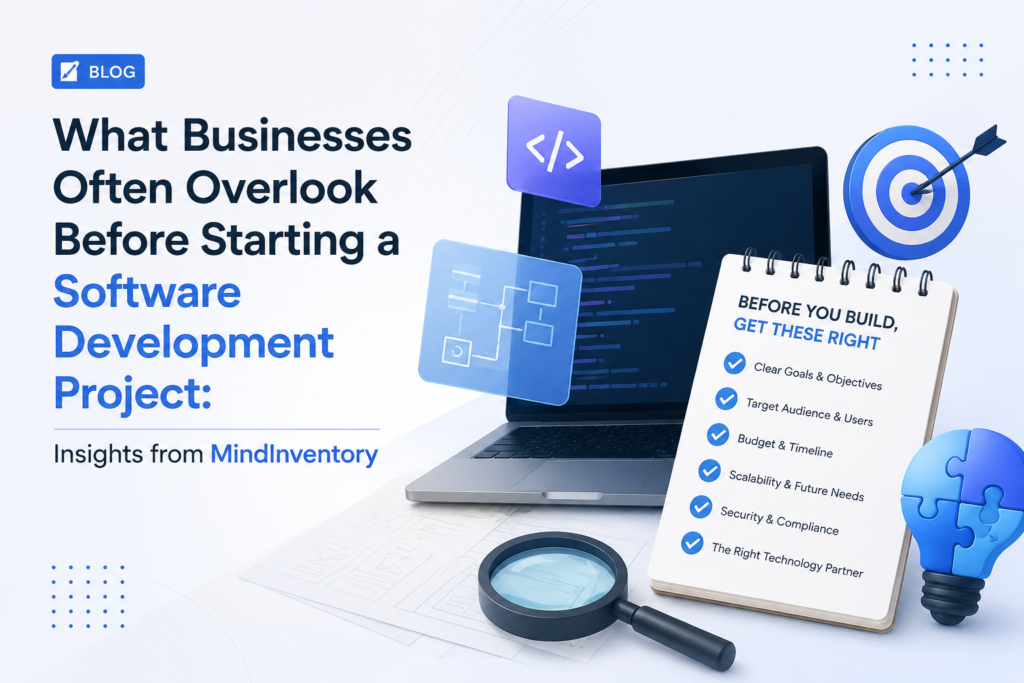
Most software projects don’t fail in the coding phase. They fail in the weeks before a single line of code gets written.
A new CRM, a customer-facing app, an internal automation tool the idea always sounds straightforward in a boardroom. Then the project kicks off, requirements start shifting, budgets balloon, and six months in, nobody can quite agree on what “done” was supposed to look like. The technology usually isn’t the problem. The planning is.
Quick answer: The most common things businesses overlook before starting a software development project are: a clearly defined business outcome (not just a feature list), a proper discovery and requirements phase, realistic budget and timeline buffers, scalability planning, early stakeholder alignment, data security and compliance needs, and a post-launch maintenance plan. Skipping any one of these is usually what turns a promising project into a costly one.
This article breaks down each of these gaps: why they happen, what they cost, and how to close them before you sign off on a single sprint.
Why Pre-Project Planning Matters More Than Most Teams Realize
It’s tempting to treat planning as a formality you rush through to “get to the real work.” The data says otherwise.
Research from McKinsey and the University of Oxford on large IT initiatives found that only about one in 200 projects hits its budget, schedule, and value targets at the same time and projects that miss even one of those marks tend to run roughly 45% over budget while delivering well below the value that was promised at the outset. Separately, the Standish Group’s long-running CHAOS research has consistently found that only around a third of software projects are considered fully successful, while close to one in five are abandoned before they ever reach completion.
The common thread in almost every post-mortem isn’t a bad developer or a buggy framework. It’s a gap that existed before development even started, an assumption nobody questioned, a stakeholder nobody consulted, or a requirement nobody wrote down.
Here are the eight gaps we see most often at MindInventory, based on years of scoping projects with founders, CTOs, and product leaders before a single sprint begins.
1. No Clearly Defined Business Outcome
Many teams start with a feature list instead of a business goal. “We need an app with login, dashboard, and payments” tells a development team what to build, but not why and that distinction matters more than it sounds.
Why This Backfires
Without a measurable outcome (reduce support tickets by 30%, cut onboarding time in half, launch an MVP investors can test in 90 days), every decision during development becomes subjective. Scope creep sets in because there’s no anchor to push back against new requests. Teams end up building software that’s technically functional but doesn’t move any business metric.
The Fix
Before writing a single requirement, define the outcome in one sentence: “This project succeeds if ___.” Every feature request after that gets measured against it. If a feature doesn’t serve the stated outcome, it goes into a backlog, not the current sprint.
2. Skipping (or Rushing) the Discovery Phase
Discovery feels like a delay when you’re eager to start building. In practice, it’s the cheapest insurance you’ll buy on the entire project.
What a Real Discovery Phase Should Cover
- Mapping current workflows and where the new software fits into them
- Identifying technical constraints (legacy systems, existing integrations, data formats)
- Defining user personas and core user journeys
- Flagging compliance or regulatory requirements early
- Producing a rough architecture and a realistic, range-based estimate
Poor or missing requirements gathering is one of the most frequently cited causes of failed software projects in independent industry research, often ranking above technical issues like infrastructure or tooling. A two-to-four-week discovery sprint almost always costs less than the rework required after building the wrong thing.
3. Underestimating Budget, Timeline, and Hidden Costs
Initial estimates are usually built on the happy path no scope changes, no integration surprises, no delayed feedback cycles. Real projects rarely run that smoothly.
Cost-overrun research on large IT and software initiatives consistently puts average overruns in the 25-45% range, with some studies showing software projects specifically running higher than non-software IT projects due to shifting requirements and integration complexity. Common blind spots include:
- Third-party API and licensing costs that weren’t priced into the original quote
- QA and testing cycles, which are frequently compressed when timelines slip
- Data migration, especially from legacy or poorly documented systems
- Post-launch bug fixes, which industry estimates suggest can consume a significant share of total project budget if quality isn’t built in early
A realistic budget includes a contingency buffer typically 15-20% and a timeline that accounts for at least one full round of stakeholder feedback and revision.
4. Forgetting About Scalability From Day One
It’s common to build for today’s user base and assume scaling is a “future problem.” That assumption gets expensive fast.
Where This Shows Up Later
- Database structures that need a full redesign once usage grows
- Architecture that works for 1,000 users but buckles at 50,000
- Manual processes baked into the MVP that can’t be automated without a rebuild
You don’t need enterprise-grade infrastructure for an MVP. But the underlying architecture should be designed so scaling later is an extension, not a rewrite. This is a conversation worth having with your technical partner before development starts, not after your first growth spike.
5. Leaving Key Stakeholders Out of Early Conversations
Software projects rarely fail because of one bad decision. They fail because of dozens of small misalignments that compound usually because the people who’ll actually use or be affected by the software weren’t in the room early enough.
If sales, support, compliance, or end users only see the product for the first time at launch, you should expect pushback, low adoption, or a list of “must-have” changes that should have been raised three months earlier. Build a short list of stakeholders whose sign-off matters at the discovery and requirements stage not just at final delivery.
6. Overlooking Data Security, Privacy, and Compliance
This is one of the most expensive things to bolt on after the fact. If your software touches customer data, payments, or health records, security and compliance aren’t a phase they’re a constraint that shapes the architecture from day one.
Depending on your industry, this could mean:
- HIPAA for healthcare data
- GDPR or similar regional laws for handling personal data of EU or other regulated users
- PCI-DSS for anything touching payment information
- SOC 2 / ISO 27001 alignment for enterprise B2B buyers who’ll ask for it during procurement
Retrofitting compliance into a finished product is one of the more disruptive and costly changes a team can make. It’s far cheaper to define these requirements during discovery and design the data model and access controls around them from the start.
7. Choosing a Development Partner on Price Alone
A lower quote is appealing, especially for budget-conscious founders. But the cheapest bid often hides costs that show up later vague scoping, limited communication, or a team that lacks experience in your specific domain.
Questions Worth Asking Before You Sign
- Can they show relevant, comparable work not just a portfolio, but outcomes?
- How do they handle scope changes and communication during the project?
- What does their QA and testing process actually look like?
- Who owns the code, documentation, and IP once the project ends?
- What happens after launch is support included, or is that a separate negotiation?
A partner who asks hard questions during the sales conversation is usually the one who saves you money during execution.
8. No Plan for What Happens After Launch
Launch day isn’t the finish line it’s closer to the starting line for the product’s actual lifecycle. Businesses that treat it as the end of the project are often blindsided by what comes next: bug reports, performance issues under real-world load, feature requests from actual users, and the need for ongoing security patches.
Before development starts, decide:
- Who owns maintenance and bug fixes after launch?
- Is there a support SLA, and what does it cover?
- How will user feedback be collected and prioritized post-launch?
- What’s the plan for scaling infrastructure if adoption exceeds projections?
A Pre-Project Readiness Checklist for Decision-Makers
Use this as a quick gut-check before you approve a project kickoff:
|
Area |
Question to Answer Before Starting |
|
Business outcome |
What measurable result defines success? |
|
Discovery |
Has a formal requirements and discovery phase been completed? |
|
Budget |
Does the budget include a 15-20% contingency buffer? |
|
Timeline |
Does the timeline account for feedback and revision cycles? |
|
Scalability |
Is the architecture designed to extend, not rebuild, as usage grows? |
|
Stakeholders |
Have end users and cross-functional teams reviewed the plan? |
|
Compliance |
Are regulatory and data-security requirements defined upfront? |
|
Partner fit |
Does the development partner have relevant domain experience? |
|
Post-launch |
Is there a maintenance and support plan already in place? |
If more than two or three of these are unanswered, it’s worth pausing before kickoff.
How MindInventory Approaches These Gaps
Most of the issues above aren’t technical they’re process gaps that show up long before development starts. That’s why structured discovery sits at the front of every engagement: mapping workflows, defining technical constraints, and aligning on a measurable outcome before any architecture decisions are locked in.
This is also where compliance gets handled early rather than retrofitted later building to standards like HIPAA, GDPR, and ISO 27001 from the design stage for clients in regulated industries like healthcare and fintech, rather than treating it as a final checklist item. Dedicated project managers track scope, budget, and timeline throughout, and post-launch support is scoped as part of the conversation, not an afterthought negotiated once the product is already live.
If you’re weighing whether your team has the internal bandwidth to manage all of this versus bringing in a partner, MindInventory’s Software development services are built around exactly this kind of upfront planning covering everything from technical discovery and architecture to development, QA, and ongoing support under one roof.
FAQs: What Businesses Overlook Before a Software Project
What is the most common mistake businesses make before starting a software project?
The most common mistake is starting development without a clearly defined, measurable business outcome. Teams default to a feature list instead of a goal, which makes scope creep and budget overruns far more likely.
How long should a discovery phase take?
For most small to mid-sized projects, a focused discovery phase takes two to four weeks. Larger, more complex systems especially those involving legacy integrations or regulatory requirements may need longer.
How much budget buffer should businesses plan for?
A contingency of 15-20% above the initial estimate is a reasonable starting point for most software projects, based on common industry cost-overrun patterns.
Why does scalability matter for an MVP if the user base is still small?
Because the cost of redesigning architecture after launch is almost always higher than the cost of designing for growth upfront. An MVP doesn’t need enterprise infrastructure, but its foundation should be extendable.
Should compliance be addressed before or after development starts?
Before. Compliance requirements like HIPAA, GDPR, or PCI-DSS often shape the data model and architecture itself. Adding them after the product is built typically requires significant rework.
Final Thoughts
None of these gaps are exotic. They’re the unglamorous, easy-to-skip steps that get crowded out by a desire to move fast. But the cost of skipping them shows up later in rework, missed deadlines, and budgets that no longer resemble the original quote.
The businesses that get this right aren’t necessarily the ones with the biggest budgets. They’re the ones who slow down just enough, before kickoff, to answer the questions in this article honestly. That single habit tends to matter more than any technology choice that follows it.