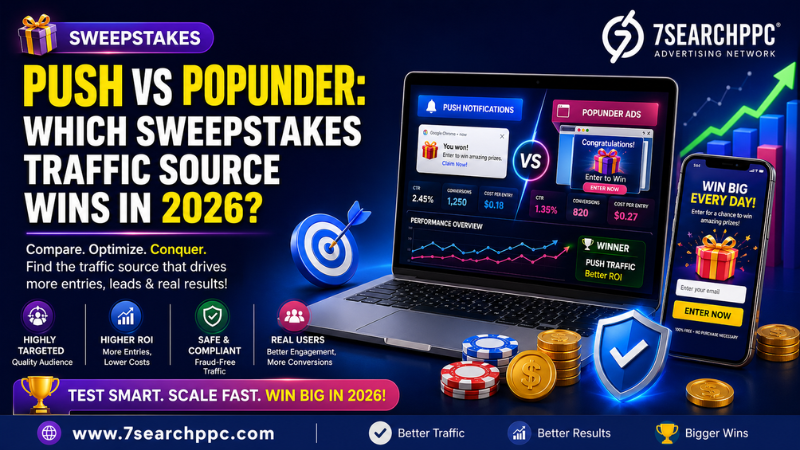
In 2026, the debate between push notifications and popunder traffic isn’t theoretical anymore—it’s operational. Advertisers running sweepstakes funnels are no longer asking which is cheaper; they’re asking which actually converts into meaningful user actions beyond low-quality registrations. In many cases, the gap between click volume and real value has widened, especially as traffic sources become more fragmented and intent signals weaker.
Within this environment, sweepstakes push ads have re-emerged as a controlled acquisition channel—particularly on networks like 7SearchPPC—where targeting and user re-engagement can be layered more deliberately. But popunder traffic still dominates in scale and raw impressions, making the comparison far more nuanced than a simple “better vs worse” decision.
Which Traffic Source Wins?
Push ads generally outperform popunder traffic for sweepstakes campaigns when conversion quality and user intent matter. They allow better segmentation, re-engagement, and messaging control. Popunder traffic, however, still wins in volume and cost efficiency, especially for aggressive lead generation models where filtering happens post-click.
Why This Comparison Matters More in 2026
The core issue isn’t traffic availability—it’s traffic integrity. Over the past year, advertisers have noticed a recurring pattern: cheaper traffic doesn’t just mean lower cost per click; it often introduces higher noise in the funnel. This is especially visible in sweepstakes campaigns where incentive-driven behavior already skews user intent.
In lower-cost environments, such as those accessible through ad platforms like 7SearchPPC, the challenge becomes balancing affordability with behavioral filtering. Push and popunder formats sit at opposite ends of this spectrum:
- Push = controlled, interruptive, opt-in driven
- Popunder = passive exposure, high-volume, low-friction
Understanding how these formats behave under real campaign pressure is where most advertisers miscalculate.
Start building a structured betting push campaign with controlled budgeting.
Push Traffic: Controlled Intent, Limited Scale
Where Push Ads Actually Win
sweepstakes Push advertising performs best when the campaign depends on message framing and user qualification before the click. Unlike popunders, push ads require user interaction—this alone filters out a significant portion of accidental or low-intent traffic.
Advertisers working with networks such as 7SearchPPC often notice that push traffic allows:
- Better geo-targeting precision
- Cleaner CTR-to-conversion alignment
- Higher engagement with localized creatives
- Retargeting based on user behavior patterns
This becomes critical in sweepstakes funnels where the difference between a “lead” and a “usable lead” directly impacts downstream monetization.
The Hidden Limitation
At scale, push traffic often plateaus. Frequency fatigue, creative burnout, and limited inventory depth can restrict aggressive growth. Many advertisers underestimate how quickly push campaigns saturate—especially in Tier-2 and Tier-3 GEOs.
This is why push works best not as a standalone acquisition channel, but as a precision layer within a broader traffic mix.
Popunder Traffic: Volume Engine with Quality Trade-offs
Why Popunder Still Dominates Volume
Popunder traffic continues to be the backbone of high-volume sweepstakes acquisition. Its strength lies in invisibility—the user doesn’t actively choose to engage, which makes it scalable but unpredictable.
For campaigns optimized around cost-per-lead rather than user quality, popunder traffic can deliver:
- Massive impression inventory
- Low CPC entry points
- Fast data accumulation for testing
This is particularly useful during early campaign validation phases where advertisers need quick signal generation.
Where It Breaks Down
The problem usually isn’t traffic volume alone—it’s conversion distortion. Popunder traffic tends to inflate top-of-funnel metrics while weakening post-click behavior:
- Higher bounce rates
- Lower engagement depth
- Incentive-driven or accidental signups
At lower budgets, this can go unnoticed. But at scale, it becomes expensive noise.
Key Factors Behind Performance Differences
The gap between push and popunder performance is driven by three core variables: user intent, message control, and behavioral filtering. Push ads introduce friction before the click, improving intent quality. Popunders remove friction, increasing volume but diluting engagement. Campaign outcomes depend on how well advertisers align traffic type with funnel expectations.
Conversion Quality vs Cost Efficiency: The Real Trade-Off
This is where most sweepstakes Push campaigns outperform expectations—not by generating more leads, but by generating more usable ones.
In practical terms:
- Push ads → higher cost per click, but stronger conversion integrity
- Popunder ads → lower cost per click, but higher filtering requirement
Across Indian traffic environments, especially during seasonal spikes like IPL, this gap becomes even more visible. Popunder traffic surges in availability, but conversion quality often drops due to aggressive bidding and inflated inventory.
Push traffic, while more expensive during these periods, tends to retain better user engagement consistency.
Where Most Advertisers Get It Wrong
One recurring mistake is treating both traffic sources as interchangeable. They are not.
Popunder is often used as a scaling tool before validating conversion quality. Push is sometimes introduced too late, after the campaign has already optimized around low-quality signals.
Another issue is over-reliance on top-line metrics:
- High CTR doesn’t equal intent
- Low CPC doesn’t equal efficiency
- Volume doesn’t equal scalability
This misalignment leads to campaigns that look profitable in dashboards but fail in actual monetization.
Strategic Use: Combining Push and Popunder
The most effective sweepstakes advertisers don’t choose one—they sequence both.
A common execution model:
- Use popunder traffic for rapid testing and audience discovery
- Identify high-performing GEOs and segments
- Layer push traffic to refine and retarget higher-intent users
This hybrid approach allows advertisers to balance acquisition cost with conversion reliability.
When executed within structured environments—such as sweepstakes advertising strategies that prioritize traffic segmentation—this model tends to outperform single-source campaigns.
Platform Environment and Traffic Behavior
Not all traffic sources behave the same across platforms. On networks like 7SearchPPC, advertisers often gain access to lower-cost inventory, but this requires stricter filtering and creative discipline.
In such environments:
- Push traffic benefits from precise targeting and message control
- Popunder traffic requires aggressive landing page optimization
Choosing a trusted sweepstakes ad network like 7SearchPPC becomes less about brand preference and more about how well the platform supports campaign-level control and optimization.
Push Traffic for Sweepstakes: When It Clearly Wins
Push traffic for sweepstakes becomes the superior option when:
- Offer requires user attention (multi-step forms, verification)
- Campaign depends on geo-specific messaging
- Retargeting is part of the funnel
- Lead quality matters more than raw volume
It’s particularly effective for advertisers focused on long-term value rather than immediate lead count.
Popunder Traffic: When It Still Makes Sense
Popunder traffic remains useful when:
- Testing new offers quickly
- Operating under tight budget constraints
- Scaling aggressively in low-competition GEOs
- Running simple, low-friction sweepstakes funnels
But it requires strong backend filtering—without it, campaign efficiency degrades rapidly.
Frequently Asked Questions (FAQs)
Is push traffic more expensive than popunder for sweepstakes?
Ans. Yes, on a CPC basis, push traffic is typically more expensive. However, it often delivers higher-quality leads, which can improve overall campaign ROI despite the higher upfront cost.
Can popunder traffic still be profitable in 2026?
Ans. Yes, but profitability depends heavily on post-click optimization and filtering. Without strong funnel control, popunder traffic can generate large volumes of low-value leads.
Which traffic source is better for beginners?
Ans. Popunder traffic is often easier for initial testing due to its volume and low cost. However, beginners may struggle with quality control. Push ads require more precision but offer cleaner data.
Should push and popunder be used together?
Ans. In most cases, yes. A combined approach allows advertisers to leverage popunder for scale and push for refinement, improving both reach and conversion quality.
Does GEO impact which traffic source performs better?
Ans. Absolutely. In Tier-3 GEOs, popunder traffic may dominate due to cost advantages, while push ads often perform better in Tier-1 and Tier-2 markets where user intent and engagement are stronger.