In high-temperature industries, the reliability of refractory materials plays a critical role in the overall efficiency, safety, and cost management of the production process. This is because a steel furnace, a ceramic kiln, or a boiler is not effective without a refractory material. Hence, choosing the right supplier of fire bricks and refractory castables is a strategic move rather than an ordinary procurement exercise.
In the list of established players in the refractory business, BM Enterprises has established itself as a dependable source of quality fire bricks and castables. Associated with quality, experience, and reliable supply, BM supplies to a variety of industries with refractory requirements.
Understanding Fire Bricks and Their Industrial Importance
What Are Fire Bricks?
Fire bricks are made of ceramic materials composed of alumina and silica compounds. They are made to withstand high levels of heat and any deformation, cracking, or loss of structural integrity. Contrary to other bricks, fire bricks act as insulators to protect furnace walls made of steel and furnace shells from damage.
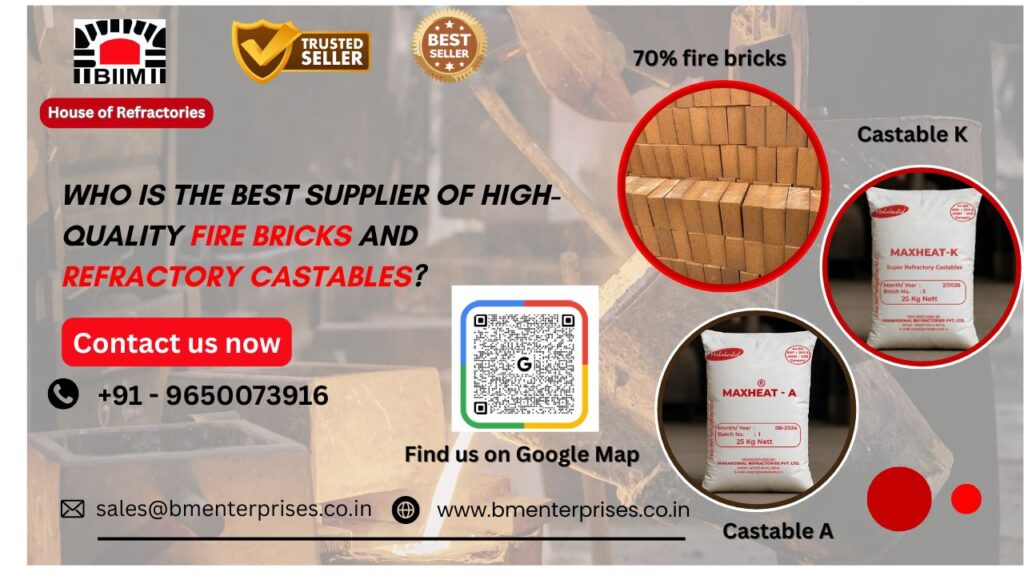
Products, such as boiler fire bricks, 70% fire bricks, and fire bricks 70 alumina, are designed for areas where high load and temperature are expected, and resistance is a prerequisite.
Key Features of Fire Bricks
High Alumina Content: Products like fire bricks 70 alumina contain up to 70% Al₂O₃, providing superior refractoriness and load-bearing capacity.
Thermal Shock Resistance: Frequent heating and cooling cycles can crack inferior bricks. High-quality bricks resist such stress.
Mechanical Strength: They maintain structural integrity even under heavy loads and extreme heat.
Specifications of 70% Fire Bricks
Chemical and Physical Properties
70 percent fire bricks are among the most widely used refractory grades. Typical specifications include:
Alumina Content: 50 – 70%
Standard Size: 230 × 115 × 75 mm
Silica Content: 25–30%
Iron Oxide: ≤2.5%
Bulk Density: 2.3–2.5 g/cm³
Apparent Porosity: 18–22%
These parameters ensure high refractoriness and resistance to slag attack.
Thermal Performance
Fire bricks 70 alumina can withstand service temperatures ranging from 1,600°C to 1,750°C, making them ideal for steel reheating furnaces, cement kilns, and glass tanks.
70% Fire Bricks / Fire Bricks 70 Alumina
Composition & Benefits
Also called 70 per cent fire bricks, these contain ~70% alumina—derived from bauxite minerals.
Higher alumina = higher refractoriness.
Applications of Fire Bricks in Industrial Systems
Fire bricks serve as the first line of defence in heat containment systems. Boiler fire bricks are used to line the combustion chamber and retain heat. These bricks enhance the efficiency of the burning fuel. In steel and forging furnaces, alumina bricks (70%) are used to shield the shell against molten metals and corrosive slags.
They are also extensively used in rotary kilns, incinerators, ladles, and heat treatment plants. In regions such as Haryana, the requirement for fire bricks in Faridabad is always on the rise because of the presence of foundries and heavy engineering units.
Refractory castables, on the other hand, are dry cement-based refractory mixtures that harden upon curing. They are used where laying bricks is difficult, especially in curved and irregular sections, and sites where there is substantial erosion.
BM Enterprises has different grades, including refractory castables A and K, which have specific requirements in terms of thermal and mechanical characteristics.
Features of Castables A and Castables K
The advantages of these materials include their seamless lining, removing the gaps between otherwise joined materials, which can suffer from heat leakage. They possess mechanical, abrasion, and chemical strength. They can be installed in an easy way, with only mixing, casting, and curing in water.
Castables K (Maxheat K) have higher density and temperature properties than Castables A (Maxheat A) types and hence may be useful in furnace heating zones.
Castable KCastable AKey features are:
Seamless lining
Easy to set up
High mechanical strength
Low maintenance
Energy Efficient Insulation
Specifications of Refractory Castables
Typical technical parameters include:
Service Temperature: 1,400°C – 1,700°C
Installation: Cast / Gunned / Troweled
Initial Setting Time: 4–6 hours
Full Curing Time: 24 hours
Shelf Life: 6–12 months
Packaging: 25 kg moisture-resistant bags
Their dense structure ensures long service life even in flame-impingement areas.
Industrial Uses of Refractory Castables
Refractory castables are commonly utilised for furnace roofs, burner blocks, boiler beds, and duct linings. Because of their monolithic design, they reduce thermal leakage and optimise insulation performance.
They are most useful in petrochemical plants, power stations, aluminium smelting units, as well as in incineration plants, where shaped bricks cannot be employed fully.
Castables are preferred where brick joints are risky:
Rotary kilns
Reheating furnaces
Incinerators
Duct linings
Burner quarls
Why BM Enterprises is Considered a Leading Supplier
Product Quality and Range
The BM Enterprises portfolio covers the following:
Boiler fire bricks
70% fire bricks
Alumina melting furnace fire bricks
Refractory Castables A
Castables K
Insulation and acid-proof bricks
Every product is also manufactured or procured under strict quality control measures.
Fire Bricks in Faridabad – Market Overview
Now, Faridabad has emerged as an important redistribution centre for refractory materials in North India, with the requirement coming from local forging units, steel rerolling mills, and thermal plants.
Buyers seeking fire bricks in Faridabad typically focus on the following:
Consistent Alumina Content
Bulk availability
Technical guidance
Fast logistics
Quality Assurance and Testing
All refractory materials are tested for performance validation before dispatch. Testing includes cold crushing strength, refractoriness under load, and thermal stability analysis. It ensures that the supplied material performs reliably under real furnace conditions.
Benefits of Partnering with a Trusted Supplier
Working with an experienced refractory supplier will enable one to realise significant advantages throughout one’s working life.
Assured thermal performance
Reduced downtime
Technical installation support
Custom product sizing
Bulk order discounts. It’s less of a transaction—and more of an operational partnership.
The Future Trends in Refractory Materials
The refractory sector is changing rapidly, and some emerging innovations are:
Low iron, high purity alumina bricks
Nano-bonded
Energy-efficient insulation refractories
Precast Monolithic Shapes
Sustainability and fuel efficiency are leading the next round of products.
Conclusion
High-temperature industries could ill afford refractory failure. From boiler fire bricks to 70 per cent fire bricks, and from refractory castables A to castables K, every material must deliver durability, insulation, and structural strength.
It has attained recognition among clients as a repetitive performer; technologically sound, customer-oriented service provider of refractory products. For companies wanting durable thermal linings, it even remains an indispensable industry partner-specially for those sourcing fire bricks in Faridabad.
FAQs
1. What makes 70% fire bricks superior?
Ans. Their high alumina content improves heat resistance and mechanical strength.
2. Where are boiler fire bricks used?
Ans. They line combustion chambers and industrial steam boilers.
3. Difference between Castables A and Castables K?
Ans. Castables K typically offer higher density and temperature tolerance.
4. Are refractory castables better than bricks?
Ans. They are ideal for complex shapes and joint-free linings.
5. Who supplies fire bricks in Faridabad?
Ans. BM Enterprises is a leading supplier serving multiple industries.