Introduction
You buy a forklift for $42,000. Six months later, someone asks what it actually costs to own that machine. You pull out the purchase receipt and say “$42,000.”
Wrong answer.
That forklift consumed $3,200 in fuel. Required $1,800 in maintenance. Needed $450 in insurance premiums. Cost $280 in permits and licensing. Depreciated by $6,300. And your operator spent 340 hours running it at $28 per hour in labor costs.
The real cost? About $56,000 in six months.
Most businesses dramatically underestimate equipment ownership costs because they only track the obvious expenses. The purchase price. The big repair bills. Maybe fuel if they’re diligent.
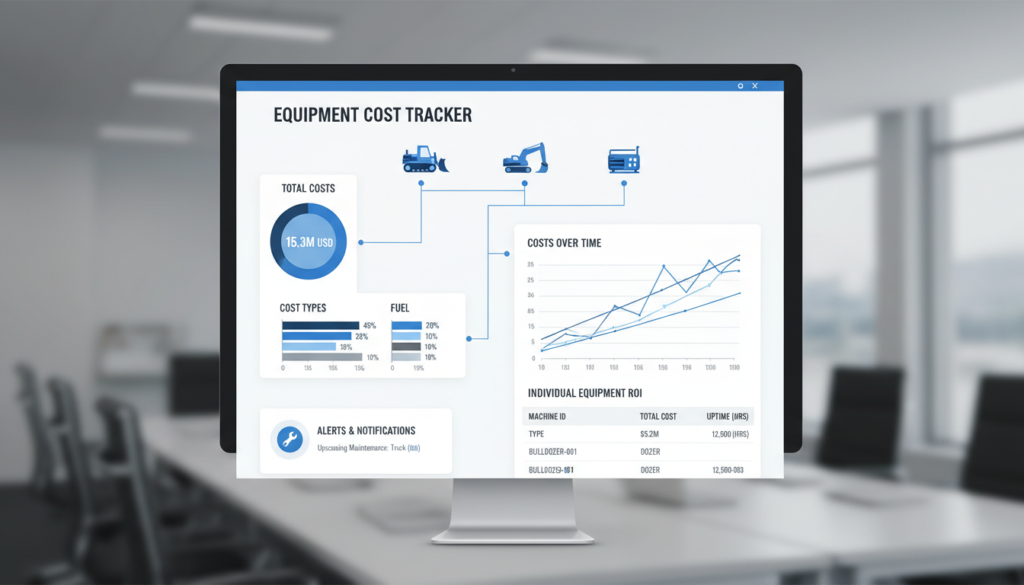
Equipment cost software exists to capture everything else, all those hidden costs that quietly drain profits while nobody’s watching.
This isn’t about paranoia or obsessive tracking. It’s about understanding reality. Because when you know what equipment truly costs, you make radically different decisions about what to buy, when to replace it, and how to use it.
Let’s break down every cost category equipment software can track and why each one matters more than you think.
Direct Purchase and Acquisition Costs
This is where everyone starts. The obvious stuff. But even here, most businesses miss important details.
Initial Purchase Price
The base cost of the equipment. Software logs the exact amount you paid, the purchase date, and the vendor. Simple enough.
But it also captures financing details if you didn’t pay cash. Interest rates, payment schedules, and total financing costs over the loan term. That $42,000 forklift financed at 6.5% over five years actually costs $49,180.
Most spreadsheets track the purchase price. Software tracks the true acquisition cost including financing.
Delivery and Shipping
Getting a 12-ton excavator from the dealer to your job site isn’t free. Delivery costs can run $2,000–$8,000 depending on distance and logistics.
This expense often gets buried in miscellaneous costs or attributed to the project instead of the equipment. Software tags it to the specific machine, giving you accurate total acquisition costs.
Installation and Setup
Some equipment needs professional installation. Industrial ovens require electrical upgrades and ventilation systems. Manufacturing equipment needs foundation work and calibration.
These costs are part of ownership but rarely get tracked properly. You might spend $12,000 installing a $65,000 machine. If you don’t capture that $12,000, your cost calculations are off by 18% from day one.
Software logs installation as part of the asset’s total basis, which matters for depreciation calculations and resale value projections.
Modifications and Customization
You buy a standard dump truck but need to add a specialized lift gate for your application. That’s $8,500 in modifications.
Is that a truck expense or an accessory expense? Software doesn’t care about philosophical debates, it tags the cost to the specific asset and rolls it into total ownership calculations.
Training Costs
New equipment often requires operator training. Your team needs two days of certification to run the new telehandler. That’s $3,200 in trainer fees plus lost productivity while workers are in class.
These costs are real but frequently overlooked. Software captures them as part of the equipment lifecycle, showing you the true cost of bringing new machinery online.
Operating Costs: The Daily Bleed
This category separates businesses that think they’re profitable from businesses that actually are profitable. Operating costs happen constantly, in small amounts, creating death by a thousand cuts.
Fuel and Energy Consumption
For mobile equipment, this means diesel, gasoline, or propane. For stationary equipment, it’s electricity or natural gas.
Basic tracking logs total fuel costs. Smart software goes deeper. It tracks cost per operating hour, gallons per hour, and efficiency trends over time.
You discover that your 2018 loader now consumes 8% more fuel than it did two years ago. Why? Declining engine efficiency signals upcoming maintenance needs before catastrophic failure occurs.
The software can also break down costs by job or project. You learn that Job Site A burns 40% more fuel than Job Site B for the same work because of terrain differences. This intelligence changes how you bid future projects.
Operator Labor Costs
Someone has to run the equipment. Their wages and benefits are equipment costs, not just general labor expenses.
Software tracks operator hours against specific machines. You see that your backhoe consumed 127 operator hours last month at a loaded labor rate of $34 per hour. That’s $4,318 in labor costs.
When you calculate cost per hour, that labor component often exceeds fuel and maintenance combined. Ignoring it gives you fantasy economics.
Consumables and Supplies
Hydraulic fluid. Coolant. Grease. DEF (diesel exhaust fluid). Filters. Wiper blades. These small purchases add up fast.
Your excavator needs a $45 hydraulic filter every 250 hours. Over 2,000 annual operating hours, that’s $360 just for that one filter type. Multiply across all consumables and all equipment, and you’re spending $15,000–$30,000 annually on items most businesses barely track.
Software logs every consumable purchase and calculates cost per hour, revealing which machines are expensive to keep fed.
Licensing, Permits, and Registration
Mobile equipment often requires annual registration. Some equipment needs operating permits. Certain industries require regular certifications and inspections.
These costs are predictable but easy to forget until renewal notices arrive. Software tracks renewal dates and costs, forecasting when payments will hit and how much they’ll be.
Maintenance and Repair Costs
This is where equipment ownership gets expensive. And where software provides the most value.
Preventive Maintenance
Oil changes. Filter replacements. Scheduled inspections. Tire rotations. Belt replacements. These routine services keep equipment running.
Software tracks every preventive maintenance event: what was done, when, at what cost, at what hour meter reading. It sets alerts for upcoming service intervals so you never miss scheduled maintenance.
More importantly, it calculates preventive maintenance cost per operating hour. You discover that Machine A costs $4.50 per hour in routine maintenance while Machine B costs $9.20. Both do the same work. One costs twice as much to maintain.
That information changes your purchasing decisions forever.
Corrective Maintenance and Repairs
Things break. Seals fail. Bearings wear out. Hydraulic lines rupture.
Software logs every repair: the problem, the solution, parts cost, labor cost, downtime duration, and whether it was warranty-covered. Over time, patterns emerge.
Your concrete mixer has developed a pattern: hydraulic pump failure every 800 hours. That’s not random, it’s a chronic issue. Armed with this data, you negotiate with the manufacturer, switch to higher-quality hydraulic fluid, or plan replacement before the next failure.
Parts and Components
Every repair requires parts. Software tracks part numbers, quantities, costs, and suppliers. You build a historical database of what components fail, how often, and what they cost to replace.
This intelligence improves procurement. You negotiate better pricing because you know exactly how many hydraulic cylinders you replace annually across your fleet. You identify suppliers with consistently higher quality because their parts last longer in your tracking data.
Emergency Service Calls
Your loader dies at 11 PM on a Friday. You call emergency service. They charge triple rates. The repair costs $4,200 when it would have been $1,400 during business hours.
Software tags this as an emergency repair and calculates the premium you paid for after-hours service. Over time, you see patterns. If emergency repairs cluster around certain equipment or time periods, you adjust preventive maintenance schedules to reduce emergencies.
Warranty Claims and Recovery
When equipment fails under warranty, you don’t pay the repair bill—the manufacturer does. But you still need to track these events.
Software logs warranty repairs separately. You see that your 2023 skid steer has had four warranty claims totaling $11,000 in repairs during its first year. That machine is a lemon. When the warranty expires, it’s going to destroy your maintenance budget.
Without tracking warranty work, you wouldn’t recognize this problem until you started paying for repairs yourself.
Depreciation: The Silent Cost
Depreciation doesn’t require writing a check, which is why most businesses ignore it. That’s a mistake. Depreciation represents real economic value leaving your business.
Straight-Line Depreciation
The simplest method. Take the purchase price, subtract estimated salvage value, divide by useful life. The software calculates annual depreciation automatically.
Your $85,000 excavator with a $15,000 residual value over seven years depreciates $10,000 per year. The software tracks this monthly ($833) and includes it in cost-per-hour calculations.
Accelerated Depreciation Methods
Some businesses use declining balance or sum-of-years-digits methods for tax purposes. Equipment software handles complex depreciation calculations automatically, generating reports that match your accounting system.
Usage-Based Depreciation
Smart software tracks depreciation based on actual usage, not just time. A machine that sits idle doesn’t wear out as fast as one running 12 hours daily.
Your fleet has two identical loaders. One operated 800 hours last year. The other ran 2,200 hours. Usage-based depreciation reflects that the high-use machine aged three times faster, which impacts replacement timing and resale value.
Market Value Tracking
What’s your equipment actually worth today? Software can integrate with market data sources to track current resale values.
You discover your 2019 dump truck depreciated to $52,000 on your books but similar trucks are selling for $68,000 in your market. That’s $16,000 in hidden equity. Maybe you sell it while values are high instead of running it another two years.
Insurance and Risk Costs
Equipment insurance is expensive. Tracking it properly reveals opportunities to optimize coverage and reduce costs.
Property Insurance Premiums
Your equipment is insured against theft, damage, and loss. Software tracks premiums per asset, renewal dates, coverage limits, and deductibles.
You might discover you’re paying full coverage on equipment worth $8,000 with a $2,500 deductible. The math doesn’t work. You adjust coverage and save $600 annually per machine.
Liability Coverage
Equipment operation creates liability exposure. Software can allocate liability insurance costs across equipment based on usage hours or risk profiles.
High-risk equipment (cranes, aerial lifts) should carry higher insurance allocations than low-risk items (air compressors, generators). Accurate allocation reveals true cost per hour.
Claims History
Every insurance claim gets logged. Over time, you identify which equipment types or operators generate the most claims.
Your data shows that Operator #3 has filed five damage claims in 18 months while everyone else has filed zero. That’s not bad luck—that’s a training problem or a performance issue. You address it before the next premium renewal when claims history drives rate increases.
Deductible Costs
When you file a claim, you pay the deductible. Software tracks these out-of-pocket costs as equipment expenses.
Your backhoe incurred three insurance claims last year with a $1,000 deductible each. That’s $3,000 in costs that wouldn’t show up as “repair expenses” in your accounting system but definitely impact equipment profitability.
Financing and Capital Costs
If you financed equipment purchases, the interest and financing charges are real costs that affect equipment economics.
Loan Interest
Software tracks interest payments separately from principal, showing you the true cost of financing. That $90,000 wheel loader financed at 7.2% over five years costs $13,680 in interest.
When calculating cost per hour, that interest gets included. Suddenly, financing choices impact operational economics.
Lease Payments
For leased equipment, software tracks monthly payments, lease terms, buyout options, and residual values. You can compare leased vs. owned equipment costs side-by-side.
Your leased forklift costs $1,950 per month. Your owned forklift costs $850 per month in depreciation plus $320 in maintenance. The lease is convenient but costs 70% more. That clarity drives future acquisition decisions.
Opportunity Cost
Advanced software can even track opportunity cost, what else you could have done with the capital tied up in equipment.
You spent $250,000 on a crane that operates 600 hours annually. At $180 per hour in total costs, you’re generating $108,000 in annual equipment revenue. If that $250,000 had been invested at 6% return instead, you’d earn $15,000 annually doing nothing.
The crane needs to generate enough margin above $123,000 to justify the capital deployment. This analysis is sophisticated but changes how you think about equipment purchases.
Storage and Facility Costs
Equipment takes up space. Space costs money.
Yard Storage
You rent 10,000 square feet of yard space at $0.60 per square foot monthly. That’s $6,000 per month. If 15 pieces of equipment live in that yard, each one carries $400 monthly in storage costs.
Software can allocate facility costs across equipment based on footprint, usage, or other factors. Suddenly, that idle bulldozer isn’t just depreciating, it’s also consuming $400 monthly in storage you could eliminate by selling it.
Climate-Controlled Storage
Some equipment requires indoor storage. Temperature-sensitive machinery, electronics, precision tools, these items need controlled environments.
Climate control isn’t cheap. Software tracks these premium storage costs and attributes them to specific equipment, revealing the true cost of maintaining specialized assets.
Security Costs
Equipment theft is a billion-dollar problem. Security systems, fencing, lighting, GPS tracking devices—these costs protect equipment value.
Software can allocate security costs across your fleet. Each piece of equipment carries its proportional share of security expenses, making total ownership costs more visible.
Downtime Costs
When equipment isn’t working, you’re not just paying for repairs. You’re losing money from lost productivity.
Revenue Loss
Your concrete pump generates $3,200 per day in revenue. It breaks down and sits in the shop for four days. That’s $12,800 in lost revenue directly attributable to equipment failure.
Software tracks downtime hours and can multiply them by expected revenue per hour, quantifying lost opportunity costs. This number often exceeds the actual repair costs by 3–5 times.
Rental Costs for Replacement Equipment
When your equipment is down, you might rent a replacement. That rental cost is an equipment ownership expense, if your machine were reliable, you wouldn’t need the rental.
Software tracks these costs and ties them to the failed equipment. Your excavator has cost you $8,400 in rental expenses over the past year while it was being repaired. That’s $8,400 in hidden costs most businesses never attribute to the problematic machine.
Environmental and Disposal Costs
Equipment has costs at the end of its life too. Software tracks the complete lifecycle, including disposal.
Emissions Testing and Compliance
Some equipment requires regular emissions testing. Certain jurisdictions charge fees for equipment that doesn’t meet standards.
Software tracks compliance costs and deadlines, ensuring you don’t miss required testing or pay late fees.
Disposal and Recycling Fees
When equipment reaches end-of-life, you pay to dispose of it properly. Hazardous materials require special handling. Some items have recycling fees.
Software estimates future disposal costs based on equipment type, helping you budget for end-of-life expenses years in advance.
Environmental Remediation
Equipment leaks fluids. Older machines might contain asbestos or other hazardous materials. Removal and cleanup costs money.
Tracking these expenses shows the true cost of operating aging equipment and informs replacement decisions.
The Power of Complete Visibility
Here’s why tracking everything matters: incomplete data leads to incomplete decisions.
If you only track purchase price and major repairs, you might think your 2016 forklift costs $35,000 per year. But when you track fuel, maintenance, consumables, insurance, depreciation, operator labor, storage, and downtime, the real number is $87,000.
That’s not twice as expensive. It’s 2.5 times as expensive. Your profitability calculations were off by 150%.
Equipment cost software doesn’t just track expenses. It reveals reality. And in business, reality beats optimism every single time.
The businesses winning in your industry see costs you’re missing. They make decisions based on complete information while you’re working with fragments.
You can’t optimize what you don’t measure. Start measuring everything. The costs you ignore don’t disappear, they just stay hidden while they quietly kill your margins. For a more efficient way to track and manage your equipment costs, check out Intersoft ERP now.
For guest post opportunities, visit PenCraftedNews and promote your content now.