Vietnam has firmly positioned itself as a powerhouse in the global seafood trade. With a coastline stretching over 3,200 kilometers and a well-developed aquaculture sector, the country continues to strengthen its reputation as one of the world’s top seafood exporters. Recent vietnam seafood export data highlights impressive growth in both value and volume, reflecting Vietnam’s resilience, adaptability, and strategic expansion into global markets.
In 2024, Vietnam’s total seafood export value reached a record $10.07 billion, marking a 13% increase compared to 2023. This milestone underscores the country’s expanding global footprint and its ability to navigate economic uncertainties, regulatory pressures, and supply chain disruptions.
As we move into 2025, early indicators suggest continued upward momentum, with Q1 exports already reaching $2.29 billion—an 18.1% year-on-year increase. Let’s explore Vietnam’s seafood export performance, top markets, major products, key players, challenges, and the outlook for 2025.
Vietnam Seafood Export Performance in 2024–2025
According to vietnam seafood export data and vietnam trade data, 2024 marked a strong recovery year after fluctuations in 2023. The $10.07 billion export figure reflects a robust rebound driven by shrimp, pangasius, and tuna.
Key 2024 Highlights:
-
Total Export Value (2024): $10.07 billion (+13%)
-
Shrimp Exports: $4 billion (+16.7%)
-
Pangasius Exports: $2 billion (+9.6%)
-
Tuna Exports: $1 billion (+17%)
-
Q1 2025 Exports: $2.29 billion (+18.1% YoY)
-
Projected 2025 Total: $11 billion
These numbers from vietnam customs data indicate that Vietnam is not only maintaining competitiveness but also expanding into higher-value product segments.
Major Seafood Products Driving Growth
Vietnam’s seafood exports are diversified across multiple high-demand categories. Based on vietnam shrimp export statistics and product-level reports, shrimp remains the dominant export category.
1. Shrimp – The Export Champion
Shrimp exports reached $4 billion in 2024, accounting for nearly 40% of total seafood exports. Both whiteleg shrimp and black tiger shrimp are highly demanded in the United States, China, Japan, and the EU.
Recent vietnam shrimp export statistics reveal:
-
Strong growth in live lobster shipments to China
-
Stable demand in the U.S. despite tariff adjustments
-
Increasing preference for value-added shrimp products in Europe
Shrimp continues to serve as the backbone of Vietnam’s seafood export economy.
2. Pangasius (Basa Fish)
Pangasius exports hit $2 billion in 2024. The fish remains popular due to affordability, versatility, and strong distribution networks in China, the U.S., Brazil, and Mexico.
While demand in China faces occasional price pressure, U.S. imports remain strong, helping stabilize overall pangasius performance.
3. Tuna
Tuna exports crossed $1 billion in 2024, supported by high global demand for canned and pouched tuna products. Key destinations include the U.S., EU, Japan, South Korea, and Israel.
Vietnam Seafood Exports by Country: Top 10 Markets
An in-depth review of vietnam seafood exports by country highlights strong diversification across Asia, North America, Europe, and Oceania.
1. China – $1.65 Billion (16.5%)
China became Vietnam’s largest seafood market in 2024, overtaking the U.S. Demand surged by 37%, especially for shrimp and live seafood products.
2. United States – $1.5 Billion (15%)
The U.S. remains a cornerstone market for Vietnamese shrimp, tuna, and pangasius. Despite countervailing duties, Vietnam maintains a competitive advantage compared to India and Ecuador.
3. Japan – $1.25 Billion (12.5%)
Japan continues to favor premium seafood imports from Vietnam. While inflation impacted consumer spending slightly, overall demand remains stable.
4. South Korea – $790 Million (7.9%)
South Korea shows consistent growth, particularly in squid, octopus, and shrimp imports.
5. Thailand – $620 Million (6.2%)
Thailand serves as both a consumer market and a processing hub within ASEAN.
6. Netherlands – $520 Million (5.2%)
The Netherlands acts as a strategic gateway into the EU market.
7. Germany – $400 Million (4%)
Germany’s demand is increasingly focused on sustainable and certified seafood.
8. Australia – $314 Million (3.1%)
Premium seafood products perform well in Australia’s high-value retail market.
9. Canada – $250 Million (2.5%)
Canadian buyers emphasize traceability and sustainability standards.
10. United Kingdom – $200 Million (2%)
The UK market shows steady demand for shrimp and frozen seafood.
The consistent growth reflected in vietnam seafood exports by country demonstrates Vietnam’s ability to maintain diversified trade partnerships.
Top Seafood Exporters in Vietnam
Vietnam’s seafood export ecosystem is supported by large, well-established enterprises that meet international quality standards.
Top exporters in 2024 include:
-
Minh Phu Seafood Corporation – $600 million
-
Vinh Hoan Corporation – $450 million
-
Quoc Viet Seafood Co., Ltd. – $350 million
-
Sao Ta Foods (Fimex VN) – $300 million
-
Nha Trang Seafood JSC – $250 million
-
Hung Vuong Corporation – $200 million
-
Thuan Phuoc Seafoods – $180 million
-
Seaprodex Vietnam – $150 million
-
Cadovimex II – $120 million
-
Bac Lieu Fisheries JSC – $100 million
These companies contribute significantly to vietnam exports, particularly in shrimp and pangasius processing.
Vietnam Seafood Export Trends Over the Last Decade
A look at historical vietnam trade data shows long-term growth with temporary fluctuations:
-
2014: $7.92 billion
-
2018: $9 billion
-
2022: $11 billion
-
2023: $8.98 billion
-
2024: $10.07 billion
The peak in 2022 followed pandemic-driven demand shifts. Although 2023 saw a slowdown, 2024 marked a strong recovery.
Regulatory & Trade Challenges
Despite growth, the sector faces several structural and regulatory challenges.
EU IUU “Yellow Card” Warning
The European Commission’s warning on illegal, unreported, and unregulated fishing continues to impact exports, particularly squid and octopus.
U.S. Countervailing Duties on Shrimp
In October 2024, the U.S. imposed preliminary duties:
-
Vietnam: 2.84%
-
India: 4.36%
-
Ecuador: 7.55%
Vietnam’s lower rate supports its competitiveness in the U.S. market.
Raw Material Shortages
Domestic shrimp and tuna supply shortages are increasing reliance on imported raw materials, affecting cost efficiency and processing timelines.
Environmental & Sustainability Pressures
Environmental sustainability is becoming central to global seafood trade. Vietnam must address:
-
Overfishing concerns
-
Marine pollution
-
Climate change impacts on aquaculture
-
Disease outbreaks in shrimp farming
Strengthening eco-certifications and traceability will enhance future vietnam seafood export data performance in environmentally conscious markets like the EU and Canada.
Price Volatility & Currency Risks
Global seafood prices fluctuate due to seasonal production cycles and supply-demand imbalances. Exchange rate movements also influence competitiveness, especially in dollar-denominated contracts.
Exporters increasingly use hedging strategies and long-term contracts to mitigate financial risks.
2025 Outlook: Can Vietnam Cross $11 Billion?
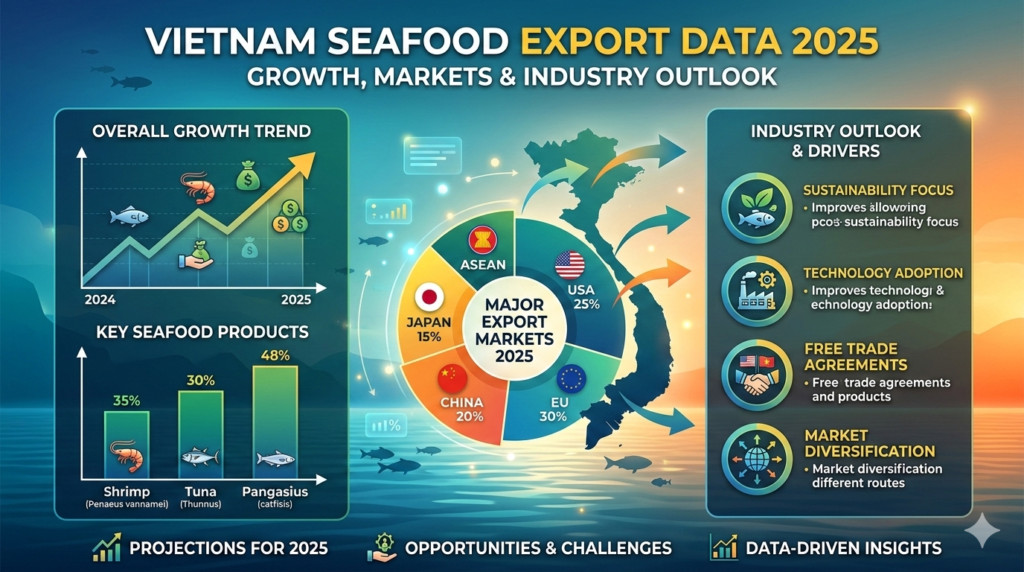
Based on current vietnam seafood export data, the country is projected to exceed $11 billion in seafood exports in 2025, representing roughly 10% annual growth.
Growth Drivers:
-
Rising seafood consumption in the U.S. and EU
-
Expanding Middle Eastern and halal markets
-
Increased value-added processing
-
Improvements in aquaculture technology
Persistent Challenges:
-
EU regulatory pressure
-
Competition from Ecuador and India
-
Domestic supply limitations
-
Climate-related production risks
However, Vietnam’s diversified export base and improving compliance framework suggest continued expansion.
Monthly & Market Trends
-
January 2025 exports reached $774.3 million (+3.3% YoY).
-
October 2024 monthly exports exceeded $1 billion for the first time since June 2022.
-
China surpassed the U.S. as the largest shrimp importer from Vietnam.
The shift in vietnam seafood exports by country illustrates growing Asian demand alongside stable Western markets.
Strategic Priorities for the Future
To maintain global leadership, Vietnam should focus on:
-
Expanding halal-certified exports to the Middle East
-
Strengthening compliance to remove the EU yellow card
-
Promoting high-value processed seafood
-
Enhancing disease control in aquaculture
-
Investing in climate-resilient farming practices
Improvements in vietnam customs data transparency and digital trade documentation will further enhance efficiency.
Conclusion
Vietnam’s seafood industry demonstrated remarkable resilience and growth in 2024, surpassing $10 billion in exports. Early 2025 figures confirm continued momentum, positioning the country to potentially reach $11 billion by year-end.
Strong demand across Asia, North America, and Europe, combined with strategic diversification and sustainability initiatives, reinforces Vietnam’s standing as the world’s third-largest seafood exporter.
While regulatory challenges, environmental pressures, and competition remain, comprehensive vietnam seafood export data clearly shows a positive long-term trajectory. With continued innovation, policy reform, and market expansion, Vietnam’s seafood exports are set to achieve even greater milestones in the years ahead.
For businesses, traders, and investors, monitoring vietnam seafood exports by country and analyzing updated vietnam trade data will remain essential to identifying new opportunities in this dynamic and fast-growing sector.