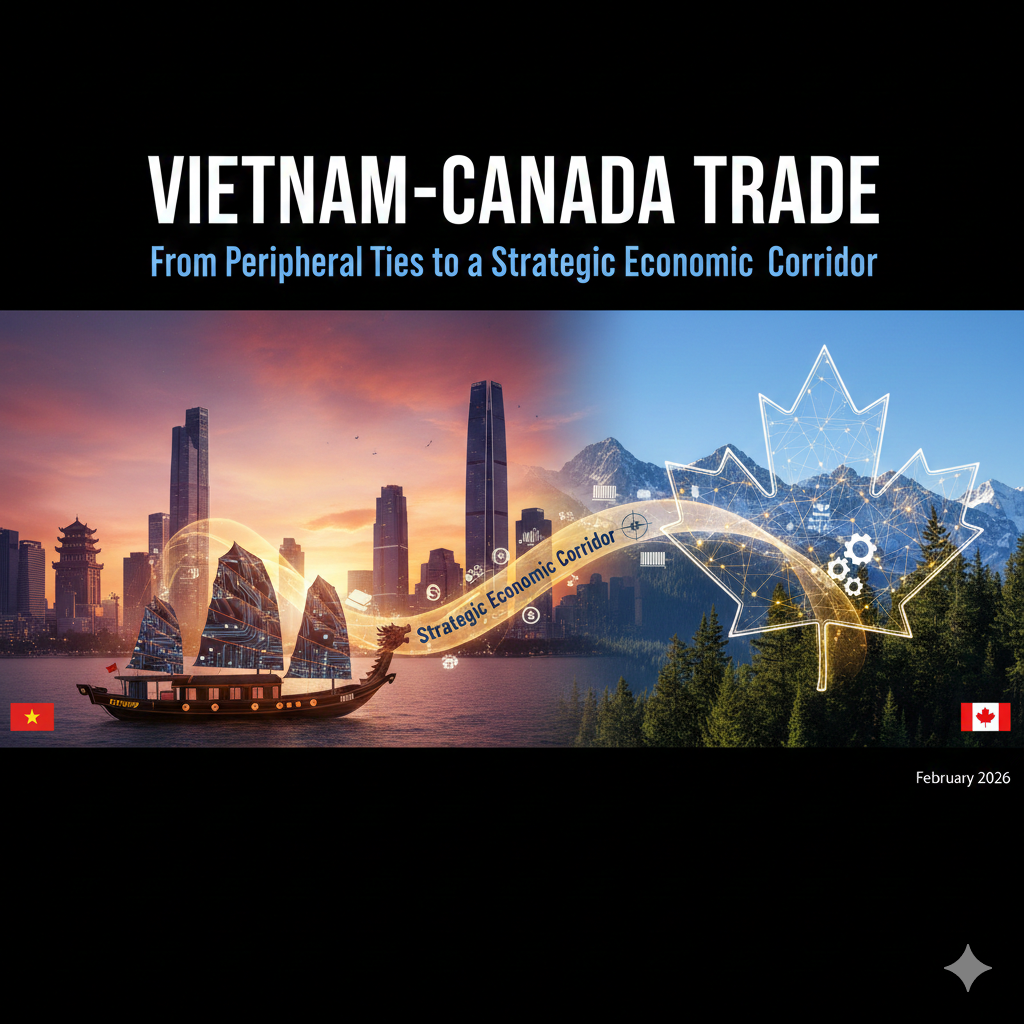
Over the past decade, Vietnam Canada trade has evolved from a modest bilateral relationship into a strategically important economic corridor within the Indo-Pacific region. What was once a peripheral partnership has now become a structurally embedded trade relationship, supported by deepening supply-chain integration, industrial upgrading in Vietnam, and the implementation of the Comprehensive and Progressive Agreement for Trans-Pacific Partnership (CPTPP).
By 2025, Vietnam has emerged as Canada’s largest trading partner in ASEAN and one of Canada’s most important global sources of imported manufactured goods. At the same time, Canada has positioned itself as a stable, high-income export destination for Vietnamese manufacturers seeking diversification beyond traditional Asian, U.S., and European markets.
According to Vietnam Canada trade data, Vietnam’s exports to Canada reached USD 6.36 billion in 2024, reflecting a 3 percent year-on-year increase. Total bilateral trade stood at USD 7.21 billion in 2024–25, based on Vietnam export customs data and Canada import statistics. Momentum continued into 2025, with trade value reaching USD 6.35 billion in the first three quarters alone, driven primarily by electronics, textiles, and footwear.
Structural Drivers Behind Vietnam–Canada Trade Growth
The rapid expansion of Vietnam Canada trade relations has not occurred by chance. It is the outcome of several reinforcing structural factors.
Global Supply Chain Realignment
As multinational firms diversify production away from over-concentrated manufacturing bases, Vietnam has emerged as a preferred alternative. Competitive labor costs, improving infrastructure, and strong trade integration have allowed Vietnam to capture market share in North American supply chains, including Canada.
Vietnam’s Industrial Upgrading
Vietnam’s manufacturing base has moved well beyond low-value assembly. Investments in electronics, machinery, furniture, and processed food have significantly improved export sophistication, enabling Vietnamese firms to meet Canada’s demanding quality and compliance standards.
CPTPP as a Trade Accelerator
The CPTPP remains the single most important policy driver shaping Vietnam Canada trade. Tariff elimination on most industrial goods, improved customs procedures, and predictable dispute-resolution mechanisms have fundamentally reshaped bilateral trade flows.
Vietnam–Canada Trade Overview in 2025
A Decade of Rapid Expansion
In the mid-2010s, total merchandise trade between Vietnam and Canada stood below USD 5 billion annually. By 2025, two-way trade is estimated to exceed USD 14–15 billion, with Vietnam accounting for the majority of exports.
Vietnam continues to record a significant trade surplus, reflecting its role as a manufacturing and export hub and Canada’s position as a consumption-driven, high-income market.
Vietnam’s Strategic Role in Canadian Trade Policy
By 2025:
-
Vietnam is Canada’s largest import partner in ASEAN
-
Vietnam ranks among Canada’s top 10 global merchandise import sources
-
Nearly half of Canada’s imports from Southeast Asia originate in Vietnam
Canada’s Indo-Pacific Strategy explicitly identifies Vietnam as a priority partner due to its demographic scale, manufacturing depth, political stability, and integration into global trade frameworks.
What Does Vietnam Export to Canada?
Vietnam’s exports to Canada are diversified but remain concentrated in manufactured consumer and industrial goods. Based on Vietnam Canada import export data and shipment statistics for 2025, the top export categories include:
Electrical Machinery & Equipment (HS 85) – USD 1.61 Billion
Electronics remain Vietnam’s largest export category to Canada. This includes telecommunications equipment, consumer electronics, and electronic components, supported by strong foreign direct investment and advanced supply chains.
Nuclear Reactors & Machinery (HS 84) – USD 820.12 Million
Exports of industrial machinery and mechanical equipment highlight Vietnam’s growing role in capital-intensive manufacturing segments.
Apparel and Textiles (HS 61 & 62) – Over USD 1.2 Billion Combined
Both knitted and non-knitted apparel remain core pillars of Vietnam Canada trade, supported by CPTPP tariff elimination and rising Canadian demand for competitively priced garments.
Footwear (HS 64) – USD 544.58 Million
Vietnam has become one of Canada’s most important footwear suppliers, leveraging scale, design capability, and supply-chain efficiency.
Furniture & Bedding (HS 94) – USD 353.87 Million
Vietnamese furniture exports benefit from strong craftsmanship, sustainable sourcing initiatives, and growing acceptance in mid-to-premium Canadian retail segments.
Seafood, Leather Goods, Vehicles, and Agricultural Products
Fish and seafood, leather articles, vehicles, and edible fruits and nuts round out Vietnam’s top export categories, reflecting both industrial and agri-food strengths.
Vietnam–Canada Trade Over the Last 10 Years
Historical Vietnam Canada trade data shows consistent long-term growth despite short-term volatility:
| Year | Total Trade Value |
|---|---|
| 2015 | USD 2.84 Billion |
| 2018 | USD 3.86 Billion |
| 2021 | USD 6.02 Billion |
| 2022 | USD 7.03 Billion |
| 2024 | USD 7.21 Billion |
| 2025 (Q1–Q3) | USD 6.35 Billion |
This trajectory underscores the structural nature of bilateral trade expansion.
CPTPP: The Cornerstone of Vietnam–Canada Trade
Tariff Elimination and Market Access
Under CPTPP provisions, tariffs on many Vietnamese exports to Canada have been reduced from 7–18 percent to zero, significantly improving price competitiveness.
Rules of Origin Challenges
Despite its advantages, CPTPP utilization remains below potential. By 2025, only 18–20 percent of Vietnamese exports to Canada formally claim CPTPP preferences, largely due to compliance complexity and documentation costs.
Improved utilization of CPTPP rules could further accelerate Vietnam Canada trade growth and export margins.
Trade Challenges and Compliance Pressures
Trade Defense Measures
Canada has applied anti-dumping and safeguard measures in select sectors, requiring Vietnamese exporters to maintain rigorous cost transparency and documentation.
Regulatory and ESG Compliance
Canadian market access increasingly depends on:
-
Product safety standards
-
Environmental compliance
-
Labor and sustainability benchmarks
Failure to meet these requirements can result in shipment delays or market exclusion.
Distribution Inefficiencies
A significant share of Vietnamese exports still transit through U.S. distribution hubs, increasing costs and limiting direct trade benefits.
Canada’s Exports to Vietnam: Smaller but Strategic
While Vietnam dominates bilateral trade flows, Canada exports agricultural products, wood pulp, machinery, and food products to Vietnam. These exports support complementary supply chains and reinforce long-term investment ties.
Canada’s role is not merely transactional but increasingly strategic within Vietnam’s industrial ecosystem.
Investment Linkages Strengthening Trade
Canada ranks among the top 15 foreign investors in Vietnam, with investments concentrated in manufacturing, renewable energy, agri-food processing, and infrastructure.
Canadian FDI reinforces trade by:
-
Transferring technology
-
Improving regulatory compliance
-
Integrating Vietnamese production into North American value chains
This investment-trade feedback loop enhances Vietnam’s export reliability and resilience.
ESG, Sustainability, and Future Market Access
Environmental, Social, and Governance (ESG) standards are becoming decisive factors in Canadian import decisions. By 2025, compliance with sustainability benchmarks is no longer optional for Vietnamese exporters.
Sectors most affected include textiles, footwear, seafood, wood products, and electronics manufacturing. Firms aligned with ESG standards gain access to premium pricing and long-term contracts.
Outlook for Vietnam–Canada Trade Beyond 2025
Key growth drivers include:
-
Expanded CPTPP utilization
-
Higher-value manufacturing exports
-
Direct Canadian distribution networks
-
Digital trade and services expansion
Risks remain, including global economic slowdowns, protectionist pressures, and increased competition from other ASEAN exporters. However, the structural foundations of Vietnam Canada trade relations remain strong.
Conclusion
In conclusion, Vietnam Canada trade represents a compelling example of how trade agreements, supply-chain realignment, and industrial upgrading can transform bilateral commerce. Vietnam has established itself as a critical supplier to the Canadian market, while Canada offers stable demand and strategic diversification.
With deeper cooperation, improved compliance, and strategic CPTPP utilization, Vietnam and Canada are well positioned to expand trade volumes and strengthen economic ties well beyond 2025.