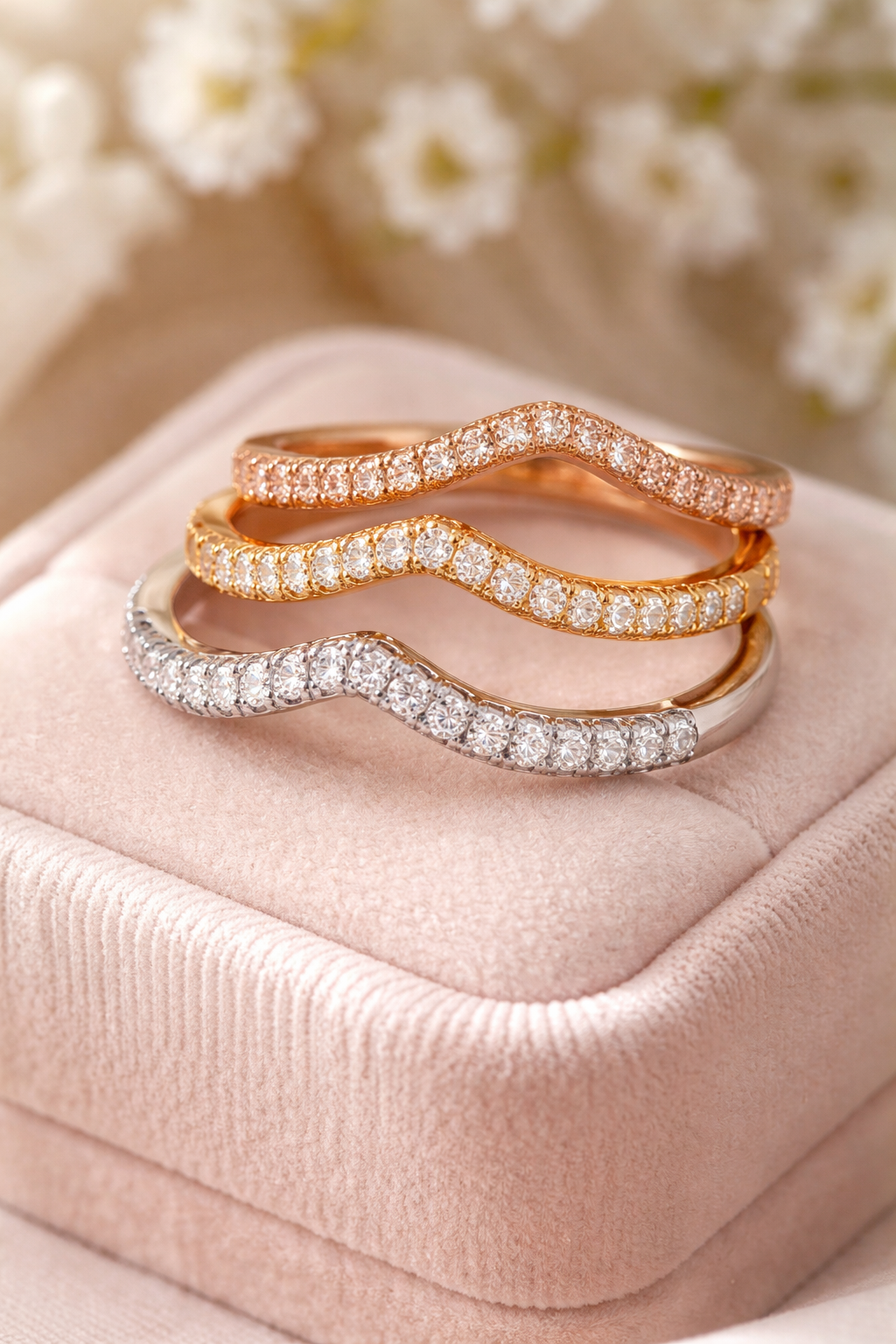
Curved Wedding Bands
So… how do you actually choose one? Not just any ring. Not just something that “fits.” I mean the right one—the one that slides next to your engagement ring and suddenly everything looks intentional. Finding the right curved wedding bands sounds simple at first. Measure. Match. Buy. But it’s never just that.
Because this is the ring that sits there every day. Through dishes. Through meetings. Through random Tuesday afternoons when you glance down and forget for half a second that you’re married—and then remember. Yeah. It’s that ring. Let’s take this slowly.
Step 1: Look at Your Engagement Ring
Before you even browse Curved Wedding Bands, pause. What shape is your center stone? Round? Oval? Pear? Is it set high? Low? Does it already have a halo? I could list technical compatibility charts here, but that’s not really what matters, is it?
What matters is how your engagement ring sits. Does it leave a gap when paired with a straight band? Does it feel like it needs something to hug it? That’s where curves come in.
Some rings need a gentle dip. Others need a dramatic V. And some—surprisingly—only need the slightest bend, barely noticeable, just enough to close the space. Hold your ring up to the light. Notice the silhouette. That’s your starting point.
Step 2: Decide Between Subtle or Statement
Here’s the thing about curved wedding bands—they can disappear quietly under your engagement ring… or they can frame it like a spotlight. And you probably already know which one you are.
If you lean minimalist, you might want a thin contour that blends in. Smooth metal. Clean line. The curve exists, but it doesn’t scream about it.
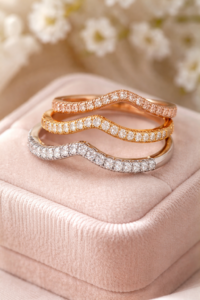
If you love sparkle, you’ll naturally drift toward diamond wedding bands with curved shapes. Pavé diamonds that arc along the contour. Maybe even a double-band enhancer that wraps both sides. It’s not about trends. It’s about comfort.
I once tried on a heavily set band when I thought I wanted “more sparkle.” It looked beautiful. It also felt like too much. Like wearing heels that were half a size too small. Pretty. But not me. Listen to that feeling.
Step 3: Understand Contour vs. Curve
Okay—small clarification moment. Not all curves are created equal. Contour Wedding Bands are specifically shaped to follow the exact outline of your engagement ring. They’re precise. Almost custom-looking, even when they’re not. Regular curved bands? They have a softer bend. More universal.
If your engagement ring has a dramatic shape—like a pear or marquise—Contour Wedding Bands might give you that seamless, no-gap finish. The kind where the rings click together softly and sit flush.
You can actually hear it sometimes. That faint metal tap when they settle into place. If your ring is simpler, a standard curved band might be enough. Try both. You’ll know.
Step 4: Think About Daily Life, Not Just the Wedding Day
It’s easy to choose based on photos. The styled shoots. The perfect lighting. But think about your actual life. Do you type all day? Lift weights? Wash dishes without taking your rings off, even though you probably should?
Some Women’s Wedding Bands are designed for comfort first—low-profile, smooth edges, and nothing catching on sweaters. Others prioritize sparkle, which is beautiful but might require a little more care.
And honestly? There’s no wrong choice. Just different ones. The metal will feel cold at first when you put it on. Then weirdly warm after a few minutes. You’ll stop noticing it. That’s when you know it works.
Step 5: Choose Your Metal—But Don’t Overthink It
Yellow gold feels warm. Traditional. Confident. White gold and platinum feel cooler. Sleek. Quietly elegant. Rose gold? Romantic, kind of soft around the edges.
Most curved wedding bands come in all three, so the choice isn’t about availability. It’s about instinct. Open your jewelry box. What do you already wear? That’s your answer.
I guess sometimes we try to reinvent ourselves during wedding planning. New hair. New style. New everything. But your ring doesn’t have to be a reinvention. It can just be an extension. Of you.
Step 6: Consider Diamond Placement Carefully
If you’re drawn to Diamond Wedding Bands, pause for a second. Full eternity or half? Full eternity bands sparkle from every angle. They’re stunning. But resizing them later can be tricky.
Half-eternity bands give you flexibility and usually cost less—and let’s be honest, the diamonds on the underside rarely see the light anyway.
Also think about setting style. Pavé sits lower and smoother. Prong settings show off more of the stone but can catch slightly on fabric. Little details. But they add up.
Step 7: Try It On—Or Visualize It Properly
If you can try on bands in person, do it. Move your hand around. Flex your fingers. See how the curve aligns from different angles.
If you’re shopping online, use virtual try-on tools or stack similar rings at home to mimic the shape. Sometimes what looks perfect in a flat photo feels different in motion. Jewelry lives in motion.
Step 8: Give Yourself a Minute
Don’t rush. Seriously. Scroll away. Close the tab. Come back tomorrow. The right curved Wedding Bands won’t lose their appeal overnight. If anything, they’ll linger in your mind.
It’s strange how certain designs stick with you. You’ll be washing dishes and suddenly picture that one band with the soft dip and tiny diamonds. You’ll catch yourself thinking about it again. That’s usually the one.
Step 9: Picture the Ordinary Days
Not the ceremony. Not the photos. Picture a random Thursday six months from now. Your grab example coffee. The light hits your ring. Does the curve still feel right? Does it feel balanced? That’s the test. Because curved wedding bands aren’t just about the wedding. They’re about the rhythm after. The normal days. The quiet ones.
And maybe that’s the whole point. Choosing among women’s wedding bands, deciding between contour wedding bands or classic curves, debating the sparkle of diamond wedding bands—it can feel overwhelming at first.
But it narrows quickly when you pay attention to how something makes you feel. Not the specs. Not the price tag. Just that subtle click when the band settles next to your engagement ring. That small, satisfying alignment. And then you stop thinking about it. Which is kind of the goal, isn’t it? Anyway… maybe that’s how you know you found the right one.