Plug-in Hybrid Electric Vehicle Market Size and Forecast 2025–2033
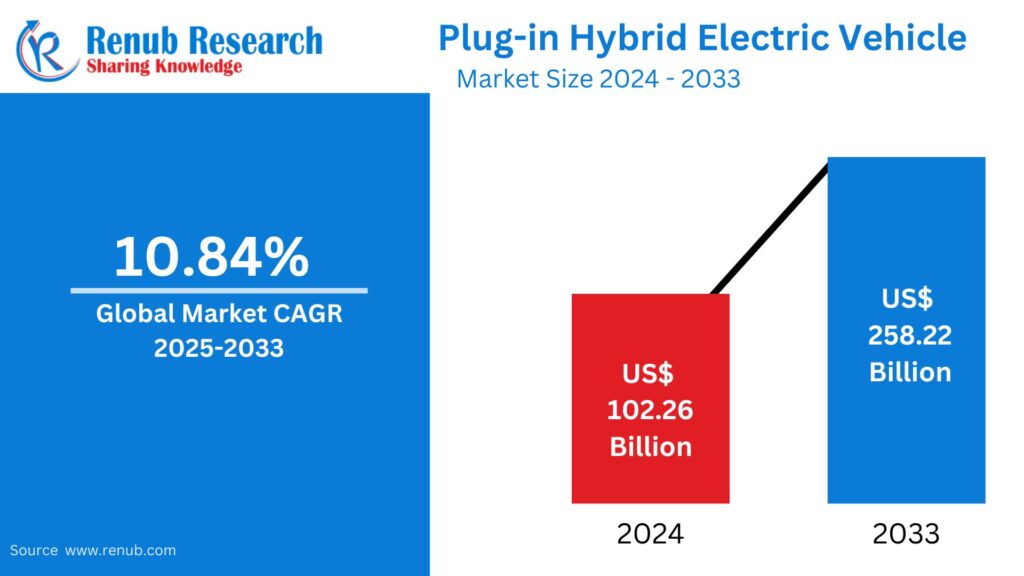
According to Renub Research global Plug-in Hybrid Electric Vehicle (PHEV) market is set for robust growth in the coming decade as the world accelerates toward sustainable transportation solutions. The market is projected to expand from US$ 102.26 billion in 2024 to approximately US$ 258.22 billion by 2033, growing at an impressive CAGR of 10.84% from 2025 to 2033. Rising environmental awareness, supportive government incentives, technological improvements in batteries, and the growing appeal of flexible yet eco-friendly mobility options are key factors driving market expansion.
PHEVs, which combine internal combustion engines with electric motors powered by rechargeable batteries, offer a balanced solution between conventional gasoline vehicles and fully electric vehicles. Their ability to operate on electric power for short distances while relying on fuel engines for longer travel makes them highly appealing to consumers who seek efficiency, convenience, and environmental responsibility without the concern of range limitations.
Plug-In Hybrid Electric Vehicle Market Overview
Plug-in hybrid electric vehicles bridge the gap between traditional fuel-based cars and fully electric vehicles. Unlike conventional hybrids, PHEVs can be externally charged using home chargers or public charging stations, allowing them to operate purely on electricity for short-to-medium distances. This reduces fuel usage, minimizes emissions, and lowers vehicle operating costs.
The growing adoption of PHEVs reflects increasing consumer confidence in electrified transportation. Their dual-power capability ensures reliable performance even where charging infrastructure remains under development. As a result, PHEVs are rapidly becoming one of the preferred choices for daily commuting, longer journeys, and eco-conscious travel. They also play a crucial transitional role in supporting global decarbonization goals while offering practical and cost-efficient mobility.
Download Free Sample Report:https://www.renub.com/request-sample-page.php?gturl=plug-in-hybrid-electric-vehicles-market-p.php
Key Growth Drivers in the Plug-in Hybrid Electric Vehicle Market
Government Incentives and Emission Regulations
Governments worldwide are actively supporting the shift toward electrified vehicles through financial incentives, tax rebates, infrastructure investments, and policy regulations. These initiatives make PHEVs more affordable while encouraging manufacturers to innovate and increase production. Strict emission standards in North America, Europe, and Asia are compelling automakers to expand their hybrid and electric vehicle portfolios, further accelerating industry growth.
Growing Environmental Awareness Among Consumers
Rising concern about climate change, air pollution, and fossil fuel dependency is prompting consumers to adopt eco-friendly transportation alternatives. PHEVs significantly reduce greenhouse gas emissions and fuel consumption, making them an attractive choice for individuals prioritizing sustainable living. As awareness campaigns, environmental commitments, and sustainability trends continue to strengthen, the preference for PHEVs is expected to rise substantially.
Advancements in Battery and Hybrid Technology
Rapid advancements in battery capacity, durability, charging speed, and energy efficiency have enhanced the overall performance of plug-in hybrids. Extended electric-only driving ranges make PHEVs more practical for daily use, while declining battery costs improve affordability. Continuous innovation, research, and production scaling are expected to make upcoming PHEV models even more efficient and consumer-friendly, driving global adoption further.
Major Challenges in the Plug-in Hybrid Electric Vehicle Market
High Initial Purchase Cost
Despite long-term cost benefits, the upfront price of PHEVs remains higher compared to traditional vehicles due to advanced technology and complex powertrain systems. Higher manufacturing costs and premium pricing limit adoption in price-sensitive markets. Although government incentives help mitigate this, affordability continues to be a key barrier in some regions.
Limited Charging Infrastructure
A well-developed charging network is essential for maximizing PHEV functionality. In regions lacking sufficient public charging infrastructure, consumers may hesitate to adopt plug-in hybrids. Although the gasoline backup reduces range anxiety, expansion of charging infrastructure remains crucial for broader PHEV penetration. Countries investing in rapid charging expansion are expected to witness higher adoption rates.
Mid-Priced Plug-in Hybrid Vehicle Segment Gaining Strong Momentum
The mid-priced PHEV segment is rapidly expanding, catering to consumers seeking a balance between cost-effectiveness and advanced hybrid technology. Automakers such as Honda, Hyundai, and Ford are enhancing their mid-range PHEV offerings with improved mileage, better electric range, and advanced features. This segment appeals strongly to mass-market customers and plays a key role in global electrification adoption.
SUVs Dominate the Plug-in Hybrid Electric Vehicle Market
SUV PHEVs are witnessing tremendous growth due to rising consumer preference for spacious vehicles with strong performance and eco-friendly capabilities. Leading automotive manufacturers such as Volvo, Mitsubishi, and Tesla are launching powerful SUV PHEVs offering extended electric range, high comfort, and efficient fuel consumption. Their ability to deliver practical utility alongside sustainability significantly boosts demand.
Regional Outlook of the Plug-in Hybrid Electric Vehicle Market
United States Plug-in Hybrid Electric Vehicle Market
The U.S. plays a vital role in the global PHEV market, supported by increasing environmental awareness, federal tax incentives, and improving charging infrastructure. Automakers are introducing innovative PHEV models as consumers seek cleaner, flexible transportation options. Although growth is slower compared to Europe, increasing policy support and consumer interest continue to strengthen market expansion.
France Plug-in Hybrid Electric Vehicle Market
France demonstrates strong PHEV market momentum driven by government subsidies, emission reduction policies, and rising environmental consciousness. French automotive leaders such as Renault, Peugeot, and Citroën are investing in expanding PHEV portfolios, while improved charging availability further boosts adoption.
China Plug-in Hybrid Electric Vehicle Market
China leads global PHEV adoption due to aggressive government incentives, emission reduction mandates, and an expanding charging ecosystem. Domestic automotive giants BYD, Geely, and NIO dominate the market, offering affordable and advanced hybrid technologies. Strong policy support and increasing urban pollution control initiatives continue to fuel rapid market growth.
Saudi Arabia Plug-in Hybrid Electric Vehicle Market
Saudi Arabia represents an emerging market for PHEVs, supported by Vision 2030, which emphasizes sustainable mobility and environmental responsibility. Although the market is in its early phase, expanding charging infrastructure and increasing availability of hybrid models from global automakers such as Toyota, BMW, and Audi are expected to significantly enhance adoption in coming years.
Market Segmentation
By Vehicle Class
- Low Priced
- Mid-Priced
- Luxury
By Car Type
- SUV
- MPV & Vans
- Midsize & Large Cars
- Small & Compact Cars
Regional Market Coverage
- North America: United States, Canada
- Europe: France, Germany, Italy, Spain, United Kingdom, Belgium, Netherlands, Turkey
- Asia Pacific: China, Japan, India, South Korea, Thailand, Malaysia, Indonesia, Australia, New Zealand
- Latin America: Brazil, Mexico, Argentina
- Middle East & Africa: Saudi Arabia, UAE, South Africa
- Rest of the World
Competitive Landscape
The PHEV market is highly competitive, with leading automotive manufacturers investing in innovation, battery technology enhancement, and strategic partnerships. Key market players include:
- Tesla
- BMW Group
- BYD Company Ltd.
- Mercedes-Benz Group AG
- Ford Motor Company
- General Motors Company
- Nissan Motor Co. Ltd.
- Toyota Motor Corporation
Ongoing investments, product expansions, and strategic research initiatives—such as Toyota’s multibillion-dollar investment plan in hybrid technology—highlight the industry’s commitment to strengthening global PHEV adoption.
Future Outlook of the Plug-in Hybrid Electric Vehicle Market
The global plug-in hybrid electric vehicle market is expected to witness strong and sustained growth from 2025 to 2033, supported by ongoing technological innovation, increasing regulatory pressure to reduce emissions, and rising consumer preference for eco-friendly yet reliable mobility options. As charging infrastructure expands worldwide and battery costs continue to decline, PHEVs will remain a critical component of the global transition toward sustainable transportation.
With environmental priorities intensifying and governments aligning policies toward green transportation, the PHEV market is set to play a pivotal role in shaping the future of global mobility through 2033 and beyond.