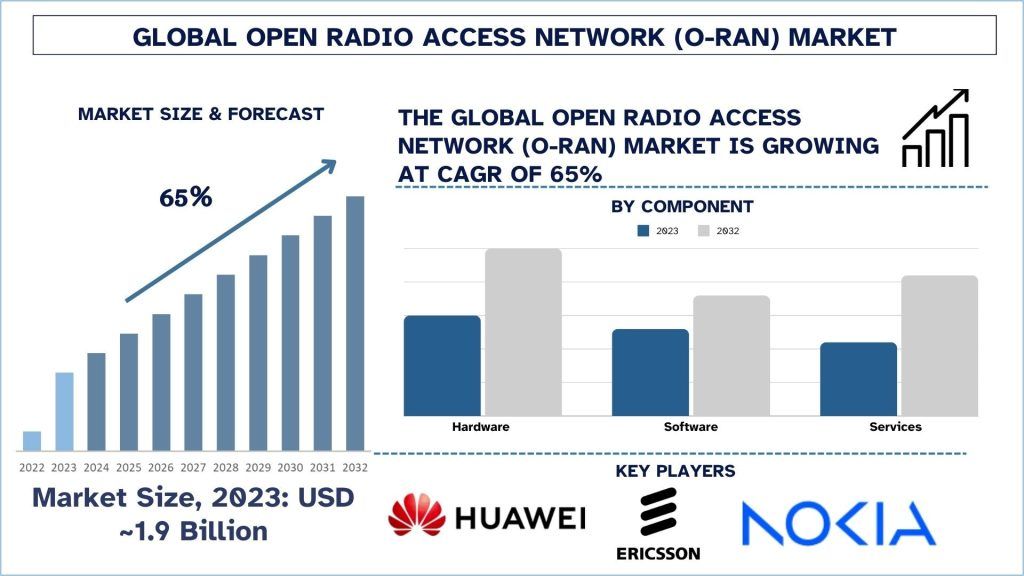
According to UnivDatos, the rapid expansion of 5G infrastructure, increasing reliance on cloud-native and virtualized network architectures, and the accelerating adoption of Software-Defined Networking (SDN) and Network Functions Virtualization (NFV) are the primary forces propelling the Open Radio Access Network (O-RAN) Market. As outlined in their “Open Radio Access Network (O-RAN) Market” study, the global O-RAN market was valued at USD 1.9 billion in 2023 and is projected to grow at an impressive CAGR of approximately 65% between 2024 and 2032, reaching USD billion by 2032.
The telecommunications industry is undergoing a significant transformation driven by the emergence of O-RAN technology. By promoting open standards and interoperability, O-RAN is redefining the way mobile networks are designed and deployed. This shift is attracting increasing interest from telecom operators and government institutions worldwide, as O-RAN offers a credible alternative to the long-standing dominance of a limited number of traditional network infrastructure vendors. As global markets advance toward large-scale 5G rollouts and beyond, O-RAN is becoming a crucial enabler of flexible, scalable, and cost-efficient network ecosystems.
The Fundamentals of O-RAN
At its core, O-RAN disaggregates traditional radio access network components, allowing service providers to integrate solutions from multiple vendors rather than relying on a single supplier. Unlike conventional RAN architectures that typically operate as closed, vendor-specific systems, O-RAN introduces open interfaces and standardized frameworks. This openness fosters healthy competition, reduces vendor lock-in, and significantly lowers deployment and operational costs.
O-RAN is built on a virtualization-first architecture that leverages SDN and NFV technologies to decouple software from hardware. This approach enables operators to dynamically scale network functions, deploy services more rapidly, and optimize network performance, all while minimizing capital and operational expenditures.
Access sample report (including graphs, charts, and figures): https://univdatos.com/reports/open-radio-access-network-market?popup=report-enquiry
Market Developments: Rising Global Momentum for O-RAN
One of the most notable trends in the O-RAN landscape is its growing adoption across regions heavily investing in next-generation mobile networks. Several European nations have emerged as strong advocates of O-RAN, recognizing its potential to reduce dependency on established telecom equipment providers such as Huawei, Ericsson, and Nokia.
- August 30, 2024 – Ericsson (NASDAQ: ERIC), in partnership with Telstra, announced a landmark global milestone by deploying Ericsson’s fourth-generation RAN compute platform. This innovation is designed to support a unified and scalable 5G Advanced infrastructure across Australia.
- September 25, 2023 – Ericsson reaffirmed its strategic focus on accelerating Open RAN industrialization. The company highlighted its commitment to delivering cloud-based, open network architectures, including full support for open fronthaul across its Cloud RAN and radio solutions.
- April 18, 2024 – During the Huawei Analyst Summit, Huawei introduced its advanced RAN Intelligent Agents. These agents integrate telecom foundation models, RAN Digital Twin Systems (RDTS), and intelligent computing capabilities to enable intelligent 5.5G networks. According to Eric Zhao, Vice President and CMO of Huawei Wireless Network, these innovations will transform network operations, user experience, and service delivery models in the 5.5G era.
United States: Driving Large-Scale O-RAN Adoption
The United States has emerged as a leading force in promoting O-RAN, driven largely by government initiatives aimed at reducing reliance on Chinese telecom vendors. Through organizations such as the Open RAN Policy Coalition, the U.S. government allocated substantial funding toward O-RAN research and development beginning in 2020. Major U.S. operators—including Verizon, Dish Network, and AT&T—have already begun integrating O-RAN solutions into their network infrastructures.
Dish Network, in particular, has committed to building a fully virtualized, cloud-native O-RAN-based 5G network, positioning itself as a pioneer in large-scale Open RAN deployment.
- December 4, 2023 – AT&T announced its ambition to become the leading Open RAN operator in the U.S. through a major collaboration with Ericsson. Under this agreement, AT&T plans to invest nearly USD 14 billion over five years, significantly strengthening the Open RAN ecosystem and diversifying its supplier base.
In addition, the Federal Communications Commission (FCC) has launched several initiatives aimed at encouraging open standards and fostering innovation within U.S. telecommunications networks.
Japan and Asia-Pacific: Emerging as a Global O-RAN Powerhouse
Japan has established itself as a major hub for O-RAN innovation, with strong backing from operators such as NTT DoCoMo and KDDI. Rakuten has played a pivotal role by deploying the world’s first fully virtualized, cloud-native mobile network using O-RAN principles. This achievement demonstrated the commercial viability of O-RAN at scale and positioned Rakuten as a global leader in next-generation network architecture.
- February 26, 2024 – NEC Corporation (TSE: 6701) announced that it had been selected by NTT DOCOMO as a virtualized RAN (vRAN) supplier for DOCOMO’s nationwide 5G commercial services. NEC will provide scalable and flexible vRAN solutions to support DOCOMO’s evolving 5G infrastructure.
Collaboration among Japanese technology leaders—including NEC, Fujitsu, Samsung, and NTT DoCoMo—has been instrumental in accelerating O-RAN adoption and ensuring end-to-end interoperability. Meanwhile, AT&T has outlined plans for 70% of its wireless traffic to run on open-capable platforms by late 2026, with fully integrated Open RAN sites expected to go live in partnership with Ericsson and Fujitsu starting in 2024.
Japan’s strong support for O-RAN aligns with its broader goals of advancing domestic technological innovation and reducing reliance on foreign vendors.
Click here to view the Report Description & TOC: https://univdatos.com/reports/open-radio-access-network-market
Outlook: What Lies Ahead for O-RAN
Telecom operators worldwide are expected to increasingly embrace O-RAN as they seek agile, scalable, and cost-efficient solutions to manage surging mobile data demand driven by 5G and future wireless technologies.
Looking ahead, O-RAN will play a critical role in enabling advancements such as edge computing and network slicing. As these technologies mature, O-RAN will provide the architectural foundation needed to support diverse service requirements across industries and use cases.
Final Thoughts
The rapid growth of O-RAN represents a fundamental shift in how mobile networks are designed, deployed, and managed. By fostering openness, interoperability, and multi-vendor collaboration, O-RAN is reshaping the global telecommunications ecosystem. With strong backing from governments and telecom operators alike, O-RAN is set to accelerate network modernization, drive innovation, and unlock new opportunities for digital transformation worldwide.
Contact Us:
UnivDatos
Contact Number – +1 978 733 0253
Email – contact@univdatos.com
Website – www.univdatos.com
Linkedin- https://www.linkedin.com/company/univ-datos-market-insight/mycompany/