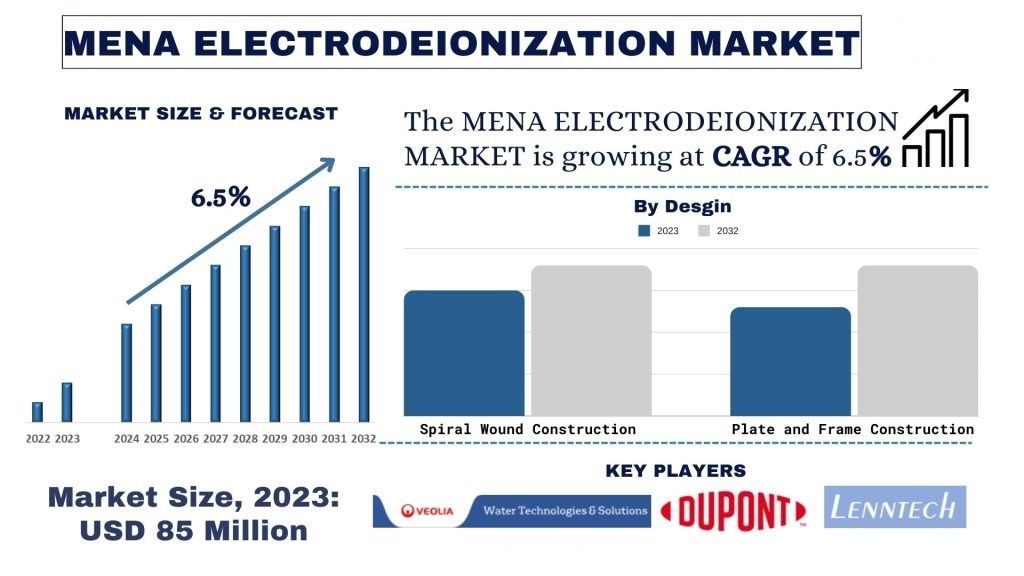
According to the UnivDatos, growing demand for high-end water purification with increased efficiency will drive the growth scenario of Electrodeionization and as per their “MENA Electrodeionization Market” report, the MENA market was valued at USD 123.56 million in 2023, growing at a CAGR of 22.67% during the forecast period from 2024 – 2032 to reach USD million by 2032.
Electrodeionization is water purification technology used for removing ions from water using an electrical potential. While there is a growing situation of water scarcity in the Middle East and North Africa region due to low-ground water levels and extreme climatic conditions, it is also a region where innovative water treatment technologies are in demand. The MENA Electrodeionization market is in the growth phase with the rapidly emerging demand for sustainable water purification techniques. Traditionally, heating and other mechanisms were used in order to purify water due to water scarcity issues in major parts of the MENA region. The quality of water people consume is one of the major necessities, and due to the extreme climatic conditions, water availability has been on the lower side, which is why sea water purification in the Middle East region is on the higher side.
Access sample report (including graphs, charts, and figures): https://univdatos.com/reports/mena-electrodeionization-market?popup=report-enquiry
Rising Demand for Sustainable Water Purification Techniques:
The Middle East & North Africa region has been extensively dependent on conventional fuel for water purification techniques due to economical prices as well as ease of availability. However, the respective technologies have been economical for the countries it creates high-degree of air pollution in the atmosphere, increasing the carbon footprint of the region. Considering the long-term sustainability goals as well as reducing carbon emissions, EDI has emerged as one of the promising technologies for water purification applications. One of the key advantages of EDI technology is energy efficiency. Continuous operation, no requirement of chemicals, high purity output, space efficiency, etc. All the aforementioned benefits of the new systems, adjoined with EDI technology, reduce both water and air pollution to a significant degree. Both plate and frame construction and spiral and wound construction-based designs used in the electrodeionization process do not require usage of chemicals to segregate ionized particles, thereby reducing the wastage of water. Additionally, the respective technology also does not require a large space and is modular (can be increased or decreased the capacity by reducing the plate size).
Some of the prominent providers of the technology in the region are Qua Group, DuPont, Ion Exchange, etc. The respective companies have also established some of the EDI plants in the region which exhibits the slow but a notable shift in the adoption of sustainable water purification techniques.
Click here to view the Report Description & TOC: https://univdatos.com/reports/mena-electrodeionization-market
Stringent Environmental Regulation to Expedite the Adoption of EDI Technology
Making:
Due to looming water scarcity in the region, many countries have imposed stringent water conservation and desalination policies that consider environmental challenges. These environmental regulations in the region will expedite the adoption of sustainable water purification techniques in the coming years. Some of the key policies are as indicated :
• In 2024, the Ministry of Environment, Water, & Agriculture (MEWA) of the Kingdom of Saudi Arabia announced its plans to meet 90% of Saudi Arabia’s water needs from desalinated water and the rest, 10% from groundwater by the year 2030. Based on existing urban water demand and committed water supply, new urban desalination plants would be required to overcome a water shortage of 4.5 million m3/day.
• In 2019, the government of the UAE launched Recycled Water Policy aiming at securing recycled water for residential, commercial, industrial, and government uses. In line with this the government would look forward to adopt low-energy and sustainable water purification techniques.
• In 2017, the Egyptian Environmental Affairs Agency (EEAA) initiated the National Water Resources Strategy 2017-2037. Under the policy, Egypt’s water-related challenges will be mitigated by adopting four strategies to develop water resources (Desalination and recycling), enhance water quality, rationalize water use, and create an enabling environment.
With the adoption of long-term strategies for the water conservation and water desalination in the MENA region, the demand for sustainable water technologies would further grow in line with the upcoming surge for respective technologies.
These updates, along with technological updates, would be further conducive to the adoption of MENA Electrodeionization in the coming period, i.e., 2024-2032.
Conclusion:
The MENA Electrodeionization market is experiencing a transformative phase driven by technological advancements, sustainability water purification, digitalization, market dynamics, and implementation of government policies. Stakeholders across the industry are embracing these trends to enhance operational efficiency, integrating communication systems, power-efficient systems, etc. As miniaturization continues to play a strategic role in improving water purification technology, staying abreast of these trends and embracing innovation will be crucial for the MENA Electrodeionization market.
Contact Us:
UnivDatos
Contact Number – +1 978 733 0253
Email – contact@univdatos.com
Website – www.univdatos.com
Linkedin- https://www.linkedin.com/company/univ-datos-market-insight/mycompany/