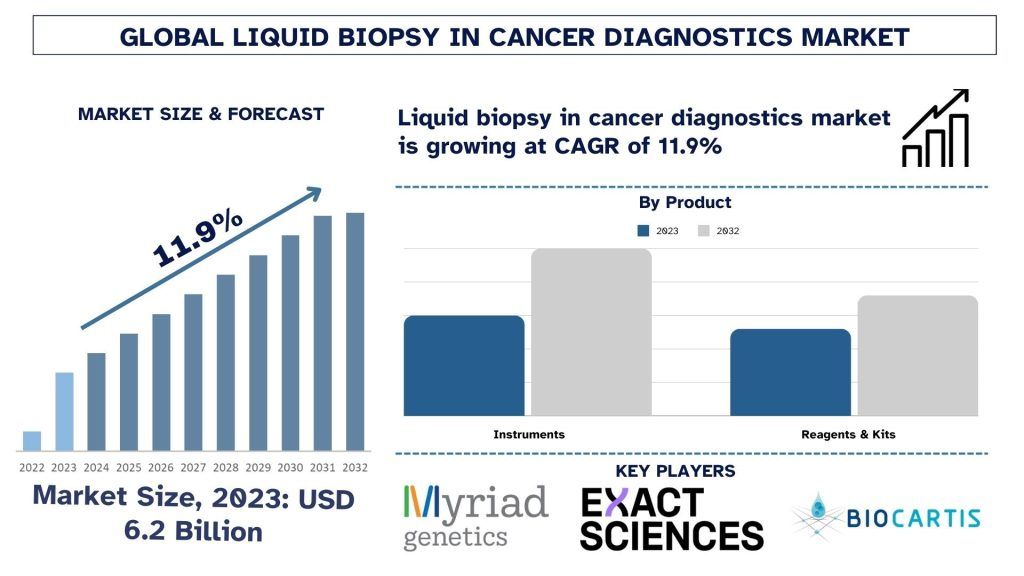
According to a recent study published by UnivDatos, the Liquid Biopsy in Cancer Diagnostics Market is projected to achieve significant growth and is expected to reach a substantial valuation by 2032, expanding at a CAGR of approximately 11.9% during the forecast period.
Cancer diagnostics have evolved rapidly over recent years, and among the most transformative innovations is liquid biopsy, which is increasingly shaping the future of oncology diagnostics. Unlike conventional tissue biopsies that require invasive surgical procedures, liquid biopsies analyze cancer-related biomarkers and genetic alterations through simple blood samples. This minimally invasive approach enables earlier detection, real-time disease monitoring, and improved prognosis assessment while minimizing patient discomfort.
The global liquid biopsy market has been experiencing strong momentum, driven by continuous technological advancements, the growing worldwide burden of cancer, and increasing emphasis on personalized and precision medicine. As healthcare systems globally move toward individualized treatment approaches, liquid biopsy is expected to play a pivotal role in transforming cancer diagnosis, treatment decision-making, and long-term disease management.
Access sample report (including graphs, charts, and figures): https://univdatos.com/reports/liquid-biopsy-in-cancer-diagnostic-market?popup=report-enquiry
Global Liquid Biopsy Market Overview
The Global Liquid Biopsy Market provides comprehensive insights into liquid biopsy technologies and their applications across disease diagnostics, particularly oncology.
One of the key trends shaping the global liquid biopsy market is its accelerating growth rate, largely fueled by advancements in precision medicine and the increasing global incidence of cancer. While traditional tissue biopsies remain widely used, they are limited by invasiveness and an inability to capture tumor dynamics in real time. Liquid biopsies overcome these limitations by allowing frequent and minimally invasive sampling, making them highly effective for ongoing disease monitoring.
Liquid biopsy applications include early cancer screening, therapy response monitoring, and detection of disease recurrence or drug resistance. Based on classification, liquid biopsies include circulating tumor cells (CTCs), circulating tumor DNA (ctDNA) or cell-free DNA (cfDNA), and exosomes. These biomarkers are found in body fluids and can be efficiently isolated and analyzed for diagnostic purposes. The liquid biopsy devices market continues to grow steadily, with leading players investing heavily in R&D to improve sensitivity, accuracy, and clinical utility. Currently, North America, Europe, and Asia-Pacific dominate the market due to advanced healthcare infrastructure and a high prevalence of cancer cases.
Technological Advancements Driving Market Growth
Technological innovation remains one of the most critical drivers of the liquid biopsy market, supported by rapid developments in molecular biology and genomic analysis.
Traditional diagnostic techniques such as PCR allowed identification of specific genes but were limited in resolution and scope. In contrast, Next-Generation Sequencing (NGS) enables real-time detection of genetic mutations and provides deeper insights into tumor biology. NGS-based liquid biopsy allows clinicians to identify precise biomarkers and genetic alterations, supporting personalized treatment strategies tailored to individual patient profiles.
Additionally, advancements in digital PCR (dPCR) have enhanced the sensitivity of liquid biopsy tests, enabling the detection of very low concentrations of tumor-derived genetic material in blood samples. These improvements are especially valuable for early-stage cancer detection.
The integration of artificial intelligence (AI) and machine learning (ML) is further transforming liquid biopsy technologies. AI-driven tools help analyze vast datasets, recognize complex patterns, and predict disease progression. By improving diagnostic accuracy and therapy response prediction, AI and ML significantly enhance the clinical value of liquid biopsy solutions.
Key Players in the Liquid Biopsy Market
Several major companies are actively shaping the growth and innovation landscape of the liquid biopsy market. Prominent players include Guardant Health, Biocept Inc., F. Hoffmann-La Roche Ltd, Qiagen N.V., and Thermo Fisher Scientific. These companies are heavily investing in research and development to introduce advanced diagnostic assays and refine existing platforms, expanding the range of detectable cancer types.
In addition, diagnostic companies are increasingly collaborating with pharmaceutical firms to integrate liquid biopsy into clinical trials and drug development pipelines. The ability to monitor tumor evolution in real time allows better assessment of treatment efficacy, accelerates drug development, and shortens time-to-market for novel oncology therapies.
Growing Demand for Personalized Medicine
One of the most influential growth drivers for the liquid biopsy market is the rising adoption of personalized medicine. With the emergence of targeted therapies, traditional trial-and-error treatment approaches are becoming less acceptable. Liquid biopsy empowers clinicians to identify patient-specific mutations responsible for cancer progression, enabling more precise and effective treatment strategies.
Furthermore, liquid biopsy plays a crucial role in monitoring treatment resistance. Cancer cells can evolve and develop resistance to therapies over time. Through continuous liquid biopsy monitoring, clinicians can detect genetic changes in tumors early and adjust treatment plans accordingly, reducing the risk of ineffective therapies.
Challenges Facing the Liquid Biopsy Market
Despite its strong potential, the liquid biopsy market faces several challenges. One of the primary concerns is test sensitivity, particularly in early-stage cancers where circulating tumor material may be present at very low levels. Although technological advancements have improved detection capabilities, achieving consistently high sensitivity remains a key focus area.
Regulatory complexities also influence market growth. Obtaining regulatory approval for liquid biopsy tests can be challenging, as assays must demonstrate strong clinical validity and utility. Differences in regulatory frameworks across regions further slow the adoption and commercialization of new diagnostic tests.
Cost remains another limiting factor. While liquid biopsy can be less invasive and more efficient than traditional tissue biopsies, the high costs associated with NGS-based diagnostics may restrict accessibility, especially in developing regions with limited healthcare budgets.
Click here to view the Report Description & TOC: https://univdatos.com/reports/liquid-biopsy-in-cancer-diagnostic-market
Growth Opportunities Ahead
Despite these challenges, the liquid biopsy market presents substantial growth opportunities. One of the most promising areas is early-stage cancer detection. With ongoing research and clinical validation, liquid biopsy could become a standard screening tool for cancers that are difficult to detect early, such as pancreatic and ovarian cancers.
Another major opportunity lies in the use of liquid biopsy in clinical trials, where continuous patient monitoring can optimize therapy development and accelerate drug approval timelines. Additionally, liquid biopsy is gaining traction in immunotherapy, one of the fastest-growing areas of cancer treatment, where precise molecular profiling is essential for selecting appropriate therapies.
Conclusion
The global liquid biopsy market is poised for strong growth, driven by the increasing demand for non-invasive diagnostic solutions and the rising focus on targeted cancer therapies. Advancements in genomic technologies, AI, and molecular diagnostics have enhanced the accuracy and reliability of liquid biopsy, positioning it as a routine tool in oncology practice.
Although challenges related to sensitivity, regulation, and cost remain, the ability of liquid biopsy to provide real-time insights into tumor genetics and support personalized treatment decisions makes it an indispensable innovation in cancer care. As research and development continue, liquid biopsy is expected to play a central role in shaping the future of cancer diagnostics, improving patient outcomes, and redefining oncology management.
Contact Us:
UnivDatos
Contact Number: +1 978 733 0253
Email: contact@univdatos.com
Website: www.univdatos.com
LinkedIn: https://www.linkedin.com/company/univ-datos-market-insight/mycompany/