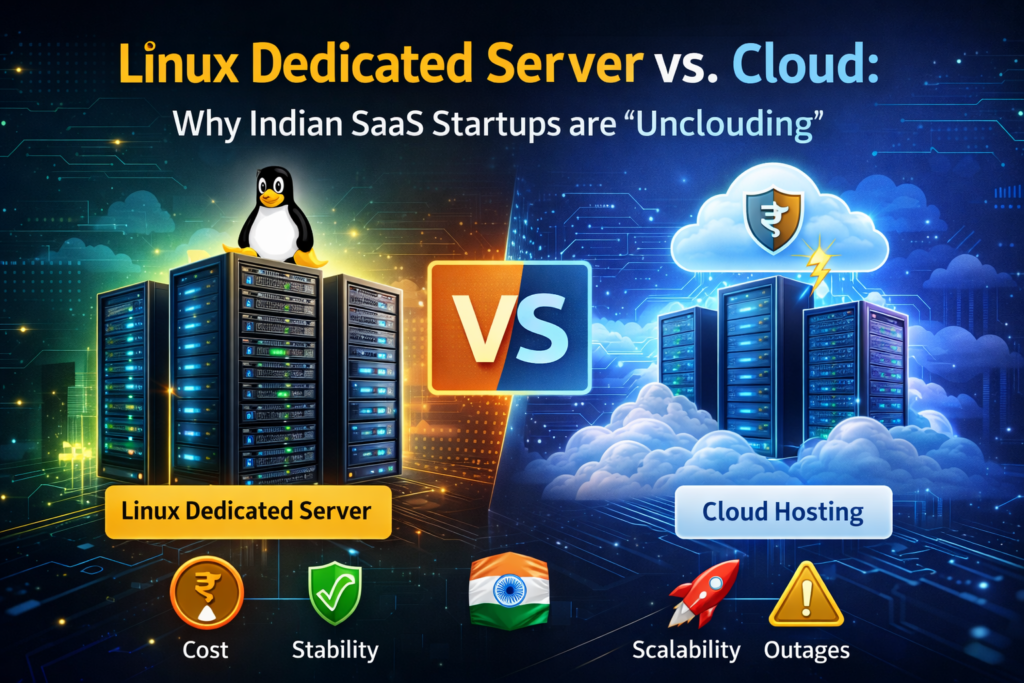
In the early 2010s, the “Cloud” was the promised land for every Indian startup. It was flexible, fast, and required zero upfront investment. Whether you were building a fintech app in Bengaluru or an e-commerce platform in Gurugram, the mantra was simple: “Put it on the cloud.”
Fast forward to 2026, and the trend is shifting. A new movement called “Unclouding” (or Cloud Exit) is gaining momentum. Many Indian SaaS startups are moving their core workloads away from giant public clouds and back onto a linux dedicated server in India.
But why are successful tech companies moving “backward” to physical hardware? Let’s break down the reasons why bare metal is winning the race for efficiency and cost.
The Hidden Cost of the “Cloud” Dream
The primary reason for the shift is simple: Money.
Public clouds like AWS, Google Cloud, and Azure operate on a “pay-as-you-go” model. While this is great when you have ten users, it becomes a nightmare when you have ten million. As a SaaS startup scales, the monthly cloud bill often grows faster than the revenue.
Indian founders are realizing that they are paying a “convenience tax.” You aren’t just paying for the server; you are paying for the brand, the complex dashboard, and the abstract layer of virtualization.
The Math of Unclouding
When you rent a linux dedicated server in India, you pay a flat monthly fee for the entire physical machine. Whether you use 10% or 100% of the CPU, the price stays the same. On the cloud, every extra gigabyte of data transfer (Egress fees) and every extra snapshot adds to your bill. For a margin-sensitive startup, switching to dedicated hardware can often slash infrastructure costs by 50% to 70%.
Performance: No More “Noisy Neighbors”
In a cloud environment, your application lives on a Virtual Machine (VM). That VM shares a physical server with dozens of other companies. If another company on your server has a massive traffic spike, your app might slow down. This is known as the “Noisy Neighbor” effect.
For a SaaS company providing real-time analytics or high-speed API responses, even a few milliseconds of lag can lead to churn.
By choosing a linux dedicated server in India, you get:
Raw Power: 100% of the RAM, CPU, and NVMe storage are yours.
Consistency: No fluctuations in performance during peak hours.
Control: You can optimize the Linux kernel specifically for your software’s needs.
Data Sovereignty and the DPDP Act
India’s regulatory landscape has changed significantly with the Digital Personal Data Protection (DPDP) Act. For SaaS startups handling the data of Indian citizens, where that data lives is no longer just a technical choice—it is a legal one.
Using a linux dedicated server in India ensures that your data never leaves the borders. While big cloud providers have Indian regions (like Mumbai or Hyderabad), dedicated servers offer a simpler “audit trail.” You know exactly which physical rack in which data center holds your disks. This transparency makes compliance much easier during government audits or enterprise security checks.
The Latency Advantage
For an Indian startup, the target audience is usually local. Whether your users are in Mumbai, Delhi, or Chennai, the physical distance between the user and the server determines how fast the website loads.
A dedicated server located in a Tier-III data center in Mumbai provides lightning-fast connectivity via local peering. By tapping into the National Internet Exchange of India (NIXI), a linux dedicated server can offer pings as low as 10-30ms across the country. In the world of SaaS, speed is a feature. If your dashboard feels “snappy,” your users stay happy.
Linux: The Engine of the Dedicated Movement
You might wonder why Linux is the specific choice here. Linux is the backbone of the internet for a reason. It is open-source, which means no expensive Windows licensing fees—another way to keep costs down.
Whether it’s Ubuntu, AlmaLinux, or Rocky Linux, these operating systems allow Indian developers to build “lean” stacks. Without the overhead of a heavy GUI or unnecessary background services, a Linux dedicated server can handle thousands of concurrent connections with ease.
Is Unclouding Hard? (The Myth of Complexity)
The biggest argument against dedicated servers used to be that they are “hard to manage.” People thought you needed a massive team of system administrators to handle physical hardware.
In 2026, this is no longer true. Modern dedicated server providers in India offer:
Managed Services: They handle the hardware health, cooling, and power.
Automated OS Installs: You can wipe and reinstall your Linux distro with one click.
Standardized Tools: Tools like Ansible, Docker, and Kubernetes work perfectly on bare metal, making the “migration” from cloud to dedicated server feel almost seamless.
When Should You Make the Switch?
While “Unclouding” is a powerful trend, it isn’t for everyone on day one.
Stick with Cloud if: You are still in the “Idea” stage, your traffic is highly unpredictable, or you need to test a prototype for just a few days.
Switch to a Linux Dedicated Server if: Your monthly cloud bill is crossing ₹50,000, your traffic is steady, and you need higher security and performance for your users.
Conclusion
The shift toward linux dedicated servers in India isn’t about moving backward—it’s about growing up. Indian SaaS startups are maturing. They are moving away from the “expensive convenience” of the cloud and toward the “engineered efficiency” of bare metal.
By taking control of their hardware, these startups are becoming more profitable, more secure, and significantly faster. In a competitive global market, that is the ultimate edge.