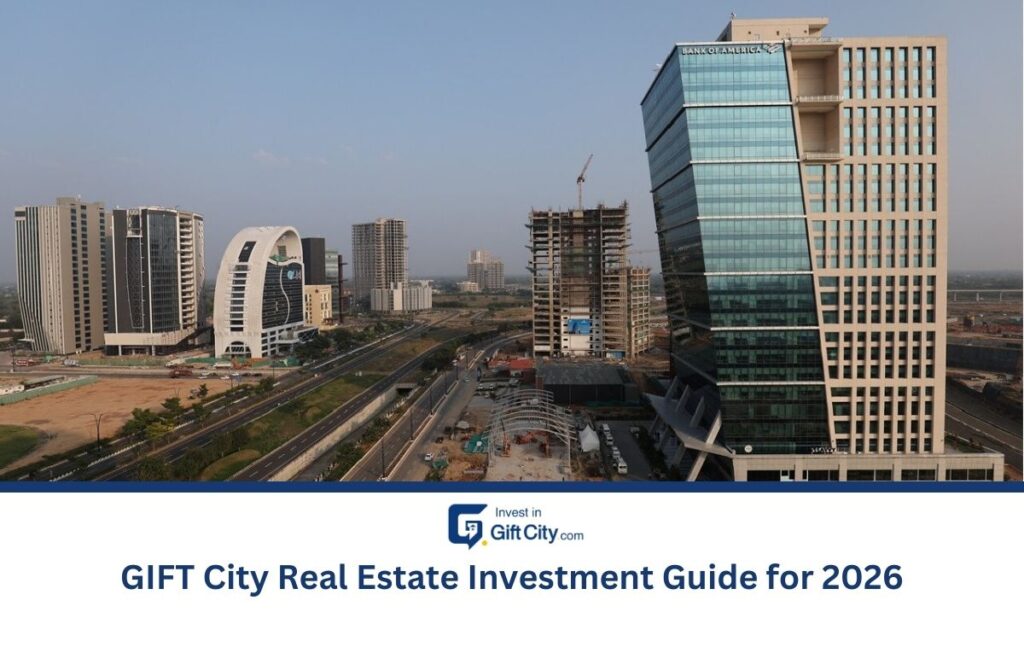
GIFT City (Gujarat International Finance Tec-City) is gradually positioning itself as India’s first operational international financial services hub. Located between Ahmedabad and Gandhinagar, this planned smart city is designed to host global finance, fintech, insurance, banking, and IT companies within a regulated ecosystem.
As we approach 2026, interest in GIFT City real estate is increasing among retail investors, NRIs, institutional players, and corporate buyers.
However, smart investing requires clarity — not hype.
This guide provides a structured, practical framework to help you evaluate real estate investment opportunities in GIFT City for 2026.
Understanding the GIFT City Ecosystem
Gujarat International Finance Tec-City (commonly known as GIFT City) was conceptualised as a global financial and IT services hub.
It operates under the International Financial Services Centre (IFSC) framework, regulated by the International Financial Services Centres Authority (IFSCA).
Key ecosystem components include:
- Banking and financial institutions
- Global fintech firms
- Insurance and reinsurance companies
- Fund management entities
- Technology and IT services
Unlike traditional residential developments, GIFT City is structured around an integrated live-work infrastructure model.
For real estate investors, this means property demand is closely tied to employment generation and corporate absorption.
Why 2026 Is a Significant Year for Investors
Several factors make 2026 a relevant milestone:
- Increasing office space absorption
- Expansion of financial institutions under IFSC
- Ongoing infrastructure completion
- Growing corporate workforce base
- Increasing residential inventory
As corporate presence stabilises, demand for housing and commercial assets typically follows.
However, appreciation depends on actual occupancy growth — not just project announcements.
Residential vs Commercial Investment in GIFT City
Investors must first define their objective.
- Residential Investment
Suitable for:
- Long-term capital appreciation
- Rental income from professionals
- NRI portfolio diversification
Advantages:
- Lower entry ticket compared to commercial towers
- Broad resale market
- Growing demand from workforce
However, rental yields in residential property are typically moderate (around 2–4%), depending on unit type and occupancy rate.
- Commercial Investment
Includes:
- Office spaces
- Managed workspaces
- Retail spaces
Commercial property in GIFT City may offer higher rental yields compared to residential units, especially if leased to established corporations.
However, risks include:
- Vacancy during slow corporate expansion
- Larger capital requirement
- Longer exit cycle
Commercial investment is more suited for experienced or high-capital investors.
Price Trends and Entry Strategy
Property price evaluation is critical.
Before investing, analyse:
- Historical price movement
- Current supply inventory
- Under-construction vs ready inventory
- Per square foot pricing comparison
Avoid entering purely based on future projections.
A data-based entry strategy includes:
- Comparing similar projects
- Understanding payment structures
- Evaluating construction stage
Early-stage investment may offer better entry pricing but carries higher execution risk.
Ready properties reduce uncertainty but may have limited short-term appreciation margin.
Rental Yield Analysis for 2026
Rental yield depends on:
- Corporate occupancy levels
- Employee migration trends
- Availability of residential supply
- Micro-location within GIFT City
If corporate hiring expands steadily, rental demand may strengthen.
However, investors should avoid aggressive rental assumptions. Conservative rental projections are safer for planning ROI.
Always calculate:
Annual Rental Income ÷ Total Investment × 100
A realistic yield projection helps assess total return expectations.
Infrastructure Impact on Property Value
Infrastructure growth directly influences property stability.
Important factors affecting 2026 outlook:
- Connectivity to Ahmedabad and Gandhinagar
- Metro network integration
- Road expansion
- Public utilities and smart city facilities
Real estate around structured infrastructure corridors generally experiences stronger long-term stability compared to unplanned suburban growth.
But appreciation takes time. Investors should plan a minimum 5–10 year holding period.
Risk Assessment for GIFT City Investors
Every investment carries risk.
Key considerations include:
- Corporate Expansion Pace
Property demand depends on actual office absorption. - Supply Volume
Excess residential supply may slow appreciation. - Economic Cycles
Financial hubs are sensitive to global economic movement. - Policy Changes
Regulatory changes under IFSC structure may influence corporate inflow.
Diversified investors must balance GIFT City exposure with other real estate holdings.
NRI Investment Perspective
GIFT City attracts attention from non-resident Indians due to:
- IFSC regulatory ecosystem
- India growth story participation
- Proximity to Ahmedabad airport
- Institutional-grade planning
NRIs should focus on:
- Legal documentation clarity
- Repatriation regulations
- Professional property management
- Tax planning
Investment decisions must remain compliance-driven.
Capital Appreciation Outlook for 2026
Capital appreciation in GIFT City will depend on:
- Office occupancy data
- Infrastructure completion
- Corporate retention rate
- Government support policies
Unlike speculative markets driven by short-term investor sentiment, GIFT City’s growth is employment-driven.
Stable, gradual appreciation is more likely than sharp spikes.
Investors seeking quick returns may face disappointment.
Investors planning structured 7–10 year holding horizons may benefit from long-term positioning.
Who Should Consider Investing in GIFT City?
GIFT City real estate is suitable for:
✔ Long-term investors
✔ Portfolio diversifiers
✔ NRIs seeking India exposure
✔ Investors comfortable with structured financial hub markets
✔ Buyers with moderate-to-high capital
It may not suit:
✖ Short-term traders
✖ Highly leveraged buyers
✖ Investors seeking immediate rental returns
Understanding alignment between investment goals and asset profile is critical.
Investment Strategy for 2026
A practical strategy includes:
- Define objective (rental vs appreciation)
- Select asset type (residential vs commercial)
- Evaluate developer track record
- Study project stage and payment plan
- Project conservative rental income
- Plan long-term holding
- Avoid over-leverage
Structured investing reduces exposure to market cycles.
GIFT City vs Other Growing Markets
Compared to traditional metropolitan markets:
- Entry pricing may still be competitive
- Infrastructure is structured
- Planning is centralised
- Market is corporate-driven
However, it is still evolving.
Mature markets offer liquidity stability. Emerging financial hubs offer structured growth potential.
Investor temperament should guide allocation.
Final Thoughts: Is 2026 a Good Time to Invest?
2026 represents a stage where:
- Infrastructure is progressing
- Corporate base is expanding
- Investor awareness is increasing
It is neither too early nor fully matured.
Real estate success in GIFT City will depend on disciplined evaluation rather than promotional narratives.
If corporate growth sustains, employment-led housing demand will strengthen over time.
However, investors must enter with realistic expectations and adequate holding capacity.
Conclusion
GIFT City real estate investment in 2026 presents opportunity supported by:
- Institutional planning
- Financial sector expansion
- Infrastructure growth
- Corporate ecosystem development
But it requires:
- Conservative financial planning
- Risk assessment
- Long-term outlook
- Developer due diligence
Smart investors rely on data, not hype.
If evaluated correctly, GIFT City can become part of a diversified real estate portfolio aligned with India’s financial growth trajectory.