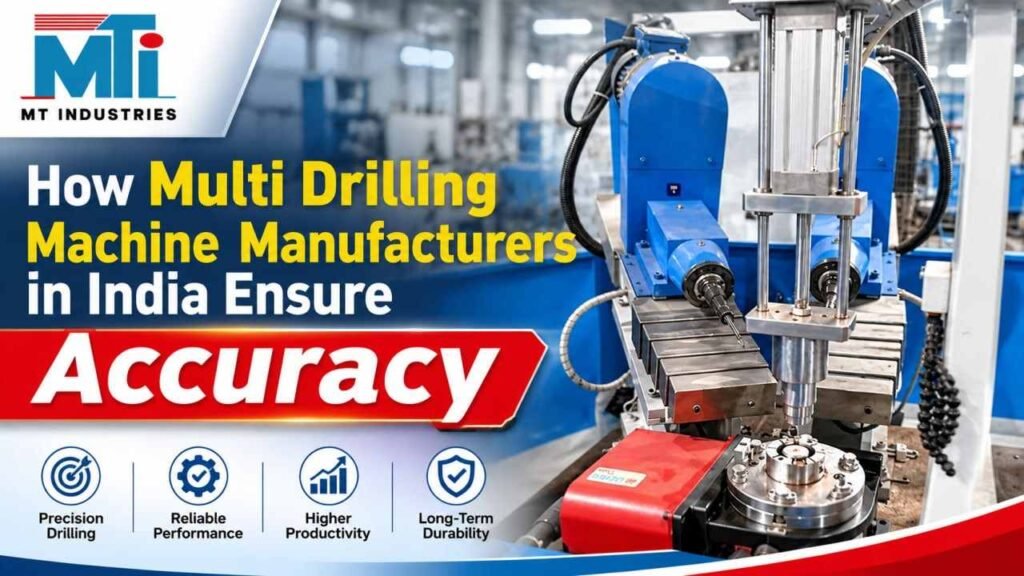
Accuracy is a critical requirement in modern manufacturing, particularly when producing components that require multiple holes at specific positions and dimensions. Industries such as automotive, electronics, electrical equipment, defence, and general engineering depend on consistent drilling quality to ensure proper component fitting and reliable product performance.
A small variation in hole position, diameter, or depth can create problems during assembly and increase rejection rates. This is why Multi Drilling Machine Manufacturers in India focus on machine design, spindle positioning, fixture accuracy, cutting parameters, and quality inspection to achieve consistent drilling results.
A multi drilling machine allows manufacturers to perform multiple drilling operations on a single component through a specially configured spindle arrangement. Depending on the application, these operations can be completed simultaneously or in a planned sequence.
Understanding how these machines maintain accuracy helps production managers, engineers, and machine buyers make better decisions when selecting industrial drilling equipment.
1. Understanding Accuracy in Multi Drilling Machines
Accuracy in a multi drilling machine refers to its ability to produce holes according to the dimensions and positions specified in an engineering drawing.
For example, an automotive component may require eight holes at fixed centre distances. If the holes are not positioned correctly, the component may not fit properly during assembly.
Several factors determine drilling accuracy:
- Hole position: Ensures holes are produced at their specified coordinates.
- Hole diameter: Maintains the required diameter throughout production.
- Drilling depth: Controls how deep the drill enters the workpiece.
- Spindle alignment: Maintains the correct position and orientation of each spindle.
- Repeatability: Produces consistent results across multiple production cycles.
- Perpendicularity: Maintains the required angle between the hole axis and component surface.
Multi Drilling Machine Manufacturers in India consider these parameters while developing machine configurations for different industrial applications.
2. Machine Structure and Rigidity
Machine rigidity is one of the most important factors affecting drilling accuracy. During operation, drilling tools generate cutting forces that can cause vibration or unwanted movement if the machine structure is not sufficiently rigid.
A stable machine structure helps maintain spindle positioning and reduces dimensional variations.
Manufacturers generally consider the following aspects:
Heavy-duty machine frame: A properly designed frame provides structural stability during drilling operations.
Precision-machined mounting surfaces: Accurate mounting surfaces help maintain alignment between machine components.
Spindle support: Proper spindle mounting reduces unwanted movement during cutting.
Vibration control: Suitable structural design helps minimize vibration and improves drilling consistency.
For multi-spindle applications, rigidity becomes particularly important because multiple tools may operate simultaneously and generate combined cutting forces.
3. Importance of Spindle Alignment
Spindle alignment directly affects the position and direction of drilled holes. In a multi drilling machine, every spindle must be positioned according to the required hole pattern.
Incorrect spindle positioning can result in dimensional errors, uneven hole spacing, and problems during component assembly.
Before configuring a machine, manufacturers evaluate:
- Number of holes required in the component.
- Distance between individual hole centres.
- Drill diameter and tool length.
- Required spindle speed.
- Component geometry.
- Available machining space.
A properly configured Multi Spindle Drilling Machine can produce multiple holes in a single setup, reducing the positioning variations associated with repeated manual drilling.
For complex components, manufacturers may develop customized spindle arrangements according to engineering drawings and production requirements.
4. Custom Fixture Design for Accurate Positioning
Fixture design plays an important role in maintaining drilling accuracy. A fixture holds the workpiece in the correct position and prevents unwanted movement during machining.
Even a precisely manufactured machine may produce inaccurate holes if the component is not positioned correctly.
A suitable drilling fixture generally includes:
- Accurate locating points.
- Proper clamping arrangements.
- Stable workpiece support.
- Clearance for drilling tools.
- Chip removal provisions.
- Easy loading and unloading arrangements.
For example, consider a metal component that requires six holes in a fixed pattern. A dedicated fixture ensures that every component is positioned using the same reference points before drilling begins.
This reduces variation between components and improves production consistency.
The Best drilling machine manufacturers consider fixture design an essential part of the machine development process, particularly when working with components having complex shapes or multiple drilling positions.
5. Selecting Suitable Drilling Tools
Drilling tool selection directly influences hole quality, dimensional consistency, and tool life.
Different materials require different drill geometries, cutting speeds, and feed rates. Using an unsuitable tool can result in excessive heat, tool wear, poor surface finish, and inaccurate hole dimensions.
Important tool selection factors include:
Tool material: High-speed steel and carbide tools are commonly selected according to workpiece material and operating conditions.
Drill geometry: Point angle, flute design, and cutting-edge geometry influence chip formation and drilling performance.
Tool diameter: The drill diameter must match the required hole specification.
Tool condition: Worn or damaged tools can affect hole quality and dimensional accuracy.
For example, aluminium components generally require different cutting conditions from stainless steel or cast iron components.
Selecting the correct drill and operating parameters helps maintain consistent results and reduces unnecessary tool replacement.
6. Controlled Feed Rate and Spindle Speed
Feed rate and spindle speed are important machining parameters that influence drilling performance.
Spindle speed determines how quickly the drill rotates, while feed rate controls how quickly the tool moves into the workpiece.
Incorrect settings can create several problems, including excessive heat, poor surface finish, tool damage, and inconsistent hole dimensions.
Manufacturers select these parameters according to:
- Workpiece material.
- Drill diameter.
- Required drilling depth.
- Cutting tool material.
- Machine power and rigidity.
- Production cycle requirements.
A controlled feed mechanism helps maintain consistent tool movement during the drilling cycle.
Depending on the application, machines may use pneumatic, hydraulic, mechanical, or servo-controlled feed arrangements.
The correct configuration improves process stability and helps achieve the required drilling quality.
7. Quality Inspection Before Machine Delivery
Machine inspection is necessary to verify whether a drilling system can achieve the required production specifications.
Before delivery, manufacturers should conduct suitable machine checks and trial operations.
Common inspection activities include:
Spindle alignment inspection: Verifies spindle positions and orientations.
Hole position measurement: Checks drilled hole locations against engineering drawings.
Diameter inspection: Confirms that hole dimensions meet specified requirements.
Depth measurement: Verifies drilling depth using appropriate measuring instruments.
Trial production: Tests the machine using representative workpieces.
Repeatability checks: Evaluates whether the machine maintains consistent results over repeated operations.
Depending on the application and required tolerances, manufacturers may use calibrated gauges, bore gauges, dial indicators, or coordinate measuring machines (CMMs).
These inspection methods help identify potential issues before the machine enters regular production.
8. Automation and Its Role in Drilling Accuracy
Automation helps reduce variations caused by manual handling and repeated component positioning.
In high-volume manufacturing, automated operations can improve consistency by controlling the sequence of clamping, drilling, and tool retraction.
Common automation features include:
- Automatic workpiece clamping.
- Component presence sensors.
- PLC-based machine control.
- Automatic drilling cycles.
- Safety interlocking systems.
- Controlled tool movement.
For example, a component detection sensor can prevent the drilling cycle from starting if the workpiece is missing or incorrectly positioned.
Similarly, automated clamping ensures that the component remains securely held during machining.
However, automation alone cannot guarantee accuracy. Correct machine design, fixture positioning, tool selection, and process control remain equally important.
9. Regular Maintenance for Consistent Performance
Regular maintenance helps preserve machine accuracy and prevent unexpected production problems.
Continuous operation can gradually affect spindle bearings, fixtures, cutting tools, and other machine components.
A preventive maintenance programme should include:
| Maintenance Activity | Purpose |
| Spindle inspection | Identifies wear and alignment issues |
| Tool inspection | Maintains drilling quality |
| Lubrication | Reduces friction and component wear |
| Fixture inspection | Maintains correct workpiece positioning |
| Coolant maintenance | Supports effective heat management |
| Fastener inspection | Prevents unwanted component movement |
Operators should also monitor unusual vibration, excessive noise, changes in drilling time, and variations in hole dimensions.
Identifying these problems early helps reduce downtime and maintain consistent production quality.
10. How to Select the Right Multi Drilling Machine Manufacturer in India
Selecting a machine manufacturer requires evaluating technical capabilities, machine design, customization options, and production requirements.
The right machine should be developed according to the component geometry, material, hole pattern, required tolerances, and expected production volume.
Before selecting a supplier, consider these factors:
Technical experience: Evaluate experience in multi-drilling applications and special-purpose machine development.
Customization capability: Check whether the manufacturer can develop spindle arrangements and fixtures according to component drawings.
Machine construction: Understand the machine frame, spindle configuration, and overall structural design.
Quality inspection: Ask about machine testing and dimensional verification procedures.
Automation options: Check whether the machine can support the required level of automation.
After-sales support: Understand installation, maintenance, and technical assistance arrangements.
The Best drilling machine manufacturers in India should be able to understand the actual manufacturing process and recommend a suitable machine configuration instead of relying only on standard machine specifications.
MT Industries has over 40 years of engineering experience in special-purpose machines and precision engineering. Its machine development approach considers component requirements, drilling operations, fixture arrangements, and production objectives.
Conclusion
Maintaining accuracy in multi drilling operations requires a combination of proper machine construction, spindle alignment, fixture design, suitable cutting tools, controlled feed mechanisms, and regular maintenance.
Multi Drilling Machine Manufacturers in India use these engineering considerations to develop machines capable of producing multiple holes with consistent positioning and dimensions.
For manufacturers working with automotive, electronics, defence, and engineering components, selecting the right drilling configuration can improve production consistency and reduce manual positioning errors.
Before investing in a machine, businesses should evaluate their component drawings, material specifications, hole patterns, production volume, and dimensional requirements. A machine designed around these factors can support reliable and efficient manufacturing operations.
Frequently Asked Questions (FAQs)
1. How do multi drilling machine manufacturers in India ensure accuracy?
They focus on rigid machine construction, accurate spindle alignment, custom fixture design, suitable cutting tools, controlled feed mechanisms, and quality inspection. These factors help maintain consistent hole positions and dimensions.
2. What factors affect multi drilling machine accuracy?
The main factors include spindle alignment, machine rigidity, fixture positioning, tool condition, feed rate, spindle speed, workpiece material, and vibration. Regular inspection and maintenance also help maintain accuracy.
3. Which industries use multi drilling machines?
Multi drilling machines are used in automotive, electronics, electrical equipment, defence, pump manufacturing, valve manufacturing, and general engineering industries where components require multiple accurately positioned holes.
4. How do I select the best drilling machine manufacturers in India?
Evaluate the manufacturer’s technical experience, machine construction, customization capabilities, fixture design, quality inspection procedures, previous applications, and after-sales support. Share your component drawings and production requirements before finalizing a supplier.
5. Can multi drilling machines be customized for different components?
Yes. Multi drilling machines can be customized according to component geometry, hole positions, drilling depth, spindle configuration, workpiece material, fixture requirements, and production volume. The final configuration depends on the specific manufacturing application.
For More Information Click Here:- https://mtindustries.in/service-drilling