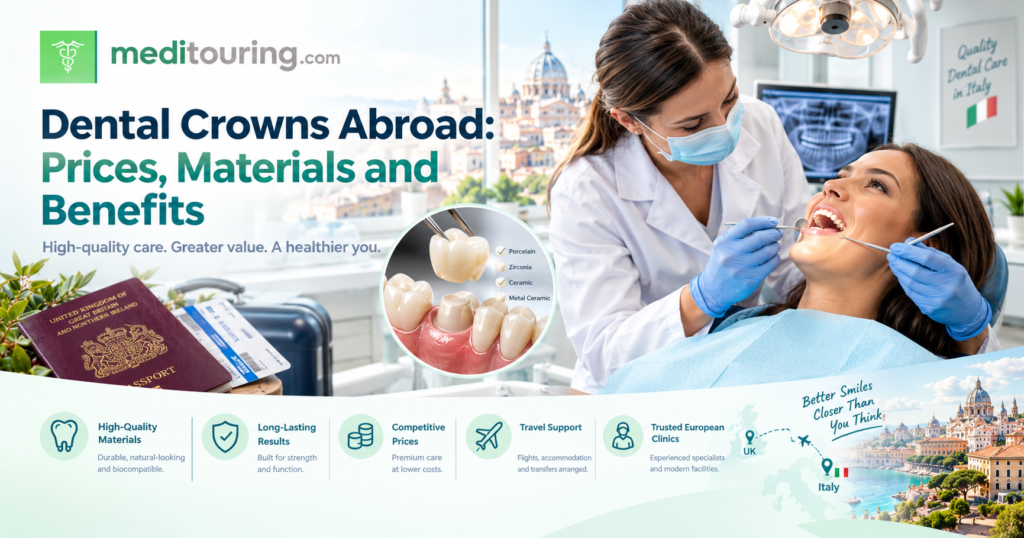
Dental crowns are a popular restorative dental treatment for repairing damaged teeth, improving appearance and restoring normal chewing function. However, the cost of private dental care can encourage patients to explore treatment options in other countries. For people comparing dental treatments abroad, dental crowns may offer an opportunity to access professional care while managing their overall treatment budget.
Choosing dental crowns abroad requires more than comparing prices. Patients should understand the available crown materials, treatment procedures, clinic standards, travel expenses and aftercare arrangements before making a decision. With careful planning, dental tourism can help patients explore suitable treatment options and make informed decisions about their oral health.
Meditouring helps patients explore dental treatment options in Italy and other European destinations, offering support with treatment planning and travel arrangements.
What Are Dental Crowns?
A dental crown is a custom-made restoration that covers the visible portion of a tooth. It is designed to restore the tooth’s shape, strength, size and appearance while protecting the remaining tooth structure.
Dentists may recommend a crown when a tooth is significantly damaged by decay, weakened after root canal treatment, fractured or worn down. Crowns can also be used to restore dental implants or improve the appearance of certain teeth.
Depending on the patient’s needs, a dentist may recommend a crown for functional reasons, cosmetic improvement or both. An examination and appropriate diagnostic imaging help determine whether a crown is suitable or whether another treatment would be more appropriate.
Why Consider Dental Crowns Abroad?
The cost of dental treatment varies between countries, clinics and individual treatment plans. Some patients consider treatment overseas because the quoted price may be lower than an equivalent private treatment at home.
Exploring affordable dental treatments abroad can provide access to different clinics, restorative materials and treatment packages. European destinations such as Italy attract patients who want to combine dental care with organised travel arrangements.
Potential benefits include:
- Cost comparisons: Patients can compare itemised quotations from different clinics.
- Material choices: Depending on the clinic, patients may be offered porcelain, zirconia, ceramic or metal-based crowns.
- Personalised treatment planning: Dentists assess the condition of existing teeth and recommend suitable restorative options.
- Travel assistance: A dental tourism provider may help coordinate accommodation, transport and appointments.
- Access to restorative care: Patients can explore treatment options for damaged, weakened or heavily restored teeth.
However, travelling abroad does not automatically guarantee lower total costs or better clinical results. Patients should consider the quality of care, travel expenses, potential return visits and access to follow-up treatment before deciding.
Dental Crown Materials: Which Option Is Best?
The best crown material depends on the tooth’s location, bite pressure, appearance, available space and the dentist’s clinical assessment. Each material offers different advantages and limitations.
1. Porcelain-Fused-to-Metal Crowns
Porcelain-fused-to-metal crowns combine a metal framework with a tooth-coloured porcelain exterior. The framework provides structural support, while the outer layer helps the restoration blend with natural teeth.
Benefits:
- A balance between strength and appearance.
- Suitable for various restorative situations.
- A long-established option in restorative dentistry.
Considerations: The porcelain layer can chip, and the metal underneath may become visible near the gumline in some cases. These crowns may be less suitable when achieving highly natural front-tooth aesthetics is the main priority.
2. Zirconia Crowns
Zirconia crowns are made from a strong ceramic material. They are frequently considered for teeth exposed to substantial chewing forces, although suitability depends on the specific zirconia formulation and restoration design.
Benefits:
- High strength and resistance to fracture.
- Tooth-coloured appearance.
- Available in different translucency levels.
- Suitable for selected front and back teeth.
Considerations: Some zirconia crowns may appear less translucent than natural teeth. The result depends on the material, laboratory work, preparation and placement.
3. Lithium Disilicate and Other All-Ceramic Crowns
Lithium disilicate is a glass-ceramic material valued for its natural-looking appearance. Other all-ceramic materials may also be used according to the patient’s needs.
Benefits:
- Good aesthetic results.
- Natural-looking translucency.
- No metal framework.
- Suitable for many visible teeth and selected other restorations.
Considerations: Strength and suitability vary by material and clinical situation. Patients with heavy grinding or particular bite conditions may require a different design or material.
4. Metal Crowns
Metal crowns, including selected gold alloys, are durable and can be useful for back teeth where appearance is less important.
Benefits:
- Strong and wear-resistant.
- Often require less removal of tooth structure than some alternative designs.
- Can be suitable for areas exposed to substantial chewing pressure.
Considerations: Their metallic appearance makes them less popular for visible teeth. Cost depends on the alloy and laboratory work.
Your dentist should explain the advantages, limitations and expected lifespan of each suitable option before treatment begins.
How Much Do Dental Crowns Abroad Cost?
The price of dental crowns abroad depends on the destination, clinic, material, laboratory fees, complexity of the case and number of crowns required. Additional procedures, such as treating decay or addressing gum disease, may increase the total cost.
For example, Meditouring has previously listed an indicative dental crown package price of approximately £2,500 through Tre.M Clinic in Italy. Patients should confirm the current price, the number and type of crowns included, and all package conditions directly with the provider before making a booking. This figure should not be interpreted as a universal price for a single crown.
When comparing dental treatments abroad, request a written quotation covering:
- The number of crowns included.
- The proposed material and restoration specifications.
- Dental examinations and diagnostic imaging.
- Temporary crowns, where required.
- Tooth preparation and laboratory fees.
- Any necessary additional dental procedures.
- Hotel accommodation and transport, if included.
- Follow-up appointments and any exclusions.
A lower headline price may not represent better value if important procedures or travel expenses are excluded. Comparing equivalent treatment plans is the most reliable way to understand the financial difference.
What Is the Dental Crown Procedure?
Dental crown treatment commonly involves several stages. The exact process depends on the tooth’s condition, the material selected and whether the crown is supported by a natural tooth or an implant.
Step 1: Consultation and examination
The dentist reviews your dental history, examines the tooth and may take X-rays or other diagnostic images. This helps identify underlying problems and establish whether a crown is appropriate.
Step 2: Tooth preparation
If the crown is placed on a natural tooth, the dentist reshapes the tooth as needed to accommodate the restoration. Local anaesthesia is commonly used during preparation.
Step 3: Impressions or digital scans
The dentist records the prepared tooth and surrounding teeth using conventional impressions or digital scanning. The information is used to manufacture a custom crown.
Step 4: Temporary crown
A temporary crown may be fitted while the permanent restoration is being made. Its purpose is to protect the prepared tooth and maintain function during the waiting period.
Step 5: Final fitting
The dentist checks the permanent crown’s fit, contact points, colour where relevant and bite. Once the necessary adjustments are complete, the crown is secured using the appropriate method.
Some cases require additional appointments or treatment. Patients travelling internationally should confirm the schedule before booking flights and accommodation.
Benefits of Dental Crowns
Dental crowns can provide several important benefits when appropriately recommended and fitted.
Restoring function: A well-designed crown can help restore chewing ability in a damaged or weakened tooth.
Protecting remaining tooth structure: A crown may reduce the risk of further damage in teeth that have lost substantial structure, although it cannot eliminate every risk.
Improving appearance: Tooth-coloured crowns can improve the shape, colour and overall appearance of selected teeth.
Supporting dental implants: Crowns can serve as the visible replacement tooth attached to a dental implant.
Supporting long-term oral health: With suitable case selection, good oral hygiene and regular dental reviews, crowns can provide years of service. Their lifespan varies according to material, bite forces, oral hygiene and clinical factors.
A crown does not prevent gum disease or decay around its margins. Daily cleaning and professional dental care remain essential.
How to Choose a Dental Clinic Abroad
Before committing to treatment, research the clinic and the dentist responsible for your care. Ask about professional registration, relevant experience, infection-control procedures, laboratory standards and the process for managing complications.
Request a written treatment plan that identifies the proposed material, number of crowns, expected appointments and alternatives. Make sure you understand whether the treatment is restorative, cosmetic or a combination of both.
Patients should also ask what happens if a crown becomes loose, fractures or requires adjustment after returning home. Confirm whether any guarantee or warranty has written conditions and whether it covers laboratory defects, clinical complications or replacement costs.
For international patients, clear communication is especially important. Obtain copies of relevant dental records, X-rays, treatment details and invoices so that a dentist at home can provide informed follow-up care if needed.
Planning Dental Treatment Abroad with Meditouring
Meditouring helps patients explore dental care options in Italy and other European destinations by coordinating treatment enquiries and supporting travel arrangements. Depending on the package, assistance may include appointment coordination, accommodation and transport.
Patients considering dental crowns should begin with a professional assessment rather than choosing a clinic based on price alone. Confirm the treatment plan, material, total package cost and follow-up arrangements before travelling.
It is also important to allow sufficient time for appointments and unexpected adjustments. Do not assume that every crown can be completed in one visit or that every case requires the same number of days.
Conclusion
Dental crowns abroad can be worth exploring for patients who want to compare restorative treatment options and overall costs. Understanding the differences between zirconia, porcelain-fused-to-metal, all-ceramic and metal crowns helps patients ask better questions and make informed choices.
The most suitable treatment depends on the condition of the tooth, the patient’s oral health, the proposed material and the dentist’s assessment. Before choosing affordable dental treatments abroad, compare itemised quotations, verify the clinic’s credentials and consider travel and aftercare expenses.
With careful research and realistic planning, patients can evaluate dental treatments abroad with greater confidence. Meditouring can help patients explore dental treatment options in Italy while coordinating relevant travel arrangements, so they can focus on making an informed decision about their dental care.