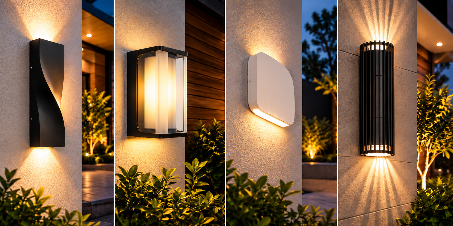
Up and down outdoor wall lights direct light upwards and downwards to create an architectural lighting effect on exterior walls. They can highlight entrances, garages, patios and feature walls while adding visual interest after dark.
The best fitting depends on your intended lighting effect, the amount of illumination required, the wall space available and the conditions where the light will be installed. Before buying, compare the IP rating, lumens, beam angle, colour temperature, dimensions, finish and installation requirements.
This guide explains what to look for and compares two Lights4Less options: the DENT Up & Down Wall Light in White Aluminium and the 3A Six-Light Exterior LED Wall Light in Black.
Which Up and Down Outdoor Wall Light Is Best for Your Home?
The right up and down wall light depends on how you want the exterior to look and how the space will be used.
- For a decorative wall effect: Compare the beam angle, light distribution and fitting design.
- For entrances and accessways: Check whether the light provides sufficient illumination for the area, rather than judging its performance by appearance alone.
- For exposed outdoor locations: Check the product’s IP rating, materials and manufacturer installation instructions.
- For coordinated exterior lighting: Compare the finish, dimensions and colour temperature with nearby fittings and exterior materials.
- For flexible light colour: Consider a model with selectable correlated colour temperature (CCT), and confirm which settings are available.
For example, the DENT Up & Down Wall Light offers selectable colour temperatures of 3000K, 4000K and 5000K, while the 3A Six-Light Exterior LED Wall Light offers 3000K, 4000K and 6500K, according to the listed product specifications. Compare these settings alongside light output, beam angle and installation requirements when choosing a fitting.
What Are Up and Down Outdoor Wall Lights?
Up and down wall lights are wall-mounted fittings that direct light towards both the upper and lower sections of a wall. Outdoors, they can create a distinctive pattern of light that highlights architectural features after dark.
Depending on their design and light distribution, they may suit:
- Front entrances and house facades
- Garage walls and side accessways
- Covered patios and outdoor entertaining areas
- Exterior feature walls
- Courtyards and selected pathway areas
The result depends on the fitting’s beam angle, light output, mounting position and the surface behind it. A narrower beam can create a more defined pattern, while a wider beam can spread light across a larger section of the wall.
Before choosing a fitting, decide whether your main priority is decorative lighting, practical illumination or a combination of both. A decorative wall effect does not automatically mean that the fitting will provide sufficient light for every entrance, step or pathway.
Phone: +61288663242
Email us: sales@lights4less.com.au