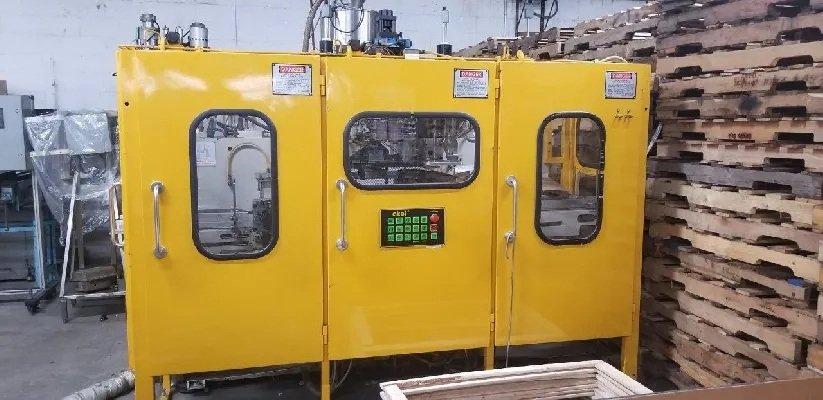
Choosing the right injection molding machine is essential for producing quality plastic parts efficiently. One of the most important specifications to consider is clamping force, commonly expressed in tons.
Selecting a machine with insufficient clamping force can lead to mold separation and flash, where excess plastic escapes between mold surfaces. Choosing a machine with far more capacity than necessary may increase equipment costs and operating expenses without providing a meaningful production benefit.
So, how do you determine the right tonnage for your application?
What Is Clamping Force in Injection Molding?
Clamping force is the force used to hold the two halves of a mold closed while molten plastic is injected into the mold cavity.
During injection, the plastic creates pressure inside the mold. This pressure generates a force that attempts to push the mold halves apart.
The machine must provide enough clamping force to resist that force and keep the mold securely closed throughout the injection cycle.
Clamping force is commonly expressed in tons, although machine manufacturers may specify it in metric tonnes or kilonewtons. Always confirm the units when comparing equipment specifications.
How Do You Calculate the Required Clamping Force?
A common preliminary method is to estimate the total projected area of the molded part and multiply it by an appropriate cavity-pressure factor.
The basic relationship is:
Required clamping force = Total projected area × Estimated cavity pressure
The projected area is the area of the part as viewed along the direction in which the mold closes. For multi-cavity molds, the projected areas of all cavities must be considered. Runner areas may also need to be included.
The estimated cavity pressure depends on the material, part geometry, flow characteristics, and processing conditions. It is not necessarily the same as the injection pressure displayed by the machine.
Because the required pressure factor varies by application, this calculation should be treated as an estimate rather than a universal sizing rule.
Example: Estimating Clamping Force
Suppose a mold has a total projected area of 100 square inches, and an initial estimate of the required cavity pressure is 3,000 psi.
The estimated separating force is:
100 square inches × 3,000 psi = 300,000 pounds-force.
Using 2,000 pounds-force per US short ton:
300,000 ÷ 2,000 = 150 US tons.
This simplified example produces an estimated requirement of 150 US tons. The actual machine selection should account for the application, process conditions, suitable safety margin, and manufacturer recommendations.
What Factors Affect the Required Tonnage?
1. Projected part area
Larger projected areas generally require more clamping force because the mold experiences a greater separating force during injection.
The projected area is determined by the part geometry and the direction of mold closure.
2. Plastic material
Different materials have different flow characteristics and processing requirements. Material selection can influence the pressure needed to fill the mold and therefore affect the clamping-force requirement.
3. Part design and wall thickness
Thin-walled or complex parts may require different filling conditions from simple, thick-walled components. These differences can affect the pressure needed during molding.
4. Number of cavities
A mold producing multiple parts in one cycle generally has a larger total projected area than a single-cavity mold. The combined projected area must be considered when selecting the machine.
5. Mold design and process settings
Runner systems, gate design, flow paths, injection speed, and other processing variables can influence the pressure distribution within the mold.
Machine tonnage should therefore be selected with input from the mold designer, process engineer, or equipment supplier when the application is complex.
What Tonnage Is Commonly Available?
Injection molding machines are available in a broad range of clamping capacities, from small machines for compact components to large machines for substantial molded parts.
Common machine categories include:
- Small-capacity machines: Often considered for smaller components and compact molds.
- Medium-capacity machines: May suit general-purpose manufacturing applications.
- Large-capacity machines: Used for larger projected areas, larger molds, or applications with higher force requirements.
These categories are broad descriptions rather than fixed industry standards. The right tonnage depends on the specific machine and application.
Is a Higher-Tonnage Machine Always Better?
No. A larger machine is not automatically the best choice.
A machine with excessive clamping force may cost more to purchase and operate than necessary. It may also be poorly matched to a small mold or low shot-weight application.
On the other hand, insufficient clamping force can contribute to flash, mold separation, and inconsistent part quality.
Besides tonnage, buyers should check:
- Maximum and minimum mold dimensions.
- Tie-bar spacing and platen dimensions.
- Shot capacity and injection capability.
- Mold opening stroke and daylight.
- Material compatibility.
- Required cycle time and production volume.
The machine must be suitable for both the force requirements and the physical dimensions of the mold.
How Should You Select a Used Injection Molding Machine?
When evaluating used equipment, start with the mold specifications and part requirements. Then compare the required clamping force with the machine’s rated capacity and review its other technical specifications.
Businesses considering Horizontal Used Injection Molding Machines should also verify that the machine’s injection unit, platen dimensions, mold space, and control capabilities are suitable for the intended production process.
Where possible, consult the mold designer, process engineer, or machinery supplier before finalizing the selection. A technical review can help prevent costly compatibility problems after installation.
Choose the Right Machine for Consistent Production
Selecting the correct clamping force helps manufacturers balance part quality, equipment cost, and production efficiency. The best choice is a machine that can safely accommodate the mold and process requirements without unnecessary excess capacity.
Hunter Plastics helps businesses source used plastic processing equipment for a range of manufacturing applications. Reviewing the mold specifications alongside the machine’s technical details is an important first step in identifying a suitable option.
Final takeaway: Start with the total projected area and estimated cavity pressure, then verify the calculation against the actual material, mold design, and processing requirements. Never select machine tonnage based on part size alone.