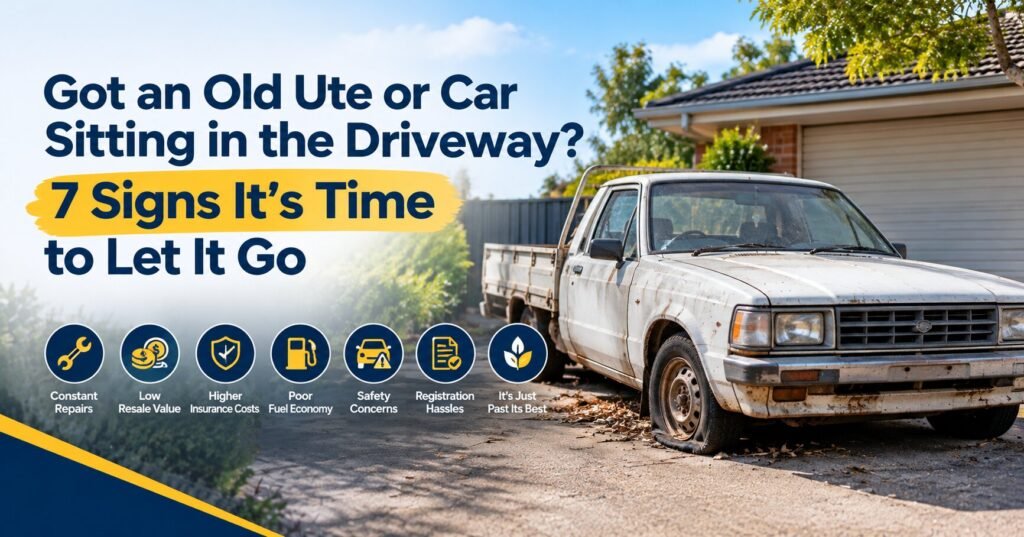
Quick answer: It’s usually time to get rid of an old car or ute when repairs cost more than it’s worth, it hasn’t been driven or registered in months, it’s failing safety checks, or it’s taking up space you need. A car that sits unused loses value every month, so selling, scrapping or arranging removal sooner usually gets you a better result.
Almost every Sydney street has one: the old Commodore under a cover that hasn’t moved since last winter, or the ute in the side yard that’s “going to get fixed one day.” Australians hold on to their cars for a long time, and the average vehicle on our roads is now more than 10 years old.
Hanging on to an old vehicle is easy. There’s sentimental value, the hope of a weekend project, or simply not knowing what to do with it. But a car that just sits there isn’t standing still. It’s quietly costing you.
Here are seven signs it might be time to let it go.
1. Repairs cost more than the car is worth
This is the clearest sign of all. If your mechanic quotes $3,000 for a new gearbox on a car worth $2,500, the maths doesn’t work in your favour.
A useful rule of thumb: if a single repair costs more than half the car’s market value, or you’re facing several big repairs in a row, it’s usually time to stop spending money on it. Check what similar cars are selling for on sites like Carsales or Gumtree to get a realistic idea of its value.
2. It hasn’t moved in months
Cars are built to be driven. When one sits idle for a long time, problems start building up quietly:
- The battery goes flat and may not recover.
- Tyres develop flat spots and can perish in the Aussie sun.
- Fuel goes stale, and seals and hoses dry out and crack.
- Brakes can seize, especially in damp or coastal areas.
- Mice and rats move in and chew through wiring.
Old cars also tend to leak oil, coolant and brake fluid. These stain driveways and can wash into stormwater drains, which isn’t great for your property or the environment.
The longer a car sits, the more expensive it becomes to get running again. If you can’t remember the last time you drove it, that’s a strong signal.
3. The rego has lapsed (or you’re paying it for nothing)
An unregistered car can’t be driven or parked on a public road in NSW. If it’s parked on the street, your local council can treat it as abandoned and have it towed, which can leave you paying release fees.
On the flip side, if you’re still paying rego and a green slip (CTP insurance) on a car you never drive, you’re spending hundreds of dollars a year to keep it parked. Either way, a car with lapsed or wasted rego has become a cost rather than a vehicle.
4. It’s failing safety checks
In NSW, cars over five years old need a pink slip (safety inspection) before each rego renewal. If your car struggles to pass, or the list of defects keeps growing, it may no longer be safe to drive. Worn brakes, structural rust, faulty lights or steering problems can all put you and other road users at risk.
When the cost of bringing it back up to a roadworthy standard keeps climbing, it’s often smarter to put that money towards a safer, more reliable car.
5. Rust is spreading
A bit of surface rust is common on older cars, particularly in Sydney’s coastal suburbs, where salt air speeds up corrosion. Rust in the floor pan, sills, chassis rails or around the suspension mounts is a different story.
Structural rust is expensive to repair properly and can affect the car’s safety in a crash. Once it’s spreading into these areas, many owners find it simply isn’t worth fixing.
6. You need the space back
Sometimes the sign isn’t mechanical at all. If the old car is taking up the garage you’d rather use for storage, blocking the driveway, or eating into a small backyard, that space has real value.
This is especially true if you’re renting, moving house or downsizing. Getting rid of an unused car frees up room, makes moving easier, and cuts down on clutter around the property.
7. Its value keeps dropping
Every month an old car sits, it’s worth a little less. Parts age, the market moves on, and the car’s condition gets worse. A car that might fetch a fair price today could be worth only its scrap metal value a year from now.
If you’re on the fence, selling or removing it sooner usually means more money in your pocket.
“We regularly collect cars that have sat for years. Owners are often surprised how much value they lost by waiting.” — Zakir Haidari from Delta Car Removals
When it might be worth keeping
Not every old car should go. Classic or collectible models, such as an early Holden ute or an original Falcon, can increase in value if restored properly.
If your car has genuine collector appeal, get it valued by a specialist before you decide. For everyday cars, though, the signs above are a reliable guide.
What are your options for an unwanted car?
Once you’ve decided to let it go, you have four main choices.
| Option | Best for | Things to know |
| Sell privately | Cars that still run and are roadworthy | Usually the highest price, but takes time and dealing with buyers |
| Trade it in | Buying a new car from a dealer | Convenient, but trade-in offers are often lower |
| Sell to a wrecker | Damaged or non-running cars | Paid for parts and metal value |
| Car removal service | Old, unregistered or non-running cars | Free pick-up in many cases; some pay for parts or scrap value |
For cars that don’t run, aren’t registered or simply aren’t worth the hassle of selling privately, an Unwanted Car Removal service is usually the easiest option. They’ll tow the car away, take care of the paperwork, and make sure it’s dismantled and recycled responsibly.
Before your car is collected
A few quick steps make the handover smooth:
- Remove your belongings from the glovebox, boot and under the seats.
- Take off your number plates and return them to Service NSW, or cancel the registration if it’s still current.
- Cancel your insurance and green slip once the car is gone.
- Have your ID and proof of ownership ready, such as registration papers or a receipt.
- Get a receipt from the buyer or removal company as proof the car is no longer yours.
Frequently asked questions
Is it worth keeping an old car that doesn’t run?
Usually not, unless you have the time, skills and budget to restore it, or it’s a classic with collector value. A non-running car keeps losing value and can develop new problems the longer it sits.
How long can a car sit before it stops running properly?
Problems can start within a few weeks. The battery is usually the first to go, followed by tyres, brakes and stale fuel after a few months.
Can I leave an unregistered car on the street in NSW?
No. An unregistered vehicle can’t be parked on a public road, and councils can remove vehicles they consider abandoned.
Will I get paid for an old car that doesn’t run?
Often, yes. Wreckers and removal companies value cars on their parts and scrap metal, so even a non-running car can be worth something.
What happens to my car after it’s removed?
Most removed cars are dismantled. Usable parts are resold, fluids are drained and disposed of safely, and the metal is recycled.
The bottom line
Letting go of an old car or ute can feel like a big decision, especially if it’s been part of the family for years. But if it’s costing more to fix than it’s worth, hasn’t moved in months, or is just taking up space, moving it on is usually the smart call.
Whether you sell it, trade it in, or book an unwanted car removal, the sooner you act, the more value you’re likely to get out of it.