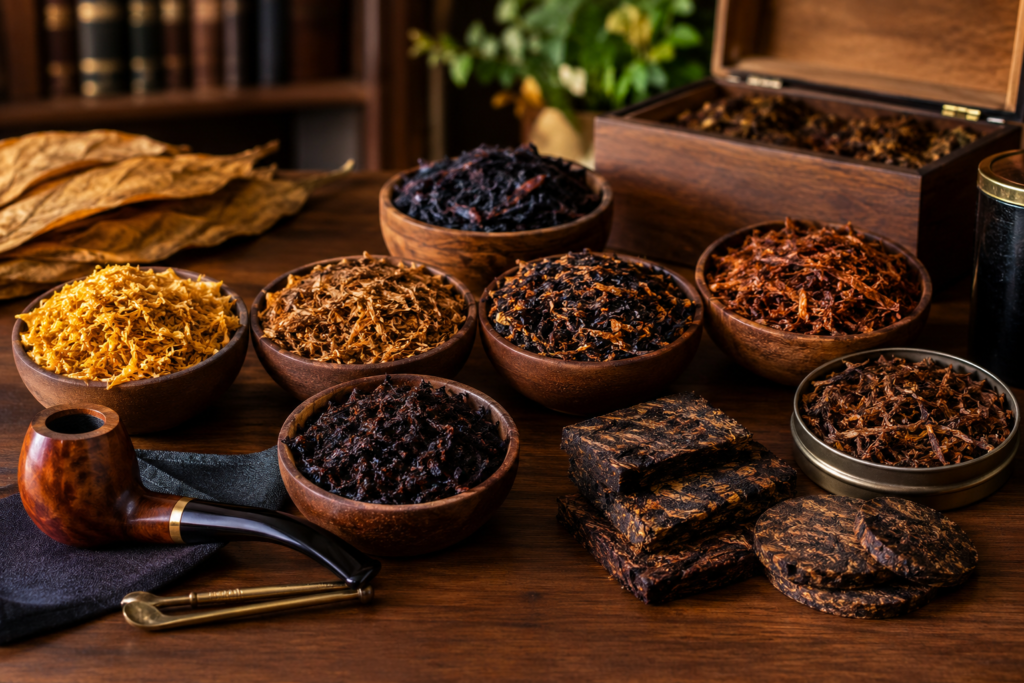
Pipe tobacco has a long history shaped by agricultural traditions, regional practices, and individual preferences. Over time, manufacturers have developed different blends, cuts, and preparation methods. These variations create distinct characteristics in aroma, texture, and overall composition. Understanding these differences helps readers recognize how pipe tobacco products are classified.
For example, people researching premium pipe tobacco may encounter blends featuring Virginia, Burley, Oriental, or Latakia leaf. Each type has its own characteristics, growing conditions, and processing methods. Furthermore, manufacturers often combine several varieties to create distinctive blends. Learning about these ingredients provides useful context for understanding product descriptions and tobacco terminology.
However, tobacco products carry significant health risks. Pipe smoking exposes users to nicotine and harmful chemicals, and it is not a safe alternative to other forms of tobacco. Therefore, understanding different tobacco types should also involve awareness of their health implications.
1. Virginia Pipe Tobacco
Virginia tobacco is one of the most widely recognized varieties used in pipe tobacco blends. It generally contains relatively high levels of natural sugars compared with some other tobacco types. Consequently, its flavor profile may include naturally sweet, grassy, or hay-like notes.
The leaf color can range from bright yellow to orange and deeper reddish shades. These differences depend on growing conditions, leaf position, curing, and processing. Bright Virginia leaf often develops lighter characteristics, while red Virginia may have deeper and richer notes.
Virginia tobacco is commonly flue-cured. During this process, controlled heat dries the leaves while limiting direct exposure to combustion gases. This curing method helps preserve many of the leaf’s natural sugars.
Manufacturers use Virginia tobacco in both single-variety products and complex mixtures. Some blends combine different Virginia grades to create variation in color and flavor. Others include additional tobacco varieties to change the overall character.
Nevertheless, natural sweetness does not make Virginia tobacco harmless. Tobacco smoke contains toxic substances regardless of the leaf variety or its perceived smoothness.
2. Burley Pipe Tobacco
Burley is another important tobacco variety used in pipe tobacco production. Compared with Virginia, it generally contains fewer natural sugars. Its flavor is often described as earthy, nutty, woody, or mildly cocoa-like.
Burley leaves are typically air-cured in ventilated barns. This process allows moisture to leave gradually under natural environmental conditions. The resulting leaf often has a relatively low sugar content and a structure suitable for absorbing added flavorings.
Because of these characteristics, manufacturers frequently use Burley as a base in blended tobacco products. Its relatively neutral profile can complement other leaf varieties. It may also contribute body and help balance a blend’s overall character.
Some Burley products receive flavoring treatments during manufacturing. These treatments may introduce aromas associated with chocolate, vanilla, fruit, or other ingredients. However, the presence of flavoring does not reduce the health risks associated with tobacco use.
Burley can appear in different cuts and moisture levels. These features affect handling and product consistency. Therefore, product descriptions may mention both the tobacco variety and its preparation method.
3. Oriental Tobacco
Oriental tobacco refers to several small-leaf varieties historically cultivated in parts of the eastern Mediterranean and nearby regions. These varieties are often associated with distinctive aromatic characteristics. Their leaves are generally smaller than those of many Virginia tobacco plants.
Oriental tobacco is commonly sun-cured. After harvesting, the leaves dry under sunlight and suitable environmental conditions. This traditional process contributes to their characteristic aroma and composition.
In pipe tobacco blends, Oriental leaf often serves as a supporting ingredient rather than the sole component. It can introduce herbal, spicy, floral, or dry aromatic notes. The exact characteristics vary according to the variety, growing location, and processing methods.
Different Oriental tobaccos may be identified by regional or traditional variety names. However, terminology can vary between producers and markets. As a result, product descriptions sometimes use broad regional categories instead of precise botanical classifications.
Understanding Oriental tobacco helps explain why two blends containing similar primary ingredients can still differ considerably. Even a relatively small proportion of another leaf type can influence a blend’s aroma and overall profile.
4. Latakia Tobacco
Latakia is a distinctive tobacco ingredient often associated with traditional English-style pipe tobacco blends. Its name refers to a historical processing tradition connected with the eastern Mediterranean. Modern production methods and sourcing can differ from earlier practices.
Traditionally, Latakia is produced by curing tobacco through processes involving smoke exposure. This treatment creates a pronounced smoky aroma. Descriptions may also mention woody, earthy, leathery, or spicy characteristics.
Latakia is usually blended with other tobacco varieties. Virginia can contribute natural sweetness, while Oriental tobacco adds aromatic complexity. Together, these ingredients create a profile that differs from blends made primarily with one variety.
The proportion of Latakia can strongly influence a product’s overall character. Some blends use it as a subtle supporting ingredient. Others emphasize its smoky qualities more prominently.
It is important to distinguish Latakia from a tobacco leaf grown exclusively for its natural flavor. Its identity is strongly connected to processing traditions. Consequently, manufacturing methods can be just as important as the original leaf variety.
5. Perique Tobacco
Perique is a distinctive tobacco traditionally associated with St. James Parish in Louisiana, United States. It is known for a specialized fermentation and pressing process. This method creates a concentrated profile that differs from many other tobacco varieties.
Production involves carefully managing harvested leaves through pressure and fermentation. Traditional methods rely on specific handling techniques and controlled conditions. These practices influence the finished tobacco’s aroma and composition.
Perique is generally used in relatively small proportions within many blends. Its concentrated characteristics can contribute peppery, fruity, earthy, or fermented notes. The exact description depends on the production process and the surrounding ingredients.
Virginia tobacco is a common partner in blends containing Perique. Its natural sweetness can contrast with Perique’s more intense character. The resulting mixture may have greater complexity than either ingredient alone.
Because Perique is strongly associated with a particular region and production tradition, its name also illustrates the importance of provenance. Origin, processing, and manufacturing standards can all affect how tobacco is classified and described.
6. Cavendish Tobacco
Cavendish is often misunderstood as a separate tobacco plant variety. In fact, the term usually describes a method of processing and preparing tobacco. Manufacturers can use Virginia, Burley, or other suitable leaf varieties to create Cavendish products.
The process may involve adding moisture, applying pressure, heating, or allowing the tobacco to condition over time. Specific techniques vary between manufacturers. Some processes also involve flavorings, although flavoring is not the sole defining feature of Cavendish.
Black Cavendish is especially familiar in many aromatic pipe tobacco products. Its dark appearance results from processing methods that may involve heat, moisture, and extended conditioning. The exact production approach depends on the manufacturer.
Cavendish tobacco can appear in different cuts and blended formulations. Its processing may alter texture, color, and the way other ingredients are perceived. Therefore, the term describes preparation more accurately than botanical origin.
Consumers should also understand that dark color does not automatically indicate greater strength or quality. Those characteristics depend on several factors, including leaf selection, processing, and the finished product’s composition.
7. Aromatic Pipe Tobacco
Aromatic pipe tobacco describes products that contain added flavorings or aromatic ingredients. These products may be made from Virginia, Burley, Cavendish, or combinations of different tobacco varieties.
Manufacturers may use ingredients associated with vanilla, cherry, chocolate, honey, or other aromas. The specific formulation differs across products and brands. Some blends have noticeable added scents, while others use more restrained flavoring.
Aromatic products are often marketed through descriptions emphasizing fragrance and blend character. However, these descriptions do not provide a reliable measure of health risk. Added flavorings do not remove the toxic substances associated with tobacco combustion.
It is also useful to distinguish between a tobacco variety and a finished blend category. Virginia identifies a type of tobacco leaf, whereas aromatic generally describes a product’s flavoring approach. A single product can therefore be both Virginia-based and aromatic.
When reading product information, checking the listed ingredients and manufacturing details can clarify these distinctions. Clear terminology helps readers understand how the product was prepared without relying solely on marketing descriptions.
8. English-Style and Traditional Blends
English-style blends are commonly associated with combinations of Virginia, Oriental tobacco, and Latakia. Some formulations also include Perique or other ingredients. Their defining feature is usually the blend’s composition rather than a single tobacco variety.
Historically, the term developed through changing trade practices and regional traditions. Today, manufacturers may use it somewhat differently. Therefore, not every product described as an English blend has exactly the same ingredients.
Traditional blends can vary in their proportions of smoky, earthy, spicy, and naturally sweet leaf. One formulation may emphasize Latakia, while another highlights Virginia and Oriental tobacco. These differences explain the diversity within the category.
The term English-style should not be treated as a guarantee of origin. Products can be manufactured in many countries while following similar blending conventions. Product labels and manufacturer information provide better evidence of where a product was produced.
Understanding this category shows how tobacco classification often depends on blending traditions. It also demonstrates why ingredient lists can be more informative than a category name alone.
9. Understanding Tobacco Cuts
Tobacco type is only one factor that distinguishes pipe tobacco products. The physical cut also affects appearance, packaging, and handling. Common forms include ribbon cut, loose cut, flake, plug, and coin or medallion formats.
Ribbon-cut tobacco consists of narrow strands. This form is widely used because it is relatively easy to package and handle. Loose-cut products can vary in strand width and consistency.
Flake tobacco is typically pressed into cakes and sliced into flat pieces. This preparation can produce a compact format that differs from loose ribbon tobacco. Plug tobacco is sold in compressed blocks, while coins or medallions are circular slices made from pressed tobacco.
Cut names describe physical preparation rather than the original leaf variety. For example, Virginia tobacco may appear as ribbon cut or flake. Similarly, Burley can be prepared in different formats depending on the manufacturer.
Packaging and moisture also influence a product’s physical condition. Therefore, understanding the cut helps explain product differences but does not establish quality, safety, or nicotine exposure by itself.
10. Factors That Influence Tobacco Characteristics
Several factors influence the characteristics of pipe tobacco. These include the plant variety, soil conditions, climate, harvesting methods, curing process, and storage conditions before manufacturing.
First, growing conditions affect the chemical composition of tobacco leaves. Soil nutrients and weather can influence plant development. However, these effects vary and do not create a simple ranking of quality.
Second, curing changes the leaf’s moisture, color, and chemical profile. Flue-curing, air-curing, sun-curing, and smoke-based methods produce different results. Each approach has its own historical uses and processing requirements.
Third, blending introduces another layer of variation. Manufacturers combine leaves to achieve particular compositions and aromas. The proportions of each ingredient can affect the finished product’s characteristics.
Finally, storage conditions can influence moisture and product stability. Excessive moisture or unsuitable environments may contribute to quality problems. Manufacturers and retailers should follow appropriate storage procedures and product-handling guidance.
These factors show why two products labeled with the same tobacco variety may differ considerably. A variety name alone cannot explain every aspect of the finished product.
11. Reading Pipe Tobacco Product Labels
Product labels often combine several kinds of information. A description may identify the main tobacco varieties, the blend category, the cut, and any added flavorings. Learning to recognize these terms makes product information easier to interpret.
For example, a label might identify Virginia and Burley as the primary ingredients. It may also describe the product as aromatic or ribbon cut. Each term provides a different piece of information.
However, marketing language should not be confused with standardized technical classification. Terms such as smooth, rich, refined, or premium may be used differently by individual brands. These descriptions do not necessarily indicate measurable differences in safety or manufacturing quality.
Where available, readers can review manufacturer details and applicable labeling information. Ingredient disclosures may vary by jurisdiction. Therefore, the absence of a specific detail does not always mean the product lacks that ingredient.
Accurate labels support better-informed decisions and reduce confusion. Nevertheless, no label can make tobacco smoking risk-free. Product descriptions should be considered alongside reliable public health information.
Conclusion
Understanding different types of pipe tobacco requires more than memorizing a list of names. Virginia, Burley, Oriental, Latakia, and Perique each have distinct histories and processing characteristics. Cavendish, meanwhile, describes a preparation method rather than a single plant variety.
Aromatic and English-style blends demonstrate how ingredients and manufacturing traditions create broader product categories. Likewise, cuts such as ribbon, flake, and plug describe physical preparation rather than leaf origin.
Furthermore, growing conditions, curing methods, blending proportions, and storage all influence finished tobacco products. Reading labels carefully can help clarify these differences and improve general product knowledge.
Ultimately, tobacco terminology provides insight into agriculture, manufacturing, and commercial traditions. However, differences in variety, aroma, or processing do not remove the serious health risks of smoking. Pipe tobacco contains nicotine and exposes users to harmful substances, so no type should be considered safe.