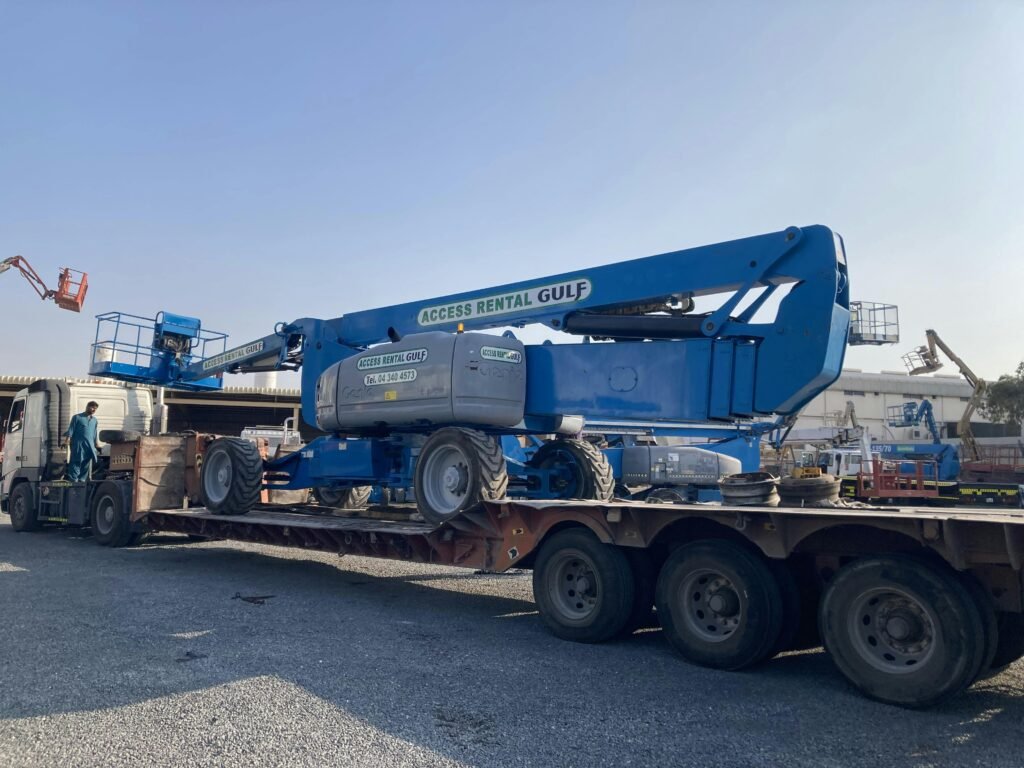
Many construction, maintenance and industrial projects involve working above obstacles or reaching areas that cannot be accessed directly from below. A boom lifts provides an effective solution by allowing workers to reach elevated work locations with a platform mounted on an extendable boom.
Unlike equipment designed exclusively for vertical movement, boom lifts can offer both height and horizontal outreach. This makes them useful for building maintenance, steel work, installation projects, external inspections and other tasks where access conditions can be challenging.
Understanding Different Types of Boom Lifts
Boom lifts are available in different configurations to accommodate varying site requirements. Selecting the correct type depends on the height, outreach, working environment and ground conditions.
An articulating boom lift features multiple boom sections connected by joints. This configuration allows the platform to move around obstacles and reach areas that may be difficult to access with straight-boom equipment. It is particularly useful for maintenance work around structures, pipework and industrial installations.
Telescopic boom lifts, by comparison, use extending boom sections to provide substantial horizontal outreach. They are often considered for projects where workers need to reach distant work areas with fewer obstructions between the machine and the target location.
When Is Boom Lift Rental the Better Option?
For many contractors, boom lift rental provides flexibility without the financial commitment of purchasing machinery. Rental is particularly useful when access requirements vary between projects or when a specific machine is needed for a limited period.
Before hiring, businesses should establish the required platform height, horizontal reach, platform capacity and suitable power source. They should also check whether the working surface can support the machine and whether sufficient space is available for positioning and manoeuvring.
Companies arranging boom lift rental in Dubai should consider site access, transport schedules and the availability of equipment suited to local project conditions. Early planning can help ensure the machine arrives when required and is appropriate for the intended task.
Choosing Between Leading Boom Lift Brands
Equipment brands offer different models, capacities and operating features. A JLG boom lift, for example, may be considered alongside other manufacturers’ machines when evaluating platform reach, controls, drive configuration and suitability for a particular application.
However, the brand name alone should not determine the final choice. Contractors should compare the specifications of individual models and confirm that the equipment meets their operational requirements.
For outdoor construction work, the assessment may include terrain capability, ground clearance and drive performance. Indoor applications may place greater emphasis on compact dimensions, electric power and floor protection.
Safety Considerations Before Operating a Boom Lift
Safe operation begins with selecting the correct machine and ensuring that operators are competent and familiar with its controls. Pre-use inspections should follow the manufacturer’s guidance and identify visible damage, control issues or other defects that could affect safe operation.
The work area should be assessed for overhead obstructions, electrical hazards, ground conditions and potential collision risks. Operators must remain within the platform’s rated capacity and follow applicable fall-protection requirements, site procedures and manufacturer instructions.
For businesses considering articulating boom lift rental, planning should also account for the machine’s movement envelope and the space required to position the platform correctly.
Improving Project Efficiency with the Right Access Equipment
Choosing suitable access machinery can reduce unnecessary repositioning and help teams complete elevated tasks more efficiently. A boom lift is particularly valuable when the work involves reaching across obstacles or accessing multiple points at different heights.
By assessing the application, comparing machine specifications and planning delivery in advance, businesses can select an appropriate access solution for their project. The result is a more organised approach to working at height, with equipment that supports productivity while maintaining suitable safety controls.
Visit Now: https://pencraftednews.com/