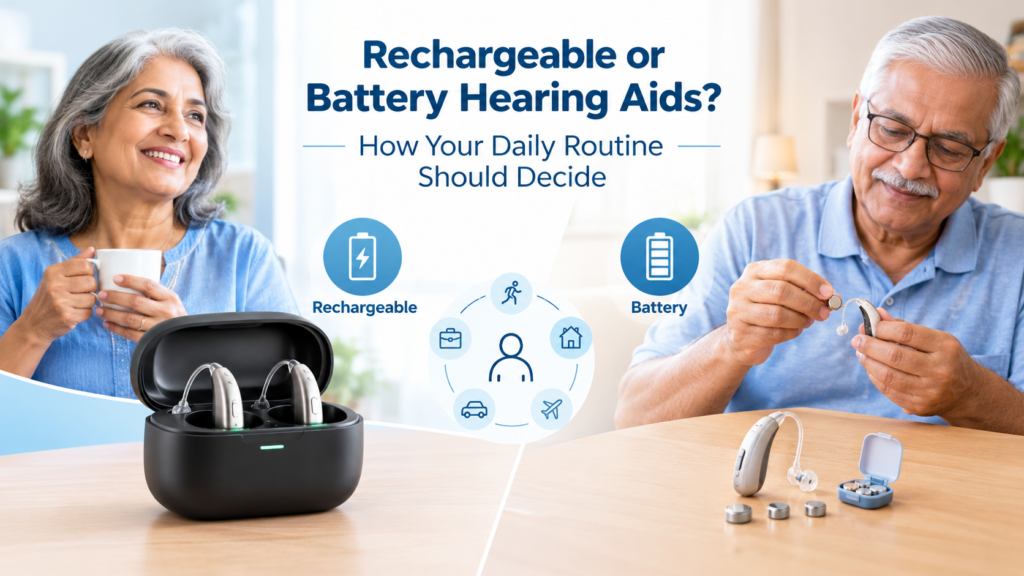
“Should I get rechargeable hearing aids?” is one of the most common questions people ask when shopping, and the honest answer is: it depends on how you live.
Rather than declaring a universal winner, let’s walk through real daily scenarios and see which option fits.
How rechargeable hearing aids work
Rechargeable models have a built-in battery. You place them in a charging case overnight, and in the morning they’re ready for the day. For most users, a full charge covers a full day, though this varies by model and how much audio you stream.
Battery-powered models use small replaceable zinc-air cells. You swap them every several days depending on the device and usage.
The case for rechargeable
You don’t want to handle tiny batteries. If you have arthritis, tremors or reduced finger sensitivity, replacing small batteries can be genuinely difficult. Charging is far simpler: drop the aids in the case and go.
You like a predictable routine. Charge at night, wear all day. There’s no wondering whether the battery will die mid-conversation.
You stream a lot. Phone calls and music use more power. Rechargeable systems are designed with that in mind.
You want to avoid ongoing battery purchases. There’s no need to keep buying and stocking packs of cells.
The case for battery-powered
You travel to places where charging is unreliable. If you trek, camp or spend days without dependable power, spare batteries are a compact, immediate backup.
You want instant replacement. If a battery dies, you can swap it in seconds rather than waiting for a recharge.
You have a preferred style. Some small or custom devices are more commonly available in battery versions, especially in very discreet designs.
You’re comfortable with the routine. Plenty of long-term users simply prefer it, and that’s a perfectly valid reason.
Scenarios: what suits whom?
The frequent flyer. A rechargeable device with a travel charging case is usually convenient. You carry one case instead of packets of batteries. For anyone relying on rechargeable hearing aids, check how many full charges the case can hold and whether it works with your power setup.
The retired grandparent at home. If dexterity is a concern, rechargeable is often kinder. Place in the case, done.
The shift worker or field staff. Think about whether you’ll have a chance to charge. If your day is long and unpredictable, make sure the battery life genuinely covers your hours, or carry a backup plan.
The heavy smartphone user. If you stream calls, videos and music for hours, ask the audiologist about realistic battery performance with streaming.
The person with significant hearing loss. More powerful devices consume more energy. Discuss the options with your audiologist, because power needs may influence which formats are available.
Questions worth asking
- How many hours does a full charge last with my typical usage?
- What happens as the battery ages over the years?
- Is the battery user-replaceable, or does it need servicing?
- Is a portable or travel charger available?
- Can I get a battery-powered version of the same model if I prefer?
Think beyond the battery
Power source is only one part of the decision. Your style, hearing loss, connectivity needs and the quality of the fitting matter at least as much. A rechargeable hearing aid that’s poorly programmed is still a poor hearing aid. This broader view is covered in this guide on matching a hearing aid to your lifestyle, which treats battery type as one factor among several.
Care tips for either type
- Keep devices dry. Moisture is a leading cause of problems.
- Clean regularly following your audiologist’s instructions.
- Store in the case overnight, whether charging or drying.
- Avoid extreme heat, such as a hot car dashboard.
- Book periodic checkups. Servicing extends the life of your devices.
A quick self-test
Answer these:
- Would changing tiny batteries frustrate me? → lean rechargeable.
- Do I often go days without reliable power? → consider battery.
- Do I stream audio heavily? → check rechargeable runtime carefully.
- Do I want the smallest possible custom device? → ask which power options exist for that style.
- Do I like simple routines? → rechargeable usually fits.
The takeaway
Neither option is universally better. Rechargeable suits convenience and simplicity, while battery-powered suits flexibility and backup. Choose according to your habits, your hands, and your travel patterns, and let a professional confirm that the device suits your hearing, not just your charging preferences.