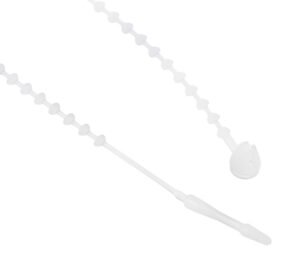
A well-organised wiring harness does more than look professional. It makes equipment easier to assemble, inspect and repair without losing track of individual connections. In compact indoor electrical assemblies, the 479-594 Nylon Cable Tie can help technicians keep selected wires together at planned positions. Its slim, beaded design suits lightweight bundling rather than heavy-duty restraint.
This RS PRO fastening component is white, non-releasable and made from Nylon 66. Used thoughtfully, it supports a repeatable cable-routing process, where each fastening point serves a purpose instead of simply hiding untidy wiring.
Why Harness Planning Comes Before Fastening
The most effective cable management starts with a route, not a cable tie. Before bundling conductors, identify where they originate, which equipment they serve and whether future access will be required.
Group cables only when their electrical, thermal and mechanical requirements allow it. Some circuits need separation to control interference or comply with installation rules. Similarly, moving components require enough slack to travel safely.
For delicate cable groups, Cable Sleeves can provide an additional covering where appropriate. A tie can gather the sleeved bundle at selected points, while the sleeving addresses abrasion and surface protection according to its own specification.
A Useful Rule for Neater Assemblies
Treat every tie location as a small design decision. The aim is to guide a bundle without pulling it against a sharp edge, squeezing insulation or forcing connectors out of alignment.
What Does Part 479-594 Contribute?
The 479-594 is a 143 mm long, 1.8 mm wide RS PRO beaded fastener. Its specified maximum bundle diameter is 35 mm, and its published tensile-strength rating is 49 N.
These measurements explain its intended role. The narrow profile is helpful for compact cable groupings, while the non-releasable head suits installations that are not expected to be reopened frequently.
Unlike adjustable reusable straps, this fastening method is effectively a one-time installation. If a wire must be added or removed, fit a new tie instead of attempting to reuse the old locking mechanism.
Understanding the Beaded Profile
Rather than relying on a conventional flat strap alone, this tie uses a beaded locking arrangement. The manufacturer describes the design as allowing visible evidence of interference and breakaway in an emergency situation.
That feature does not make it a certified tamper-evident seal or a personnel-safety release. Its primary purpose remains lightweight fastening of suitable cables and components.
Create Wiring Routes That Stay Easy to Follow
A tidy harness should make the destination of each conductor understandable. Straight runs, sensible turns and clearly defined branches are often more valuable than the maximum possible number of fastening points.
In larger panels, Cable Trunking provides dedicated routes for properly selected conductors. Small ties may help prepare groups before they enter these channels, but trunking fill limits, heat dissipation and access requirements still govern the design.
Plan for Inspection, Not Just Installation
Allow space around terminals, plugs and serviceable components. A beautifully compressed bundle becomes a problem if an engineer must cut several fasteners to inspect one connection.
Make Identification Part of the Workflow
Production teams benefit from wiring assemblies that look and function consistently from one unit to the next. Mark the purpose of each branch before bundling, then verify that labels remain readable after the ties are fitted.
Appropriate Cable Marking Kits can help installers apply consistent wire identifiers across recurring builds. Clear identification makes it easier to compare a finished assembly with its circuit drawing during inspection or maintenance.
For repeatable work, a simple build checklist can include:
- Confirm branch locations against the wiring diagram.
- Check connector orientation before securing nearby wires.
- Keep bend radii within cable manufacturer limits.
- Avoid trapping insulation beneath a fastener head.
- Inspect each completed bundle for unintended tension.
- Record substitutions when a fastening specification changes.
These checks support quality control without turning a straightforward fastening job into an overly complicated process.
Remember the Cable Entry Point
A harness inside a machine or enclosure behaves differently from a cable entering through its wall. At an entry point, the design may need to resist pulling forces, protect the cable jacket and prevent unwanted contaminants from passing through.
Properly selected Cable Glands are designed for many of these enclosure-entry requirements. The 479-594 tie cannot replace a suitable gland, and it should not be relied upon as the primary mechanical strain relief for a cable passing through an enclosure.
What Should Designers Know About the Material?
Nylon 66 offers flexibility and mechanical strength for appropriate cable-bundling tasks, but its performance depends on temperature, moisture and exposure conditions.
For this part, the published operating range is -40°C to +85°C. The product is also listed as non-UV-resistant, making prolonged direct sunlight an unsuitable default environment.
Where insulation or joint protection is needed, correctly specified Heat Shrink Tubing serves a different purpose from a fastener. Heat-shrink material may protect a cable termination, while a tie controls the position of nearby insulated wiring. Neither function should be confused with the other.
A Better Choice Is Often a More Specific Choice
The 479-594 is not designed for lifting, structural fixing or every outdoor installation. Its 49 N tensile figure describes a rated property of the tie, not a permissible suspended load.
For projects with frequent rewiring, select a reusable fastening solution. For larger bundles or demanding environments, evaluate an appropriately rated alternative rather than assuming that one compact nylon tie suits every task.
Small Fasteners, Better Working Habits
A successful cable harness is planned for its entire working life, from assembly and testing to future access. The 479-594 Nylon Cable Tie fits into that process as a compact, non-releasable fastener for suitable lightweight wiring groups.
When installers coordinate routing, identification, environmental suitability and inspection access, even a small fastening component can contribute to a cleaner and more maintainable electrical assembly.