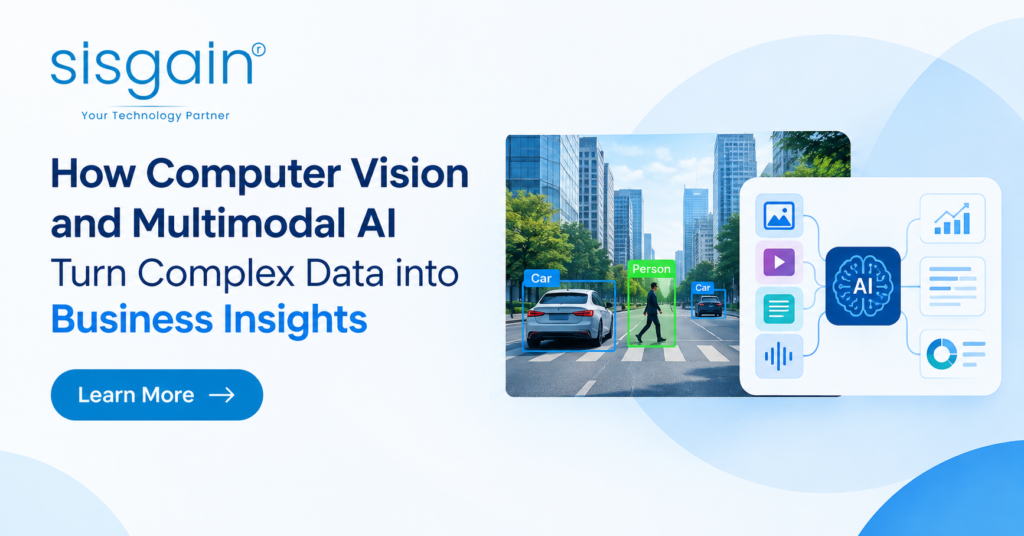
Computer Vision and Multimodal AI turn complex data into business insights by first extracting meaning from images and video, and then connecting those findings with text, audio, documents and structured records. Computer Vision tells a business what is visible. Multimodal AI explains what it means in context and what to do next. This guide explains how the combination works, where it delivers value, how to measure ROI and how to implement it responsibly.
Key Takeaways
- Computer Vision detects events in images and video. Multimodal AI connects those events with documents, records and conversations to explain why they matter.
- The strongest results come from one well-defined use case, clean data, clear KPIs and a focused pilot, not from broad enterprise rollouts.
- Edge processing, vision-language models and agentic workflows are the main 2026 trends, but each needs governance, human approval and audit trails.
- ROI should be calculated against a measured baseline, with all implementation and operating costs included.
- Choose a partner on verifiable project outcomes, security practices and long-term support, not on promises.
What Are Computer Vision and Multimodal AI, and How Do They Work Together?
Computer Vision is the branch of AI that interprets images and video. It recognizes objects, reads text, classifies scenes and spots visual patterns such as a cracked part, an empty shelf or a missing safety helmet.
Multimodal AI processes and connects several data types at once: text, images, audio, video and structured data such as spreadsheets or databases. Instead of analyzing one source in isolation, it combines them to build context.
The difference matters in practice. A vision model can flag a damaged package. A multimodal system can also check the shipment record, the carrier’s handling notes and the customer’s complaint, then explain the likely cause and recommend a next step. In short, detecting an event is not the same as understanding why it matters to the business.
This is the foundation of Multimodal AI for Business Insights: visual recognition supplies the evidence, and contextual reasoning supplies the meaning. Together they support faster, better-informed decisions.
Why Businesses Are Combining Computer Vision and Multimodal AI in 2026
The demand is practical. Most companies already collect large volumes of images, video, scanned documents and sensor data, but these sit in separate systems and are rarely analyzed together. Combining them closes that gap and moves AI from passive detection toward reasoning, real-time response and controlled automation. These themes also appear in recent industry analysis from firms such as Gartner, though adoption varies widely by sector and maturity.
From Basic Image Recognition to Context-Aware AI Intelligence
Vision-language models (VLMs) link visual evidence with natural-language questions. A manager can ask, “Which assembly-line images from last night show surface scratches?” and receive relevant results with a short summary. The model can also match visual events to operational records, such as work orders, batch numbers or maintenance logs.
This context is what makes the output useful for enterprise decisions. A flagged image is a data point. A flagged image tied to a supplier, a shift and a product batch is an insight someone can act on.
Real-Time Video Analytics and Edge AI for Faster Decisions
Production lines, warehouses, retail floors and physical infrastructure generate continuous video. Edge AI processes selected data close to where it is created, which reduces latency and avoids sending every frame to the cloud.
Teams must balance three factors: real-time performance, computing cost and privacy. Local processing can help with speed and data minimization, but edge devices add hardware, maintenance and update requirements that should be planned from the start.
Agentic AI and Automated Workflows Based on Visual Evidence
Agentic systems can identify an event, recommend an action and, within approved limits, trigger a workflow, such as escalating a safety incident or generating an inspection ticket.
Because the system can initiate actions, governance is essential. Define what the AI may do on its own, require human approval for consequential steps, restrict permissions and keep an audit trail of every decision.
How Computer Vision and Multimodal AI Turn Complex Data into Business Insights
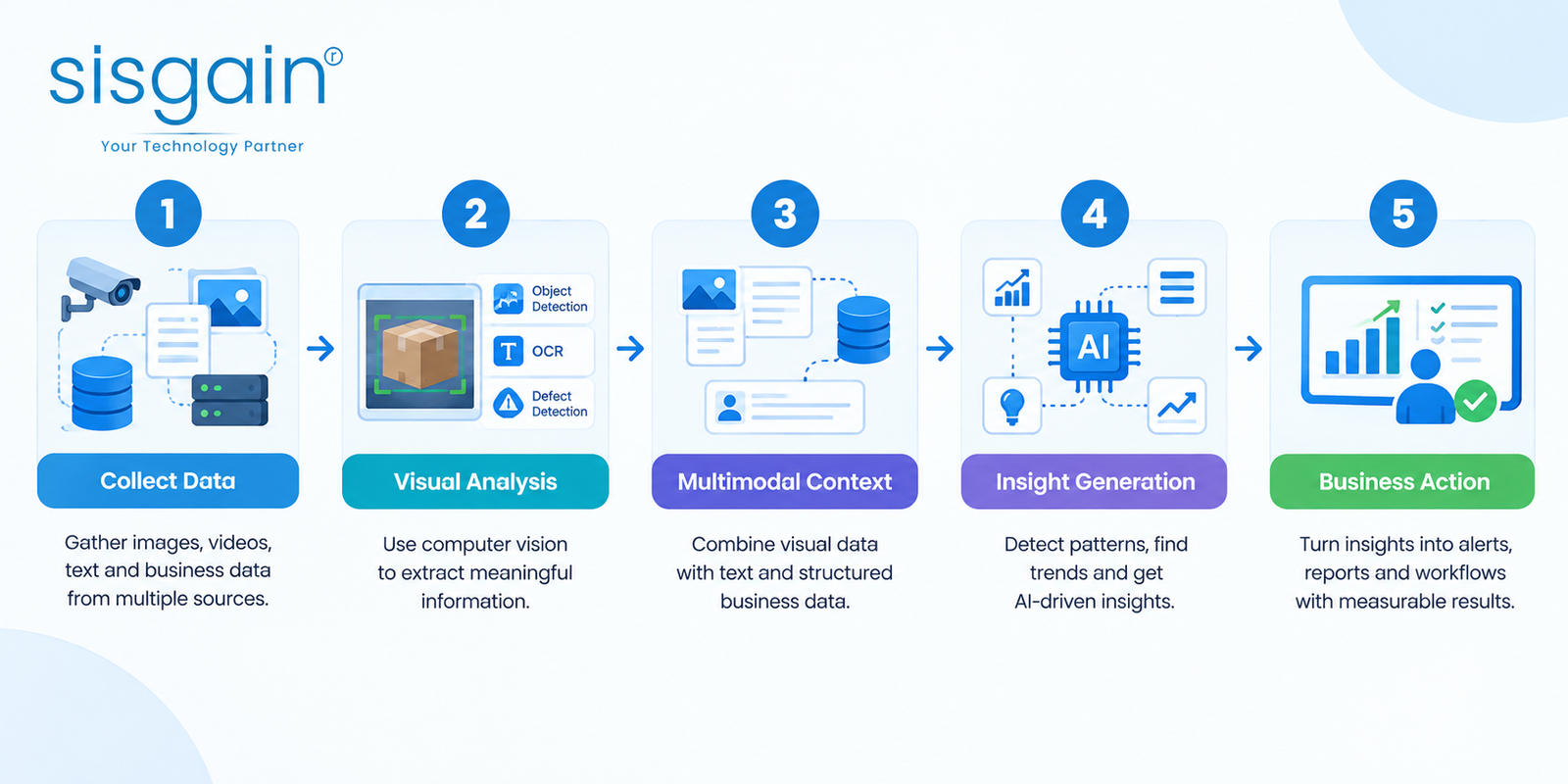
The process follows five connected stages: Data Collection → Visual Analysis → Multimodal Context → Insight Generation → Business Action. This workflow is the engine behind AI-Powered Business Insights.
Step 1: Collect Data from Multiple Business Sources
Start by identifying every relevant source: CCTV and camera footage, product images, scanned documents, customer interactions, sensor readings, CRM systems and enterprise databases. Capture metadata such as timestamps, locations and asset IDs, because it is what later allows different sources to be linked.
Step 2: Extract Meaningful Information from Images and Videos
Computer Vision converts raw pixels into structured information using several established techniques:
- Object detection locates items such as pallets, vehicles or equipment.
- Image classification sorts images into categories, for example acceptable or defective.
- OCR reads text from labels, invoices and forms.
- Visual inspection identifies surface defects, misalignment or damage.
- Scene understanding and event detection recognize situations, such as a blocked exit or a spill.
Step 3: Combine Visual Information with Text and Structured Data
Here the visual findings are correlated with product records, inventory data, business policies, transaction history and operational metrics. A detected defect becomes far more valuable when it is linked to the machine, operator, material lot and inspection history behind it.
Step 4: Use AI Models to Identify Patterns and Generate Insights
Models then perform anomaly detection, contextual reasoning and trend identification. They can write natural-language summaries and offer evidence-based recommendations, citing the images and records they relied on. Grounding every conclusion in visible evidence makes outputs easier to verify.
Step 5: Convert Insights into Measurable Business Actions
Insights only create value when they reach decision-makers. Findings can feed dashboards, alerts, reports and workflow systems, with humans reviewing important decisions. Each action should map to a KPI so results can be measured.
Top Computer Vision Applications in Business Across Industries
The table below summarizes leading Computer Vision Applications in Business. Value depends on data quality, deployment and process fit, so treat it as potential rather than guaranteed.
| Industry | Application | Potential business value |
|---|---|---|
| Manufacturing | Visual quality inspection and defect detection | Lower defect rates and less rework |
| Retail and e-commerce | Shelf monitoring, product recognition and visual search | Better inventory visibility and product discovery |
| Healthcare | Medical image analysis and document-assisted workflows | Clinical decision support and more efficient review |
| Logistics and supply chain | Package inspection, damage detection and shipment monitoring | Fewer handling errors and better traceability |
| Banking and insurance | Document verification, damage assessment and fraud indicators | Faster reviews and improved risk detection |
| Real estate and construction | Site progress monitoring and safety observation | Better project visibility and earlier issue detection |
| Energy and infrastructure | Equipment inspection and anomaly detection | More proactive maintenance and reduced downtime |
Manufacturing: Detect Defects Before Products Reach Customers
Automated inspection cameras classify defects and monitor production lines in real time. When results are integrated with a quality management system, each defect can be traced to a batch, machine or process step, helping teams reduce rework and fix root causes.
Retail: Turn Customer and Store Data into Actionable Insights
Cameras and product recognition can track shelf availability and monitor queues. Combined with sales and inventory data, they show whether an empty shelf is a restocking delay or a demand spike, and what to do about it.
Healthcare: Connect Medical Images with Relevant Context
AI can assist clinicians by organizing medical images alongside records and supporting document workflows. These are decision-support tools, not replacements for clinicians. They require rigorous domain-specific validation, strong privacy controls and clear clinical oversight.
Logistics: Improve Shipment Visibility and Operational Efficiency
Image-based parcel condition checks, package tracking and warehouse activity monitoring help identify handling issues early. Linking damage images to scan events and delivery records supports faster exception management and clearer accountability.
Banking and Insurance: Strengthen Document and Risk Analysis
Document extraction, visual evidence review and damage assessment speed up claims and onboarding. Fraud indicators raised by AI should always be reviewed by trained staff before any decision affects a customer.
Organizations that want tailored visual inspection, recognition and monitoring often explore computer vision solutions built around their own cameras, products and environments rather than generic tools.
How Multimodal AI Solutions Deliver Deeper Business Intelligence
The industry examples above show where visual AI is applied. This section explains what makes Multimodal AI Solutions more valuable than isolated tools.
Connect Images, Videos, Documents and Business Records
Cross-modal retrieval lets users search one format and find related content in another, for example locating the inspection report, supplier contract and product photos linked to a single defect.
Discover Hidden Patterns Across Multiple Data Sources
Image analysis alone may show that defects exist. Combined with operational data, it can reveal that they cluster around a certain shift, material supplier or humidity level. These correlations are hard to see in a single data source. They should be validated before being treated as causes.
Generate Natural-Language Reports and Executive Summaries
AI can summarize detected events, supporting evidence, business implications and suggested follow-up in plain language. Teams exploring context-aware reporting often evaluate custom generative ai development services to produce summaries that match their terminology and report formats.
Improve Enterprise Search and Knowledge Discovery
Multimodal retrieval helps employees find product images, inspection records, technical manuals and operational reports in one query. To keep answers accurate, many organizations work with a rag development company to build retrieval-augmented generation (RAG) systems that ground AI responses in trusted enterprise knowledge.
Support Predictive and Proactive Decision-Making
Historical trends, live observations and business context can support risk forecasting and maintenance planning. Predictions are only as reliable as the underlying data and validation, so they should be tested against real outcomes before being relied on.
The design and integration of these capabilities is typically handled by a multimodal ai company with experience across vision, language and enterprise data.
Computer Vision vs. Multimodal AI vs. Traditional Data Analytics
| Capability | Computer Vision | Multimodal AI | Traditional Data Analytics |
|---|---|---|---|
| Primary input | Images and videos | Multiple data types | Primarily structured data |
| Main purpose | Interpret visual information | Connect information across modalities | Analyze metrics, trends and relationships |
| Example output | Detected defect in a product | Defect explanation linked to product and inspection records | Defect rate by production line |
| Business value | Visual monitoring | Context-rich insights | Quantitative reporting |
| Key limitation | Limited context without other data | Integration and reasoning complexity | May not natively interpret raw visual or audio content |
Which Approach Should Your Business Choose?
- Choose Computer Vision when the main challenge is visual recognition or inspection.
- Choose Multimodal AI when decisions need several types of evidence.
- Choose traditional analytics when the need is reporting on structured business metrics.
- Combine them when a use case needs visual interpretation, contextual reasoning and quantitative reporting.
These approaches complement each other. Modern AI Data Analytics Solutions often feed visual and multimodal outputs into the same dashboards and reporting systems that teams already use.
Read More :- AI in Computer Vision Market: Growth, Trends, Applications, and Future Outlook
How to Measure the ROI of Computer Vision and Multimodal AI
Decision-makers need a business case before investing. Avoid universal ROI promises. Results vary by use case, data and execution.
Identify the Right KPIs Before Deployment
- Inspection accuracy and false-positive rate
- Manual review time per task
- Defect rate and rework cost
- Operational downtime
- Incident detection and response time
- Data processing cost per transaction or asset
- Employee productivity and workflow completion time
Record baseline values for each KPI before launch, otherwise improvement cannot be proven.
Calculate the Total Cost of AI Implementation
Include data preparation, model development, infrastructure, edge devices, cloud computing, integration, security, monitoring and ongoing maintenance. Recurring costs are often underestimated.
Use a Practical ROI Calculation
ROI (%) = (Annual Benefits − Annual Costs) ÷ Annual Costs × 100
Estimate annual benefits from measurable improvements against your baseline, such as hours saved, rework avoided or downtime reduced. Costs should cover both implementation and recurring operating expenses.
Start with a Pilot Before Scaling Across the Enterprise
Test one well-defined use case, validate performance on representative data and expand only when business value and reliability are demonstrated.
How to Implement Computer Vision and Multimodal AI in Your Business
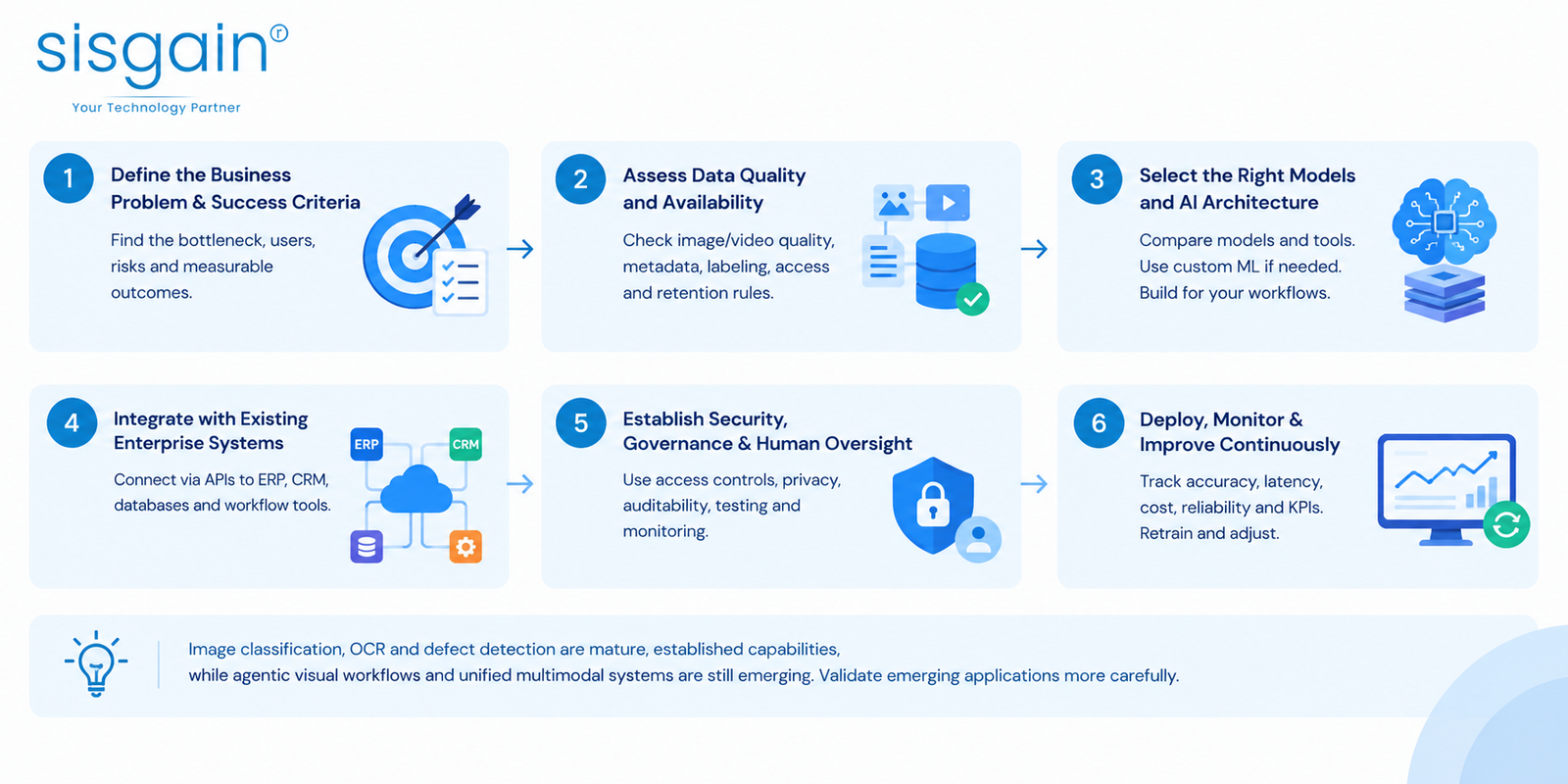
Define the Business Problem and Success Criteria
Identify the operational bottleneck, intended users, business risks and measurable outcomes before choosing any technology.
Assess Data Quality and Availability
Review image resolution, video quality, missing metadata, labeling needs, access permissions and retention rules. Weak data is the most common reason projects underperform.
Select the Right Models and AI Architecture
Compare specialized vision models, vision-language models, multimodal foundation models, retrieval systems and analytics tools against the use case. Where domain-specific accuracy or forecasting is needed, custom machine learning development services can train models on your own data. An architecture shaped around your workflows is the focus of ai development services custom business solutions.
Integrate AI with Existing Enterprise Systems
Connect through APIs to databases, ERP, CRM, business intelligence platforms and workflow tools so insights appear where teams already work.
Establish Security, Governance and Human Oversight
Cover access controls, privacy, auditability, model evaluation, bias testing, human escalation paths and monitoring for performance degradation.
Deploy, Monitor and Improve Continuously
After launch, track accuracy, latency, cost, reliability and business KPIs. Retrain and adjust as conditions change.
Note that image classification, OCR and defect detection are mature, established capabilities, while agentic visual workflows and unified multimodal systems are still emerging. Validate emerging applications more carefully.
Challenges of Using Computer Vision and Multimodal AI and How to Solve Them
Poor Data Quality and Fragmented Data Sources
Clean and standardize data, manage metadata consistently and validate inputs before training or deployment.
High Computing Costs and Real-Time Processing Requirements
Choose models sized to the task, optimize workloads, process selectively at the edge and monitor cost continuously.
Incorrect Predictions and Hallucinated Explanations
Use confidence thresholds, ground explanations in visible evidence, test on representative data and keep human review for consequential decisions.
Data Privacy, Security and Regulatory Compliance
Apply data minimization, encryption, access control and retention policies, and follow industry-specific requirements, especially for video of people and medical data.
Integration Complexity and Limited Internal Expertise
Success depends on sound technical architecture, clear business process ownership and cross-functional collaboration between IT, operations and compliance teams.
How to Choose the Right AI Development Partner for Business Insights
Evaluate Technical Expertise in Computer Vision and Multimodal AI
Look for experience in model selection, data engineering, system integration and production deployment, not just prototypes. A capable Computer Vision AI Solutions provider should explain trade-offs openly.
Check Industry Experience and Verifiable Project Outcomes
Review relevant case studies, documented results, technical references and project scope. Ask what was measured and how.
Assess Scalability, Security and Long-Term Support
Confirm plans for monitoring, model updates, integration maintenance, governance and ongoing optimization.
Build a Customized AI Roadmap Around Business Objectives
The architecture should reflect your problem, data, infrastructure, risk level and success criteria. Once insights are trusted, AI Automation Solutions can convert them into operational workflows such as ticketing, alerts and approvals. For staff who need to interpret reports and business data quickly, ai copilot development services can deliver employee-facing assistants.
What Is the Future of Computer Vision and Multimodal AI in Business?
These developments are already visible in the market. They are evolving opportunities, not guaranteed outcomes for every business.
Vision-Language Models for Contextual Visual Understanding
Businesses will increasingly ask natural-language questions about visual evidence and retrieve relevant findings instantly.
Real-Time Visual Intelligence at the Edge
Low-latency, local processing will expand in industrial settings where speed and data control matter.
Agentic Visual AI and Controlled Workflow Execution
Systems will move from detecting events to proposing or initiating approved actions, under clear permissions and human oversight.
Unified Multimodal Intelligence Across Enterprise Systems
Documents, images, video, operational data and knowledge repositories will be connected into more cohesive decision-support workflows.
Responsible AI as a Competitive Requirement
Explainability, privacy, security, evaluation and accountability are becoming core implementation priorities, and a basis for customer and regulator trust.
Final Thoughts on Computer Vision and Multimodal AI for Business Insights
Computer Vision extracts meaning from visual data, while Multimodal AI connects it with broader business context. Real value depends on data quality, appropriate model selection, integration, security and continuous evaluation.
The best way to begin is to pick one specific operational challenge, set measurable KPIs and validate results through a focused pilot before scaling.
Frequently Asked Questions About Computer Vision and Multimodal AI
What is multimodal AI for business insights?
It is the use of AI to analyze different types of business data together, such as images, video, text, audio and structured records. By connecting these sources, it produces contextual findings and recommendations that a single data source or isolated tool cannot provide.
How do Computer Vision and Multimodal AI work together?
Computer Vision recognizes objects, text and events in images or video. Multimodal AI then combines those findings with documents, audio or structured data to add context. Together they explain what happened, why it matters and what action may be appropriate.
What are the most valuable Computer Vision applications in business?
Common high-value uses include quality inspection, inventory and shelf monitoring, document processing, asset and equipment inspection, and safety monitoring. The best choice depends on where visual checks are slow, costly or error-prone in your operations.
How can Multimodal AI improve business decision-making?
It improves decisions through contextual analysis, retrieval across different sources and evidence-based reporting. Leaders can see the images, records and reasoning behind a recommendation, which makes it easier to verify and act on than an isolated alert.
How much does it cost to implement Computer Vision and Multimodal AI?
Costs vary with data readiness, model complexity, infrastructure, integrations, security needs and ongoing operations. A fixed price cannot be quoted without scope. A focused pilot is the most reliable way to estimate full costs and expected value.
How long does it take to implement a multimodal AI solution?
Timelines depend on scope, data availability, integration complexity and validation requirements. A narrow pilot is usually faster than an enterprise rollout, but no universal estimate is reliable. Define the use case and data first to get a realistic plan.
Is Multimodal AI secure for enterprise data?
It can be, when properly designed. Key measures include access controls, encryption, data governance, retention policies, a suitable deployment architecture and careful vendor evaluation. Security should be reviewed before deployment and monitored continuously afterward.
Can Computer Vision and Multimodal AI integrate with existing business systems?
Yes. Integration typically uses APIs, connectors, databases and workflow tools to link AI outputs with ERP, CRM, BI platforms and other enterprise systems. Planning data flows and ownership early reduces integration risk.