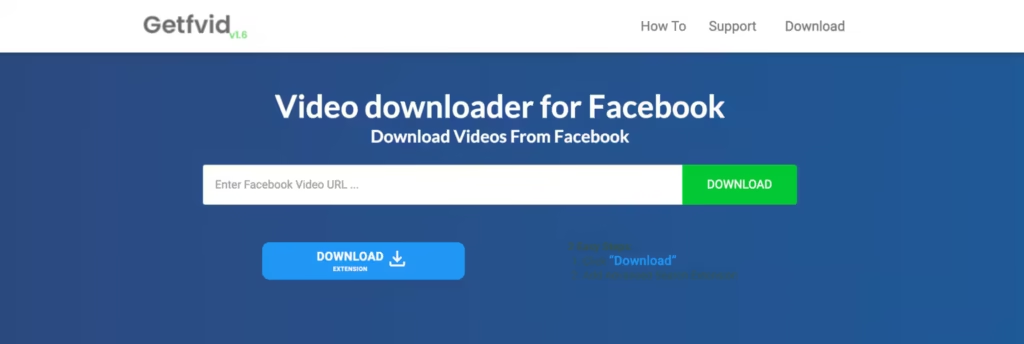
Facebook has become a major platform for sharing videos, with users posting everything from educational content and product demonstrations to entertainment, news, tutorials, travel clips, and personal moments. With so much video content available, users may sometimes want to save a video for offline viewing, personal reference, or content organization.
A online facebook video downloader can provide a convenient way to save eligible online videos by using the video’s link. Instead of repeatedly searching through a social media feed, users can keep permitted content on their device and access it when needed.
However, downloading a video does not automatically give a person permission to repost or commercially use it. Users should respect copyright, privacy, and the rights of the original creator when saving or reusing Facebook content.
Why People Save Facebook Videos
There are many reasons users may want to save Facebook videos. Someone might find an educational tutorial that they want to watch again later. Another user may want to keep a recipe, workout guide, product demonstration, or travel video for personal reference.
Content creators can also save their own published videos as part of a backup or content-management system. Having copies of original social media posts can be useful when organizing previous projects or preparing future campaigns.
Businesses may also maintain archives of their own promotional videos, product demonstrations, customer education content, and announcements. Keeping these files organized can make it easier to review previously published material.
The purpose of saving a video should therefore be considered before downloading it. Personal reference and backup are different from reposting someone else’s content or using it in commercial advertising.
How a Facebook Video Downloader Works
Online video downloaders generally use a simple link-based process. A user copies the URL of an eligible Facebook video and enters it into the downloader’s input field.
The general process usually involves these steps:
- Open Facebook and locate the video.
- Use the available sharing option to copy the video link.
- Open the downloader in a web browser.
- Paste the copied URL into the provided field.
- Let the tool process the link.
- Select an available quality or format.
- Save the resulting file to the device.
A browser-based approach can be convenient because users do not necessarily need to install additional software. It can also allow people to access the tool from different devices depending on the service’s compatibility.
Choosing the Right Video Quality
Video quality is an important consideration when saving Facebook content. A lower-resolution file may use less storage space and can be sufficient for viewing on a smartphone. Higher-resolution files may be preferable when users want to watch the content on a larger display.
The available quality usually depends on the original video and the source provided by the platform. A downloader cannot create details that were not present in the original video.
Users should therefore select a quality level based on how they plan to use the saved file. For simple offline viewing, moderate quality may be enough. For personal archiving or editing of content that the user owns or has permission to edit, a higher-quality version may be more appropriate.
Saving Videos for Offline Viewing
Internet connectivity is not always available or reliable. People may travel to areas with limited service, experience slow connections, or simply want to reduce the need to stream the same video repeatedly.
Saving permitted videos for offline viewing can make access more convenient. Once the file is stored on a device, users can open it later without searching for the original post.
This can be especially useful for educational material, tutorials, recipes, presentations, and other reference content. Users should still make sure that they have the appropriate rights to download and store the content.
Benefits for Content Creators
Facebook creators often invest significant time in producing videos. Keeping an organized backup of published content can help protect their digital media library.
Creators may save their own Facebook videos for several reasons. They might want to reuse footage in future projects, review older content, maintain records of previous campaigns, or prepare videos for distribution across other platforms.
However, downloaded social media copies should not replace original project files. Original footage generally provides greater flexibility because it may contain higher resolution, separate audio tracks, editable graphics, and other production elements.
A downloaded copy can therefore serve as an additional backup rather than the primary source file.
How Businesses Can Use Saved Video Content
Businesses increasingly use Facebook videos for marketing, education, customer communication, and product promotion. A company might publish a product demonstration, behind-the-scenes video, promotional campaign, or instructional clip.
Saving copies of a business’s own videos can help create an organized content archive. Marketing teams can use these files to review previous campaigns and understand which topics or formats were used.
Businesses should be particularly careful when dealing with third-party content. A video being publicly visible does not mean that it is automatically available for commercial reuse.
If a company wants to use another person’s Facebook video in advertising, on a website, or in promotional material, it should obtain the necessary permission or use content with an appropriate license.
Browser-Based Access Across Devices
Modern users access Facebook from smartphones, tablets, laptops, and desktop computers. A browser-based downloader can be useful because users can work from different types of devices without depending on a single operating system.
Someone might discover a useful video while browsing Facebook on a smartphone and later want to organize the saved file on a computer. Cross-device access can make this type of workflow more convenient.
Before downloading, users should also check their available storage space. High-quality video files can take up more storage than standard-resolution versions, especially when multiple videos are saved.
Organizing Downloaded Facebook Videos
Saving many videos can quickly create a disorganized downloads folder. A simple filing system can make saved content much easier to find later.
Users can create folders based on topics such as education, business, recipes, entertainment, travel, or personal projects. Creators and businesses can organize files by campaign, date, product, or project.
Clear file names can also make a difference. Instead of keeping automatically generated names, users can rename files according to their content and purpose.
Regularly removing duplicate or unnecessary videos can help conserve storage space and keep the archive manageable.
Privacy and Online Safety
Privacy is another consideration when using online downloading services. Users should avoid entering unnecessary personal information and should be careful when interacting with unfamiliar websites.
It is also important to avoid suspicious download buttons, unexpected pop-ups, or files that appear unrelated to the requested video. Keeping a browser and operating system updated can provide an additional layer of general security.
Users should also remember that downloading a file from the internet does not guarantee that the file is safe. Responsible browsing habits remain important regardless of the type of online tool being used.
Respecting Copyright and Creator Rights
Facebook contains a large amount of user-generated content, and much of that material may be protected by copyright. A person may be able to view a video publicly while still lacking permission to reproduce or distribute it elsewhere.
Before downloading and reusing content, users should consider who created the video and whether they have permission to save, modify, publish, or commercially use it.
For personal reference, users should still follow the applicable platform rules and creator rights. For commercial projects, obtaining explicit permission or using appropriately licensed material is especially important.
Respecting content ownership helps protect creators and reduces the possibility of copyright disputes.
Common Reasons a Download May Not Work
Not every Facebook video will necessarily be available for downloading. A link may fail because the video has been removed, the post has privacy restrictions, the URL is incorrect, or the source is temporarily unavailable.
Users can start by checking that the copied link is complete and that the video is still accessible through Facebook. They can also try copying the URL again or checking their internet connection.
If a video is restricted or unavailable, users should not attempt to bypass privacy controls. Instead, they should look for content that is publicly accessible and permitted for the intended use.
Saving Videos Responsibly
A video downloader can be a useful tool when used for appropriate purposes. Saving your own content, permitted educational resources, or videos for which you have the necessary rights can make digital media easier to organize and access.
The important distinction is between downloading and using content. Having a file stored on a device does not automatically grant permission to upload it to another platform, edit it for commercial use, or distribute it to others.
Users should always consider the creator’s rights and the intended purpose before sharing saved material.
Final Thoughts
Facebook contains a wide variety of video content, and users may have legitimate reasons to save certain videos for offline viewing, personal reference, backup, or organization. A video downloader can simplify the process by allowing users to work from a video link through a browser-based workflow.
The best approach is to combine convenience with responsible use. Users should select suitable video quality, organize saved files carefully, maintain good online safety practices, and most importantly, respect copyright, privacy, and creator rights.
When used for content that users own or are permitted to save, video downloading can be a practical way to manage digital media and keep useful content available when an internet connection is not convenient.