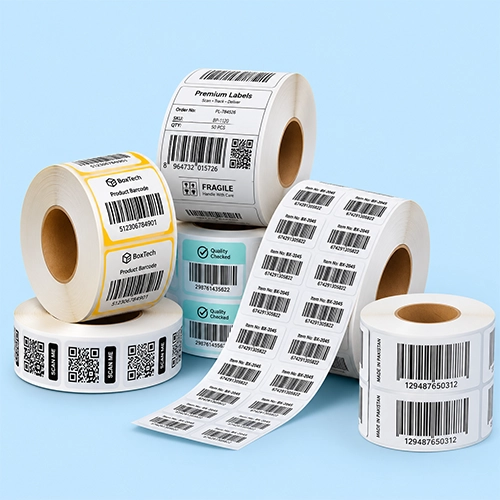
Businesses handle thousands of products, packages, and inventory records every day. Keeping track of these items manually can take time and may increase the possibility of identification or inventory errors. Barcode labeling provides a practical way for businesses to organize product information, improve tracking, and make everyday operations more efficient.
From retail stores and warehouses to logistics companies, healthcare organizations, food businesses, and apparel brands, barcode systems can support different stages of product management. Properly designed labels can make products easier to identify while helping businesses maintain more organized inventory processes.
Why Barcode Labels Are Important
A barcode is a visual representation of information that can be read using a compatible scanner. Instead of entering product information manually, employees can scan the label and retrieve the associated data through their inventory or business management system. Custom printed barcode labels can be designed to match different product sizes and business requirements while keeping essential identification information clear and easy to scan.
This can be useful when businesses handle large numbers of products. Scanning can help reduce repetitive manual data entry and make tasks such as receiving, stocking, picking, and checkout more organized.
For retail businesses, barcodes can connect products with pricing and inventory information. In warehouses, they can help employees identify products and track their movement through different stages of storage and fulfillment.
Supporting Better Inventory Management
Inventory management requires businesses to know what products they have, where those products are located, and when stock needs to be replenished. Barcode systems can support these processes by giving products a consistent identification method.
When an item is received, stored, moved, or sold, its barcode can be scanned and recorded in the relevant system. This creates a more structured way to monitor inventory activity.
For businesses with many product variations, such as different sizes, colors, or models, individual barcode identification can make product organization easier.
Barcode Labels for Retail Businesses
Retail stores depend on accurate product identification for pricing, inventory control, and checkout. A barcode label can connect a physical product with information stored in the retailer’s system.
During checkout, scanning the barcode can retrieve product information quickly. Employees can also scan products during stock counts or when new shipments arrive.
Custom labels allow retailers to create barcode formats and sizes that fit their products and packaging. The label can include additional information where appropriate, depending on the business’s requirements.
Barcode Labels for Warehouses and Logistics
Warehouses and logistics companies handle products as they move between suppliers, storage locations, distribution centers, and customers. Accurate identification becomes increasingly important as the number of shipments grows.
Barcode labels can help employees identify packages and products at different stages of handling. Shipping-related barcodes can also support tracking and processing through logistics systems.
For busy warehouses, labels need to remain readable throughout normal handling. Choosing suitable materials and adhesives can help maintain barcode visibility when products are exposed to moisture, temperature changes, friction, or frequent handling.
Choosing Between 1D and 2D Barcodes
Businesses can choose from different barcode formats depending on the type and amount of information they need to encode.
1D Barcode Labels
One-dimensional barcodes use lines and spaces to represent information. They are commonly used for product identification, pricing, inventory, and shipping applications.
Their straightforward structure makes them suitable for many everyday scanning requirements where only a limited amount of information needs to be stored.
2D Barcode Labels
Two-dimensional barcodes can store more information than traditional linear formats. Depending on the barcode type and system, they can be used for information such as URLs, product details, and other data.
QR codes are a familiar example of 2D barcodes and can be scanned using many smartphones. This makes them useful for applications that connect physical products with digital information.
Understanding UPC and EAN Barcodes
UPC and EAN are commonly used for product identification in retail environments.
UPC, or Universal Product Code, is widely associated with retail product identification and checkout systems. EAN, or European Article Number, is used internationally to identify products across retail and distribution environments.
The appropriate barcode format depends on the business, product, market, and system requirements. Businesses should make sure that the selected barcode meets the requirements of their inventory or retail system before printing large quantities.
Selecting the Right Label Material
Barcode labels may be exposed to different environmental conditions, so material selection is important.
Paper labels can be a practical choice for everyday indoor applications such as price tags, shelf labels, and general product identification.
BOPP labels can provide additional resistance to water and oil, making them useful for certain food and cosmetic applications. Polyester labels can provide durability and strong adhesion on various smooth or textured surfaces.
Vinyl can also be considered for applications where flexibility and durability are important. The best material depends on the product surface, storage environment, expected handling, and required lifespan of the label.
Choosing the Appropriate Adhesive
The adhesive is another important part of a barcode label. A label that does not remain securely attached can create problems with identification and scanning.
Permanent adhesives are suitable when the label needs to remain attached to a product for its useful life. Removable adhesives may be more appropriate for temporary labels, promotions, reusable products, or applications where the label needs to be removed later.
Businesses operating in refrigerated or frozen environments may need freezer-grade adhesive. Products exposed to moisture or chemicals may require specialized adhesive properties.
Roll and Sheet Barcode Labels
Businesses can also choose between roll and sheet formats depending on how labels will be applied.
Roll labels can work well with automatic or semi-automatic labeling equipment. They can be particularly useful for businesses applying large quantities of labels as part of a regular production or packaging process.
Sheet labels can be convenient for businesses that apply labels manually or require smaller quantities. The choice should depend on the business’s application method, equipment, volume, and workflow.
The Importance of Clear Barcode Printing
A barcode needs to be printed clearly enough for scanners to read it consistently. Poor print quality, fading, smudging, or damage can make scanning difficult and slow down operations.
Businesses should therefore consider print quality when selecting a barcode label supplier. Consistent production is especially important for companies ordering large quantities of labels because every batch needs to maintain reliable readability.
For applications involving frequent handling, thermal transfer printing may also be considered when long-lasting label performance is required.
Barcode Labels for Apparel Businesses
Clothing companies often manage products by style, size, color, and quantity. Barcode labels can help connect these product variations with inventory records.
For example, a clothing business may assign different identifiers to different sizes or colors of the same garment. Scanning the label can then help employees identify the specific product variation.
Barcode clothing labels can therefore support more organized stock management while reducing the need for manual product identification.
Barcode Labels for Food and Cosmetic Products
Food and cosmetic businesses may require labels that can withstand particular storage or handling conditions. Depending on the product and environment, businesses can consider materials that offer greater resistance to moisture, oils, or other conditions.
Barcode information can help connect products with inventory records and other business data. The label design should also leave enough clear space around the barcode so that it can be scanned properly.
Businesses should always ensure that their label materials and adhesive choices are suitable for their specific application and regulatory requirements.
Custom Sizes and Shapes
Not every product has the same surface area or packaging structure. A large standard label may not be suitable for a small product, while a very small label may not provide enough space for the required information.
Custom sizing allows businesses to create labels according to the available surface area. Different shapes can also be considered when the label needs to fit a particular package or product design.
The barcode itself should still follow the technical requirements of the intended scanning system regardless of the overall label shape.
Making Barcode Labels Part of a Larger Business System
Barcode labels are most useful when they work together with an appropriate inventory, point-of-sale, warehouse, or tracking system. The label provides the physical identification, while the software or database stores and manages the associated information. For businesses that use different types of product packaging, including custom flexible pouches, barcode labeling can provide a convenient way to connect physical products with digital inventory records.
Businesses should therefore consider the complete workflow before creating their labels. They need to determine what information the barcode should represent, which scanners will be used, where labels will be applied, and how long the labels need to remain readable.
This planning can help businesses select suitable barcode formats, materials, adhesives, sizes, and printing methods according to their products and packaging requirements.
Final Thoughts
Barcode labeling can make product identification and inventory management more organized for businesses across many industries. From retail stores and warehouses to logistics, healthcare, food, cosmetics, and apparel, different barcode formats and label materials can be selected according to specific operational needs.
The right combination of barcode format, label material, adhesive, printing quality, size, and application method can support reliable scanning and everyday product tracking.
For businesses looking to improve product identification and maintain more organized inventory processes, custom barcode labels offer a flexible solution that can be adapted to different products, industries, and business workflows.