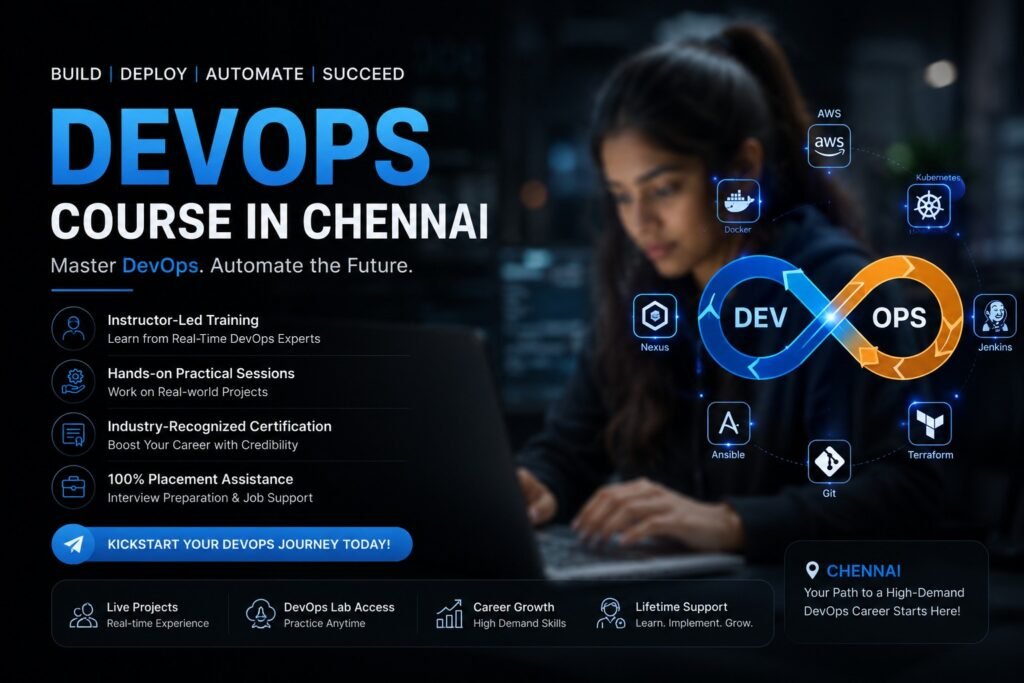
Choosing an IT career sounds exciting until you start looking at job descriptions. Suddenly, there are Linux commands, Git, Docker, Kubernetes, Jenkins, AWS, Terraform and a bunch of other terms staring back at you. A DevOps Course in Chennai can help make that learning process less confusing by bringing these tools together through structured training and practical exercises. And honestly, that practical part matters. Knowing what Docker is and actually using Docker are two very different things.
Why DevOps Skills Matter in Today’s IT Jobs
Software development has changed quite a bit. Companies want applications to be developed, tested and deployed faster, but they also need those applications to remain stable.
That is where DevOps comes in.
DevOps combines development and operations practices to improve collaboration, automation and software delivery. Instead of developers throwing code over the wall to an operations team, both sides work more closely throughout the development and deployment cycle.
For someone starting an IT career, this creates an interesting opportunity.
A good DevOps learning path can introduce you to:
- Linux and shell commands
- Git and GitHub
- CI/CD pipelines
- Jenkins
- Docker
- Kubernetes
- Cloud platforms
- Infrastructure as Code
- Terraform
- Monitoring and logging
- Basic scripting
- Automation practices
You don’t necessarily need to master everything on day one. That would be exhausting, honestly. The goal is to build the skills gradually and understand how the different pieces connect.
What You Can Learn in a DevOps Course in Chennai
A structured DevOps Course in Chennai generally covers the tools and concepts used across the software delivery lifecycle. The exact syllabus varies by training provider, so students should check the curriculum before enrolling.
1. Linux Fundamentals
Linux is a common starting point for DevOps training.
You may learn how to navigate directories, manage files, work with permissions, monitor processes and use basic shell commands. These might seem simple at first, but they become useful when you’re working with servers and cloud environments.
For example, instead of relying entirely on a graphical interface, you may eventually be comfortable connecting to a remote server and checking what is happening from the command line.
Small skill. Big difference.
2. Git and Version Control
Imagine three developers changing the same application at the same time. Without version control, things can get messy very quickly.
Git helps teams track code changes, create branches, merge updates and maintain a history of development work.
A job-ready learner should not just know the definition of Git. They should have some experience creating repositories, committing changes, branching and handling basic merge conflicts.
Learning CI/CD Through Practical Projects
CI/CD is one of the major areas covered in DevOps training.
Continuous Integration allows developers to integrate code changes frequently, while Continuous Delivery or Deployment helps automate the process of getting those changes through testing and into an environment where they can be released.
Tools such as Jenkins are often used for building pipelines.
A simple project could look like this:
Developer pushes code → Git repository → Jenkins pipeline → Testing → Docker build → Deployment
Once you see this working, DevOps starts feeling less like a collection of random tools and more like one connected process.
That is exactly the kind of understanding beginners should aim for.
Docker and Kubernetes: Skills Worth Practising
Containers have become an important part of modern application deployment.
Docker allows applications and their dependencies to be packaged into containers, making them easier to move between environments.
Then there is Kubernetes.
At first, Kubernetes can feel like a lot. Pods, deployments, services, namespaces… the terminology alone can be intimidating. But hands-on practice makes it easier to understand.
A useful training project might involve creating a Docker image, running a container locally and then deploying the application to a Kubernetes cluster.
You make mistakes. The container fails. You check the logs. Fix something. Run it again.
That process teaches more than simply reading definitions.
Cloud and Infrastructure Skills
Modern DevOps roles often involve cloud platforms such as AWS, Microsoft Azure or Google Cloud.
A learner may explore services related to virtual machines, storage, networking, identity and application deployment.
This is also where Infrastructure as Code becomes useful.
With tools such as Terraform, infrastructure configurations can be written as code instead of being created manually every time.
For beginners, this can take some getting used to. But once you understand the idea, it becomes easier to see why automation is such a big part of DevOps.
Why Hands-On Projects Matter for Job Readiness
Finishing a course and being job-ready are not automatically the same thing.
This is probably one of the most important points for beginners.
Suppose someone asks you in an interview:
“Have you worked with Jenkins?”
Saying yes is one thing. Explaining how you created a pipeline, what happened when a build failed and how you fixed it is much stronger.
That is why projects should be part of your learning process.
You could build projects around:
- Automated application deployment
- Dockerized web applications
- Jenkins CI/CD pipelines
- Kubernetes deployments
- AWS infrastructure using Terraform
- Git-based development workflows
- Monitoring and log management
Keep screenshots, configuration files and notes from your projects. They can become useful when preparing for interviews.
Chennai Is Not the Only Option for DevOps Training
Students sometimes compare training options across different technology hubs before choosing a course.
For example, people also search for a DevOps Course in Hyderabad because Hyderabad has a large IT and technology ecosystem. Bangalore is another major destination, and searches for a DevOps Course in Bangalore are common among people looking to enter cloud and DevOps careers.
The city matters to some extent, but the training itself matters more.
Look at the syllabus, practical sessions, trainer experience, project work, lab access and whether the course covers current DevOps tools. Don’t choose purely because a course promises a certificate or uses words like “100% job guarantee.”
Those promises can sound attractive. Read the details.
How to Choose the Right DevOps Training
Before joining any DevOps training program, ask a few straightforward questions.
Does the Course Include Live Projects?
Projects help you understand how different tools work together.
Are Cloud Platforms Included?
Cloud knowledge can complement your DevOps skills, particularly when learning deployment and infrastructure concepts.
Will You Get Hands-On Lab Access?
Watching someone perform a deployment isn’t quite the same as doing it yourself.
Does the Curriculum Cover CI/CD and Containers?
Git, Jenkins, Docker and Kubernetes are useful areas to understand when building a modern DevOps skill set.
Is Interview Preparation Included?
Technical knowledge is important, but explaining your projects clearly during an interview is another skill altogether.
A Simple Learning Roadmap for Beginners
If you’re starting from scratch, don’t try to learn everything in one week.
A practical sequence could be:
Linux → Git → Networking basics → Jenkins/CI/CD → Docker → Kubernetes → Cloud → Terraform → Monitoring → Projects
Spend time practising each stage before moving forward.
Even 60 to 90 minutes of regular hands-on practice can be more useful than spending hours watching tutorials without touching the tools yourself.
And yes, there will be errors. Lots of them.
A broken pipeline or failed deployment isn’t necessarily wasted time. If you understand why it failed and fix it, you’ve learned something useful.
Frequently Asked Questions
1. Is a DevOps Course in Chennai suitable for beginners?
Yes. Beginners can start with fundamental topics such as Linux, Git and networking before moving into CI/CD, Docker, Kubernetes and cloud technologies. A structured course can make the learning path easier to follow.
2. What tools should I learn for a DevOps career?
Common tools and technologies include Git, Jenkins, Docker, Kubernetes, Terraform and cloud platforms such as AWS, Azure or Google Cloud. The exact requirements vary between companies and job roles.
3. Can I learn DevOps without programming experience?
Yes, although basic scripting and programming concepts can be helpful. DevOps professionals often work with shell scripting, YAML and automation tools, so learning basic scripting alongside DevOps is a sensible approach.
4. Is certification enough to get a DevOps job?
A certification can demonstrate that you studied a particular technology, but it does not replace practical experience. Projects, troubleshooting ability and an understanding of real deployment workflows are also important.
5. Should I choose Chennai, Hyderabad or Bangalore for DevOps training?
The city is only one factor. Compare the course syllabus, practical training, projects, cloud labs, trainer experience and learning support before making your decision. DevOps Course in Chennai, DevOps Course in Hyderabad and DevOps Course in Bangalore can all be searched as training options, but the actual course content should be checked carefully.