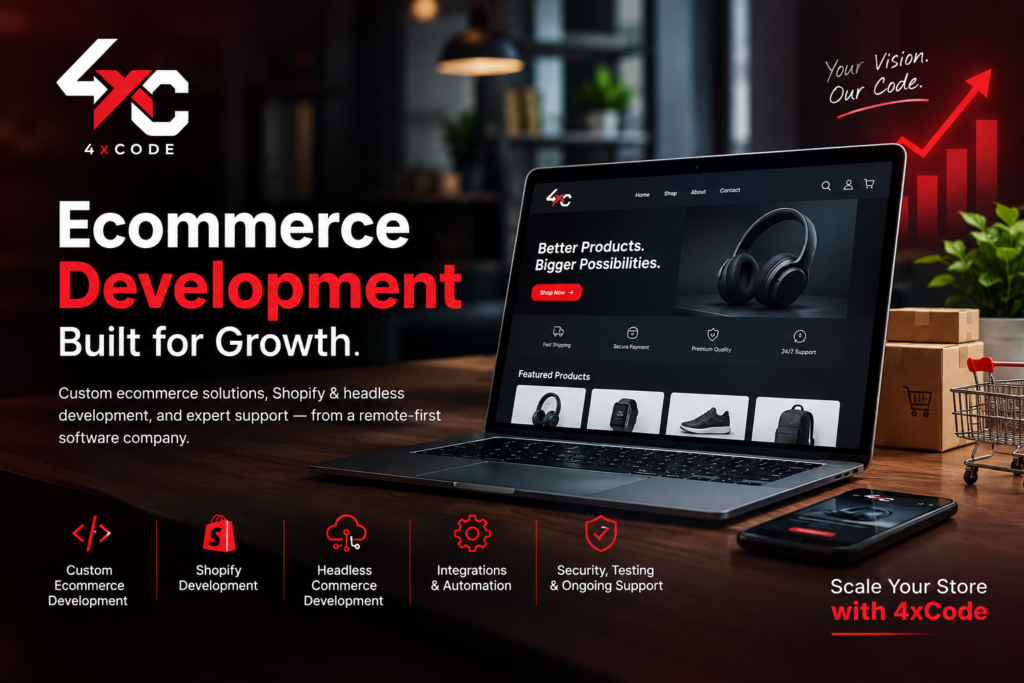
Online shoppers expect fast, secure, and beautiful stores, and they leave quickly when a site disappoints. Building that experience takes more than a template. It takes engineers who understand performance, design, and business growth. That is where 4xCode comes in. As a remote-first software company, 4xCode brings together developers, designers, and strategists from around the world to build ecommerce experiences that convert.
In this guest post, we will look at how 4xCode ecommerce development works, what makes a reliable ecommerce development company, and why growing brands choose an ecommerce solutions provider that offers both custom ecommerce platform development and Shopify and headless commerce development.
What Is a Remote-First Software Company?
A remote-first software company designs its entire workflow around distributed teams rather than a central office. Communication is documented, projects are tracked transparently, and talent is hired for skill instead of location. For clients, this means access to a wider pool of experts, flexible time zones, and faster delivery.
4xCode operates this way by choice. Being a remote-first software company allows it to assemble the right specialists for each project, whether that means a Shopify expert, a front-end engineer focused on performance, or a backend architect who handles integrations.
The practical benefits for ecommerce clients include:
- Access to global talent: You are not limited to developers in one city.
- Extended working hours: Distributed teams can keep progress moving across time zones.
- Clear documentation: Remote work demands written specs, tickets, and status updates, so nothing gets lost.
- Fair pricing: Lower overhead means more of your budget goes into the product itself.
- Focus on outcomes: Delivery is measured by results, not hours spent in an office.
Why Ecommerce Businesses Need a Dedicated Development Partner
Ecommerce is competitive. A slow checkout, a confusing menu, or a poorly integrated inventory system can cost sales every single day. Many brands start with a simple store and quickly outgrow it. A professional ecommerce development company helps you plan for that growth from the start.
When you choose an experienced ecommerce solutions provider, you get more than code. You get architecture decisions, security practices, performance tuning, and long-term support that keep your store reliable as traffic and product catalogs grow.
4xCode Ecommerce Development: What You Can Expect
4xCode ecommerce development covers the full lifecycle of an online store, from the first strategy call to post-launch support. Here are the core services.
Discovery and Strategy
Every project begins with questions. Who are your customers? What products do you sell? Which systems must connect to your store? 4xCode reviews your goals, competitors, and technical needs, then recommends a platform and roadmap that fit your budget and timeline.
UX and UI Design
A store must be easy to use before it can be easy to sell from. Designers create clean layouts, intuitive navigation, and mobile-first product pages that guide shoppers toward checkout without friction.
Custom Ecommerce Platform Development
When off-the-shelf tools cannot support your business rules, custom ecommerce platform development is the answer. 4xCode builds tailored platforms for complex catalogs, multi-vendor marketplaces, subscription models, and B2B workflows with unique pricing logic.
Shopify and Headless Commerce Development
For brands that want speed to market or a fully flexible front end, 4xCode offers Shopify and headless commerce development. That includes custom themes, app integrations, storefront performance work, and headless builds that separate the shopping experience from the commerce engine.
Integrations and Automation
Modern stores rely on payment gateways, shipping providers, ERP systems, CRMs, email platforms, and analytics tools. 4xCode connects these systems so data flows automatically and your team spends less time on manual work.
Security, Testing, and Support
Before launch, every store goes through quality assurance, performance testing, and security checks. After launch, ongoing maintenance and improvements keep the store healthy and competitive.
Custom Ecommerce Platform Development: When Does It Make Sense?
Not every store needs a fully custom build, but some do. Custom ecommerce platform development is worth considering when:
- Your pricing, discount, or fulfillment rules are too complex for standard tools
- You run a marketplace with multiple vendors and commission structures
- You need deep integration with internal systems such as ERP or warehouse software
- You want a unique shopping experience that sets your brand apart
- You expect rapid scaling and need full control over performance and architecture
A trustworthy ecommerce development company will tell you honestly when a platform is enough and when custom ecommerce platform development is worth the investment. 4xCode ecommerce development follows this honest approach: recommend what fits the business, not what costs the most.
Shopify and Headless Commerce Development: Speed Meets Flexibility
Shopify is popular because it is reliable, secure, and quick to launch. For many brands, a well-built Shopify store is the perfect answer. Shopify and headless commerce development goes a step further by letting you pair the platform’s commerce features with a custom front end built in modern frameworks.
Here is a simple way to compare the two approaches:
- Standard Shopify build: Faster launch, lower cost, and easy management for most teams.
- Headless build: Greater design freedom, potentially faster storefronts, and the ability to serve websites, apps, and other channels from one backend. The trade-off is more complexity and a larger initial investment.
As an ecommerce solutions provider, 4xCode helps you decide which path suits your goals instead of pushing a single option. Sometimes the smartest move is starting on Shopify and moving toward headless as the business grows.
The 4xCode Remote-First Workflow
Great remote delivery depends on process. This is how a typical project runs:
- Kickoff: Align on goals, scope, stakeholders, and success metrics.
- Planning: Break the project into milestones and sprints with clear deliverables.
- Design: Create wireframes and visual designs for review and approval.
- Development: Build in short sprints with regular demos so you always see progress.
- Testing: Check performance, security, browser compatibility, and checkout flows.
- Launch: Deploy carefully with monitoring in place.
- Optimization: Use real customer data to improve speed, conversions, and usability.
Because 4xCode is a remote-first software company, every step is documented and communication stays open through shared boards and scheduled check-ins. This discipline separates a dependable ecommerce development company from one that disappears after launch.
Key Features Every Modern Ecommerce Store Needs
Whatever platform you choose, these features are essential:
- Mobile-first, responsive design
- Fast page loading and strong Core Web Vitals
- Secure, simple checkout with multiple payment options
- SEO-friendly structure, clean URLs, and structured data
- Real-time inventory and order management
- Analytics and conversion tracking
- Personalization, search, and filtering that help shoppers find products quickly
4xCode ecommerce development treats these as standard considerations, not optional extras.
How to Choose the Right Ecommerce Partner
Picking a partner is one of the biggest decisions in your ecommerce journey. Consider the following:
- Relevant experience: Look for real ecommerce projects, not just general web work.
- Platform range: The best ecommerce solutions provider can advise on several options.
- Technical depth: Ask whether the team can handle custom ecommerce platform development as well as theme customization.
- Modern skills: Check their experience with Shopify and headless commerce development.
- Communication: A remote-first software company should be able to show exactly how it keeps clients informed.
- Support: Ask what happens after launch.
When comparing any ecommerce development company, request examples, timelines, and a clear breakdown of costs. 4xCode welcomes these questions because transparency builds trust.
Common Ecommerce Development Mistakes
Even strong brands make avoidable errors. Watch out for these:
- Choosing a platform based on trend instead of business needs
- Ignoring site speed until sales drop
- Overloading the store with unnecessary apps and plugins
- Skipping mobile testing
- Treating security as an afterthought
- Launching without analytics and tracking
An experienced ecommerce development company helps you avoid these pitfalls before they become expensive problems.
Measuring the Success of Your Store
A beautiful store is only successful if it performs. Track these numbers regularly:
- Conversion rate and average order value
- Cart abandonment rate
- Page speed and mobile usability
- Organic traffic and search visibility
- Customer retention and repeat purchases
4xCode ecommerce development ties technical decisions to these metrics so every improvement supports business growth.
Final Thoughts
Building an online store is a journey, and the partner you choose shapes the outcome. As a remote-first software company, 4xCode combines global talent with disciplined processes and honest advice. Whether you need a dependable ecommerce development company, a flexible ecommerce solutions provider, custom ecommerce platform development, or Shopify and headless commerce development, 4xCode ecommerce development is built to help your brand grow with confidence.
Frequently Asked Questions (FAQs)
1. What is 4xCode ecommerce development?
4xCode ecommerce development is a full-service offering that covers strategy, design, engineering, integrations, testing, and ongoing support. As a remote-first software company, 4xCode delivers these services through a distributed team of specialists.
2. What does a remote-first software company do differently?
A remote-first software company builds its processes around distributed collaboration. That means documented workflows, transparent communication, and access to global talent, which helps ecommerce clients get faster and more flexible delivery.
3. Why hire an ecommerce development company instead of using a template?
Templates work for simple stores, but an ecommerce development company can tailor performance, integrations, and user experience to your business. This matters when you need to stand out, scale, or connect complex systems.
4. What does an ecommerce solutions provider offer?
An ecommerce solutions provider offers a complete set of services, including platform selection, design, development, integrations, optimization, and support. 4xCode also advises on custom ecommerce platform development when a standard platform is not enough.
5. When do I need custom ecommerce platform development?
You may need custom ecommerce platform development if you have complex pricing, multi-vendor requirements, unique customer workflows, or deep integrations with internal software. 4xCode reviews your needs first and recommends a custom build only when it truly adds value.
6. Is Shopify and headless commerce development right for my store?
Shopify and headless commerce development suits brands that want reliable commerce features combined with a fast, flexible storefront. If your store is simple, a standard Shopify build may be enough, and 4xCode will tell you honestly which option fits.
7. How long does 4xCode ecommerce development take?
Timelines depend on scope. A Shopify store may launch in weeks, while custom ecommerce platform development or a headless build usually takes longer. 4xCode provides a clear schedule after the discovery phase.
8. Why choose 4xCode as your ecommerce solutions provider?
4xCode is a remote-first software company and ecommerce development company that pairs technical skill with clear communication. As an ecommerce solutions provider, it offers Shopify and headless commerce development and custom builds tailored to your goals.