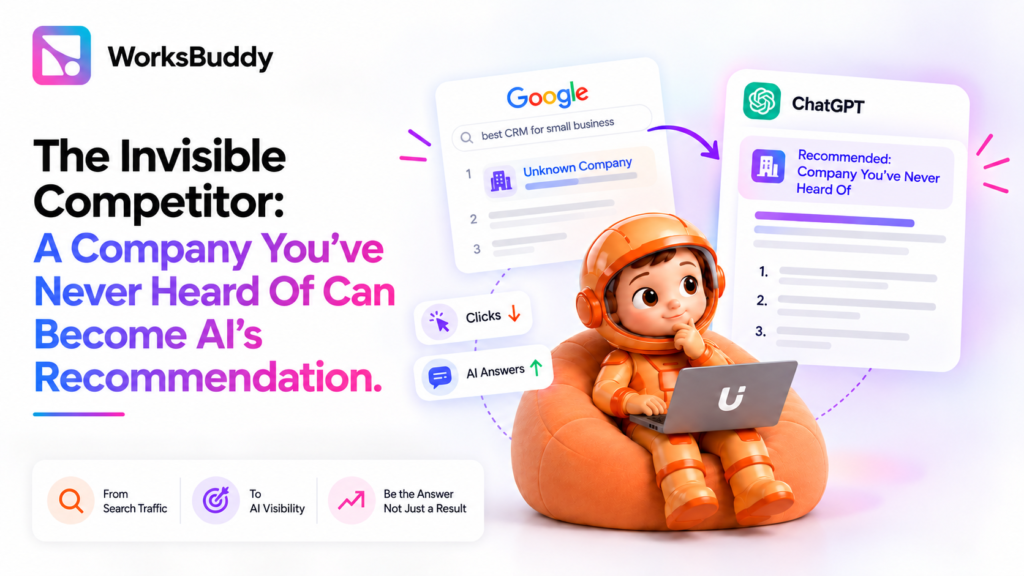
AI assistants can create competitor sets that differ from Google rankings or the competitors a company traditionally monitors.
Every sales and marketing team can name their competitors without thinking about it. They’re the companies that show up in the same deal cycles, the ones sales reps ask for battlecards on, the ones marketing tracks in every quarterly competitive review. That list feels complete because it’s been built the same way for years: watch who shows up next to you in search results, who gets compared to you in review sites, who your prospects mention by name.
AI search doesn’t respect that list.
Ask an AI assistant to recommend a product in your category, and it may return a name your team has never discussed in a competitive review. Not a scrappy new entrant everyone’s heard is coming. A company that’s been operating quietly, doing solid work in a narrower slice of the market, that an AI system has decided is a strong answer to a question you assumed only your known competitors could answer.
That company was never on your radar because it was never on Google’s radar in the way that mattered to you. It didn’t need to outrank you. It needed to be legible to an AI system in a way your team never thought to measure.
Why AI assembles a different competitor set
Traditional competitive monitoring is built on visibility signals a company can watch directly: who ranks near you for shared keywords, who gets included in the same comparison articles, who prospects mention when a deal is lost. Those signals share a common trait. They’re all downstream of search behavior that’s been stable for two decades.
AI systems build their answers differently. When a user asks an AI assistant to recommend a product, the system isn’t retrieving a ranked list of pages that match a keyword. It’s synthesizing an answer from a wide, distributed set of signals: how a company describes itself, how credible third parties describe it, which problems it’s consistently associated with across the web, and how well a brand’s own content actually answers the specific question being asked.
A company can score well on that second set of signals while barely registering on the first. It might not compete for your primary keywords at all. It might focus on a narrower niche within your category, one it’s covered thoroughly enough that an AI system reads it as an authority on that specific slice, even if the company’s overall footprint is a fraction of yours.
From a traditional monitoring standpoint, that company barely exists. From an AI system’s standpoint, it might be the best answer to a very specific version of the question a buyer actually asked.
The mechanics behind an unfamiliar recommendation
This isn’t a fluke in how AI systems work. It follows directly from how they’re built to answer questions.
Google has described its AI features as using a process it calls query fan-out, where the system issues several related searches across different topics and sources before assembling a response, rather than matching a single query to a single ranked list. OpenAI has similarly explained that ChatGPT search draws on third-party search providers and publisher content to produce answers grounded in sources from across the web.
Both approaches mean an AI-generated answer can pull from a much wider and more specific set of sources than a person would typically encounter through a single Google search. A company with a detailed, well-written piece of content that precisely answers a narrow version of a buyer’s question can get surfaced for that exact scenario, even if its broader domain authority is modest.
This is compounded by something Semrush found when it studied 50,000 brands across 1,094 topic areas: only 15.2% of the topics studied had what Semrush classified as a clear topic owner. For the overwhelming majority of buyer questions, there isn’t one dominant brand consistently winning the recommendation. The field is far more fragmented than a Google results page would suggest, which leaves room for companies with narrow, specific authority to show up right alongside category leaders.
Add to that Ahrefs’ observation that AI responses are probabilistic, meaning a brand can appear in one version of an answer and disappear from a nearly identical follow-up, and the competitive picture stops looking like a stable ranking at all. It starts looking like a shifting set of possibilities, where the company that shows up depends on exactly how the question was asked and what sources happened to be weighed most heavily that time.
Why this matters more than it sounds
It’s tempting to treat this as a curiosity rather than a real business risk. A single AI answer naming an unfamiliar company doesn’t cost a deal by itself.
But consider where in the buying process this happens. A prospect researching a purchase decision is increasingly likely to ask an AI assistant to compare options before they’ve built their own shortlist. If that assistant introduces a name the buyer had never encountered, that company is now inside the prospect’s consideration set from the very first moment of research, on equal footing with brands that have spent years building recognition through more traditional channels.
That’s a fundamentally different competitive dynamic than losing a deal to a known rival. A known competitor is something a sales team can prepare for, with a battlecard, a comparison page, a clear answer to “why us instead of them.” An unfamiliar competitor introduced by an AI assistant gives a sales team no such preparation, because nobody on the team knew to expect the name.
This is also a slow, cumulative risk rather than a single dramatic loss. It shows up as a marketing team wondering why inbound quality has shifted, or a sales team noticing prospects mention an unfamiliar name more often, without anyone connecting it back to a pattern of AI-generated answers quietly reshaping who gets considered.
Why traditional competitive monitoring misses this
Most competitive intelligence processes were built around a small, fixed list of known rivals: track their pricing, their positioning, their content, their reviews. That process works well for the competitors a company already knows to watch.
It has no mechanism for surfacing a competitor nobody added to the list. A marketing team isn’t going to stumble across an unfamiliar brand’s AI visibility by accident, the way they might notice a new competitor’s ad campaign or a mention in a trade publication. AI-generated answers aren’t public in the way a billboard or a press release is. They happen inside millions of individual conversations, most of which the company being discussed, or displaced, will never see.
This is precisely the gap that a dedicated AI visibility platform exists to close. Rather than starting from a list of known competitors and monitoring how they perform, the right approach starts from the actual questions buyers are asking and observes which brands, known and unknown, actually get named in response. That reverses the traditional process. Instead of asking “how do we compare to our competitors,” the question becomes “who is actually showing up when someone asks this question,” with no assumption about who that will be.
What monitoring for the unfamiliar actually looks like
Catching an invisible competitor requires a different discipline than traditional competitive tracking, built around three habits.
Test real buyer questions, not just brand comparisons. Most competitive monitoring implicitly assumes the buyer already knows the players and is comparing them by name. Many AI-assisted buyers haven’t reached that stage. They’re asking broader, needs-based questions, and those are exactly the questions where an unfamiliar brand is most likely to surface.
Repeat the same questions over time. Because AI answers are probabilistic, a single check tells you little. A brand appearing once in an answer might be a fluke. A brand appearing consistently across repeated queries and different phrasings is a real, ongoing pattern worth taking seriously.
Track the pattern across multiple AI platforms. A brand’s presence in ChatGPT, Gemini, Claude, Copilot, and Perplexity can differ meaningfully from one system to the next, since each draws on a different mix of sources and weighs them differently. A competitor invisible in one system might be dominant in another.
This is the layer WorksBuddy built Ranko to monitor. Rather than tracking a fixed list of known rivals, Ranko is designed as an AI brand visibility tool that tests the actual questions buyers ask across AI engines, records every brand that gets named in the response, known or unknown, and tracks how consistently each one appears. Used this way, it functions less like a traditional competitor tracker and more like an early-warning system, surfacing the names a business would otherwise only discover after losing a deal to one of them.
Turning visibility into a response
Discovering an unfamiliar competitor inside an AI answer isn’t just useful for defense. It’s useful information about where the market is actually heading.
A company that keeps surfacing for a specific, narrow version of a buyer’s question is usually doing something well in that specific area, whether that’s a piece of content that answers the question unusually thoroughly, a feature set genuinely suited to that use case, or a reputation built in a corner of the market a larger competitor hasn’t paid attention to. That’s worth studying, not just monitoring. It can point directly at a gap in a company’s own content or positioning that a competitor has quietly found first.
Treating this as ongoing AI visibility software rather than a one-time audit matters here too. The competitive set an AI system assembles today isn’t fixed. New content gets published, existing pages get updated, and the sources an AI system trusts shift over time. A company that checks once and moves on will miss the moment a new name starts appearing consistently, right up until a prospect mentions it in a sales call and nobody on the team recognizes it.
Conclusion
For twenty years, competitive intelligence meant watching a known list of rivals closely. That approach still matters, but it was built for a world where visibility was a position on a ranked page, earned and monitored in familiar ways.
AI search assembles its own competitive set, built from a wider, less visible mix of signals, and it doesn’t check with anyone’s competitive review before doing it. The company that shows up in that answer might be one your team has never discussed, doing well in exactly the narrow scenario a buyer just described.
The only way to know before a prospect brings up an unfamiliar name is to test the actual questions buyers are asking and see who answers them. See how Ranko surfaces the competitors an AI system is already recommending, including the ones your team has never heard of.