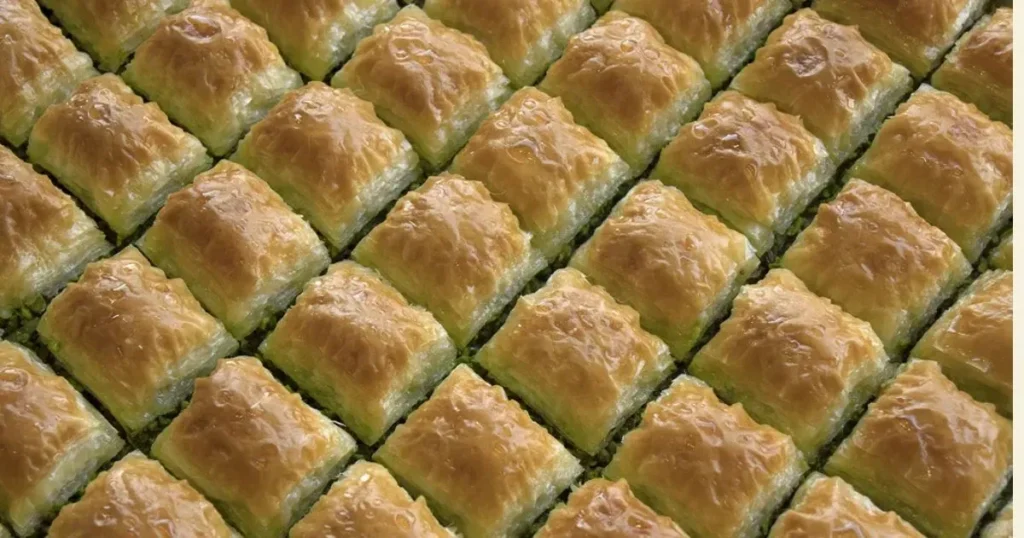
Baklava is one of the most recognizable desserts in the Eastern Mediterranean and Middle East. Made with layers of thin pastry, chopped nuts, butter, and sweet syrup or honey, it has become a favorite dessert in countries ranging from Greece and Turkey to Lebanon, Syria, the Balkans, and beyond. But one question continues to spark debate: Is baklava Greek or Turkish?
The short answer is that baklava cannot be easily assigned to only one modern country. Its exact origins are difficult to establish because layered pastries and sweetened breads existed in several ancient cultures, while the dessert we recognize today developed over centuries through cultural exchange. Both Greek and Turkish culinary traditions have played an important role in shaping baklava into the dessert enjoyed today.
What Is Baklava?
Baklava is a rich pastry traditionally prepared by layering sheets of very thin dough, usually phyllo, with butter and finely chopped nuts. The most common nuts include pistachios, walnuts, and hazelnuts, depending on the region. After baking, the pastry is soaked or drizzled with a sweet syrup made from ingredients such as sugar, water, lemon juice, or honey.
The result is a dessert with crisp, delicate layers on the outside and a rich, nutty filling inside. Different countries and regions have developed their own versions, which can vary considerably in shape, ingredients, sweetness, and preparation methods.
In Greece, baklava is commonly associated with walnuts, cinnamon, and honey or sugar syrup. Turkish baklava is particularly famous for its use of pistachios, especially in southeastern Turkey, where Gaziantep is widely associated with high-quality pistachio baklava.
Where Did Baklava Originate?
Determining the original birthplace of baklava is surprisingly complicated. There is no universally accepted historical evidence proving that the modern dessert was invented by either the Greeks or Turks.
Several ancient civilizations had foods involving layers of dough, nuts, and sweeteners. Ancient Mesopotamian, Persian, Greek, and Roman culinary traditions all included various types of pastries and sweet dishes. However, these early foods were not necessarily identical to modern baklava.
One theory connects baklava to ancient Central Asian or Turkic layered breads that eventually developed through the movement of Turkic peoples. Another theory points toward older Middle Eastern and Mediterranean pastries that influenced the dessert over time.
Rather than appearing suddenly in one place, baklava likely developed gradually as cooking techniques, ingredients, and culinary traditions moved between different cultures.
The Role of the Ottoman Empire
The Ottoman Empire is especially important when discussing the history of baklava.
At its height, the Ottoman Empire covered large parts of southeastern Europe, Anatolia, the Middle East, and North Africa. These regions had diverse culinary traditions, and food techniques traveled extensively across the empire.
By the Ottoman period, layered pastries filled with nuts and sweetened with syrup had become increasingly sophisticated. Palace kitchens played an important role in developing and documenting elaborate dishes. Baklava eventually became strongly associated with Ottoman cuisine.
Historical records from the Ottoman period provide evidence of baklava-like preparations. One well-known historical reference comes from the Topkapı Palace kitchens in Istanbul, where records describe preparations involving layered dough, nuts, and sweeteners.
This does not necessarily prove that baklava was invented in the Ottoman Empire. Instead, it shows that the Ottoman culinary tradition was important in developing and popularizing the form of baklava that became familiar across the region.
Why Is Baklava Associated With Turkey?
Turkey has one of the world’s strongest baklava traditions, and the dessert has become an important part of Turkish culinary culture.
Turkish baklava is generally made using extremely thin layers of phyllo dough. Pistachios are particularly important in many Turkish varieties. Gaziantep, a city in southeastern Turkey, is especially famous for its pistachio baklava.
Gaziantep baklava has received international recognition for its traditional production methods and use of locally grown pistachios. The region’s baklava makers are known for carefully preparing the dough, selecting high-quality nuts, and controlling the balance between pastry, butter, nuts, and syrup.
In Turkey, baklava is often served during religious festivals, celebrations, weddings, family gatherings, and other special occasions. Its importance in Turkish food culture goes far beyond being an everyday dessert.
Why Is Baklava Associated With Greece?
Greece also has a long-standing baklava tradition. Greek baklava is commonly prepared with layers of phyllo dough, walnuts, cinnamon, cloves, and sweet syrup.
Greek cuisine has incorporated many foods and culinary techniques that developed through centuries of interaction with neighboring cultures. Because Greece and the Ottoman Empire were historically connected for centuries, culinary traditions naturally crossed geographic and cultural boundaries.
One important difference often noticed between Greek and Turkish versions is the flavor profile. Greek baklava may emphasize walnuts and warm spices such as cinnamon and cloves, while many Turkish versions, particularly those from Gaziantep, place greater emphasis on pistachios.
However, these differences are not absolute. Recipes vary from family to family and region to region, so there is no single recipe that represents every Greek or Turkish baklava.
What About Phyllo Dough?
Phyllo dough is one of the defining characteristics of modern baklava. It consists of extremely thin sheets of dough that are layered with butter or another fat.
The history of very thin pastry is itself complicated. Various cultures developed techniques for stretching or rolling dough into thin sheets. The Ottoman culinary world became particularly skilled at producing delicate layered pastries.
Greek cooks also developed and preserved their own traditions surrounding phyllo-based desserts. As a result, trying to identify phyllo as belonging exclusively to one modern country oversimplifies a long culinary history.
The development of baklava was likely influenced by the spread of pastry-making techniques across regions rather than by the work of a single inventor.
Greek Baklava vs. Turkish Baklava
Although both versions share the same basic concept, there are some recognizable differences.
Turkish Baklava
Turkish baklava often features:
- Very thin layers of phyllo
- Pistachios, particularly in southeastern Turkey
- Butter-rich pastry
- Sugar-based syrup
- Different shapes and regional preparations
Gaziantep-style baklava is especially famous for its pistachio filling and carefully layered pastry.
Greek Baklava
Greek baklava often features:
- Phyllo dough
- Walnuts or a mixture of nuts
- Cinnamon and other spices
- Honey or sugar-based syrup
- Lemon or citrus flavors in some recipes
Greek versions can also differ by region and family tradition.
Neither style is necessarily more “authentic” than the other. They represent different culinary traditions that developed within a broader historical region.
Is Baklava Also Found in Other Countries?
Absolutely. Baklava is not limited to Greece and Turkey.
Versions of baklava or closely related pastries can be found throughout the Balkans, the Caucasus, the Middle East, and parts of North Africa. Countries such as Lebanon, Syria, Jordan, Armenia, Azerbaijan, Bulgaria, Serbia, Bosnia and Herzegovina, and others have their own versions.
Some use walnuts, while others emphasize pistachios or almonds. Some recipes rely heavily on sugar syrup, while others use honey or flavored syrups containing rose water, orange blossom water, or citrus.
The differences demonstrate how a shared culinary tradition can evolve as it moves between cultures.
Why Do Greece and Turkey Both Claim Baklava?
The debate largely comes from modern ideas about national cuisine. Today, food is often categorized according to national borders, but many famous dishes developed before modern national identities and boundaries became established.
The regions where baklava evolved have experienced centuries of migration, trade, conquest, and cultural exchange. Greeks, Turks, Arabs, Persians, Armenians, and many other communities contributed to the culinary history of the wider region. This diverse culinary influence can still be seen today at places such as Al-Basha Restaurant, where traditional Middle Eastern flavors continue to reflect the region’s rich food heritage.
So, Is Baklava Greek or Turkish?
The most historically responsible answer is that baklava is part of a shared culinary heritage, with strong Greek and Turkish traditions among many others.
Turkey has a particularly well-developed and internationally recognized baklava tradition, especially in Gaziantep. Greece also has a long and important baklava tradition with its own characteristic ingredients and preparation methods.
The modern form of baklava was significantly shaped by the culinary culture of the Ottoman world, but its deeper roots are difficult to trace to a single ancient culture or inventor.
Instead of thinking of baklava as exclusively Greek or Turkish, it is more accurate to view it as a dessert whose history reflects centuries of cultural interaction across the Eastern Mediterranean, Anatolia, the Balkans, and the Middle East.
The Cultural Importance of Baklava
Baklava is more than a sweet pastry. In many communities, it is connected with hospitality, celebrations, religious holidays, weddings, and family gatherings.
In Turkey, baklava is commonly enjoyed during celebrations such as Eid and other special occasions. In Greece, it is also served during holidays, family meals, and festive gatherings.
Its cultural significance helps explain why discussions about its origin can become so passionate. Food often represents identity, family history, and cultural heritage. A recipe passed from one generation to another can carry memories and traditions that are much more meaningful than its ingredients alone.
Conclusion
So, is baklava Greek or Turkish? There is no simple historical answer that assigns the dessert exclusively to one country.
Both Greece and Turkey have rich and established baklava traditions, while many other cultures across the Balkans, Middle East, and surrounding regions have developed their own versions. The dessert as we know it today emerged through a long history of culinary exchange, particularly within the Ottoman world and the broader Eastern Mediterranean and Middle Eastern region.
Rather than belonging exclusively to Greece or Turkey, baklava can be understood as part of a shared culinary heritage. Whether you prefer a pistachio-rich Turkish version from Gaziantep or a walnut-and-spice Greek style, both reflect centuries of craftsmanship and cultural history.