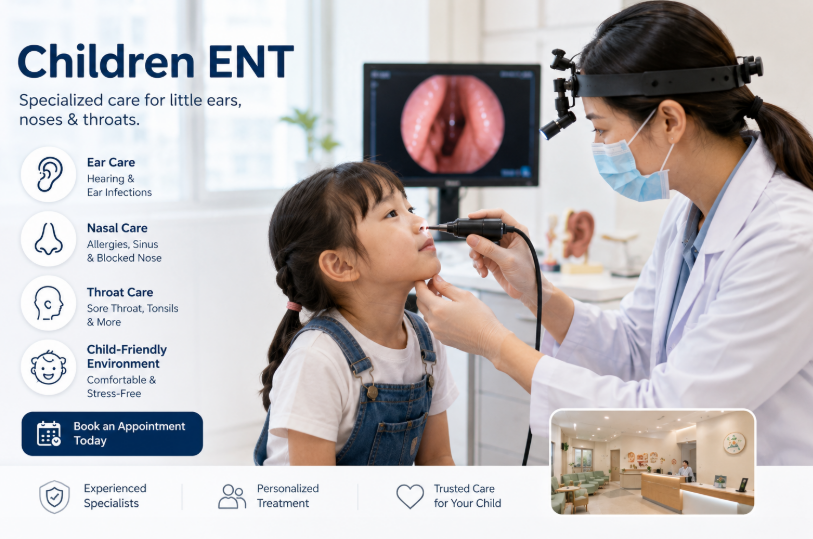
children ent
“Can you hear me?” If you find yourself asking your child this question again and again, it may be worth paying attention to the pattern. A child who frequently says “huh?”, asks you to repeat yourself, turns the television volume up or does not respond when called may not simply be ignoring you.
Children are not always able to explain that sounds seem unclear or that one ear feels different from the other. Sometimes, a hearing concern can show up through everyday behaviour long before a child tells a parent that something is wrong. This is where proper children ENT and hearing assessment can make a real difference.
Hearing Problems in Children Can Be Easy to Miss
Hearing difficulties do not always mean that a child cannot hear at all. Some children may hear certain sounds clearly but struggle when several people are speaking, when there is background noise or when someone is talking from a distance.
This can make the problem surprisingly difficult to spot at home. Your child may respond normally in a quiet room but appear inattentive at school, misunderstand instructions or frequently ask people to repeat themselves.
The Small Signs Parents Often Notice First
Parents are usually the first people to notice changes in a child’s behaviour. Perhaps your child suddenly starts turning the television louder, watches people’s lips when they speak, does not answer when called from behind or repeatedly says “what?” during conversations.
None of these signs alone proves that a child has hearing loss. However, when the same behaviour happens regularly, it is sensible to discuss the concern with a doctor or paediatric ENT specialist rather than simply assuming the child is not paying attention.
Could Repeated Ear Infections Affect Hearing?
Ear infections are common during childhood. The problem is not necessarily one isolated infection, but what happens when ear problems become recurrent or hearing seems affected after an infection.
Fluid can sometimes remain in the middle ear after an infection, and this may temporarily affect hearing. For a child who is still developing speech and language skills, persistent hearing difficulties deserve proper attention.
Watch What Happens After an Ear Infection
Once your child appears to have recovered, observe whether they respond normally to voices and sounds. If your child continues asking for repetition, speaks differently from before or seems less responsive, mention these changes during a medical consultation.
An ENT clinic can assess the child’s ears and determine whether hearing assessment or further investigation may be appropriate. The cause may be temporary, but parents should not have to guess.
When Should a Child Have a Hearing Test?
There is no need to wait until a child has an obvious hearing problem before asking about hearing assessment. Hearing tests can be performed using different methods depending on the child’s age and developmental stage.
For newborns and very young children, specialised testing can assess hearing without requiring the child to respond verbally. Older children may be able to participate in interactive or play-based hearing assessments.
Children’s Hearing Tests Are Different From Adult Tests
A common misconception is that every hearing test involves putting on headphones and raising a hand whenever a sound is heard. In paediatric audiology, testing can be adapted to the child’s developmental level.
Novena ENT provides a range of paediatric hearing assessments, including newborn hearing screening, auditory brainstem response, auditory steady-state response, otoacoustic emissions, tympanometry, visual reinforcement audiometry and play audiometry.
Speech Delay and Hearing Can Be Connected
When a child is not speaking as clearly or as much as expected, parents may immediately think about speech development. However, hearing is one of the factors that may need to be considered.
A child needs to hear sounds consistently in order to learn how words are pronounced and understand spoken language. If hearing is reduced or inconsistent, it may affect how the child picks up certain sounds and words.
Do Not Assume Your Child Is Simply a Late Talker
Every child develops at their own pace, and speech development can vary. At the same time, persistent concerns about speech or language development are worth discussing with an appropriate healthcare professional.
A hearing assessment can help determine whether hearing may be contributing to the concern. If a hearing issue is identified, parents can then discuss suitable next steps with the relevant specialists.
What If Your Child Snores Too?
Hearing is only one part of paediatric ENT care. Some children experience several ENT symptoms at the same time, such as hearing difficulties combined with snoring, nasal congestion or mouth breathing.
Persistent snoring can sometimes be associated with enlarged adenoids or tonsils, nasal obstruction or other upper-airway concerns. When snoring occurs regularly, particularly with restless sleep or mouth breathing, parents may wish to seek professional advice.
Snoring and Mouth Breathing Should Be Observed Together
One night of snoring after a bad cold is very different from a child who snores most nights throughout the year. Parents can look for patterns rather than becoming alarmed by a single episode.
Notice whether your child sleeps with their mouth open, breathes noisily, wakes frequently or seems to have difficulty breathing comfortably through the nose. These details can help an ENT specialist understand what is happening during sleep.
Why Children Need Child-Focused ENT Care
An adult can usually explain whether an ear feels blocked, whether sounds seem muffled or whether swallowing is uncomfortable. Younger children may not have the vocabulary to describe these sensations.
That is why paediatric ENT care requires an approach suited to children. The specialist may need to combine parental observations, physical examination, hearing tests and other investigations to understand the child’s condition.
A Comfortable Environment Can Help
Children can become anxious when faced with unfamiliar medical equipment or examinations. A clinic that regularly sees paediatric patients can make the experience more manageable by using age-appropriate communication and assessment methods.
At Novena ENT, paediatric ENT services include child-focused hearing assessment and ENT evaluation. The clinic also provides facilities intended for children’s audiological assessment.
When to Take a Child to an ENT Specialist
Parents often search online for “when to take a child to an ENT specialist” because they are unsure whether a symptom is serious enough to warrant an appointment.
A practical starting point is to look at persistence, recurrence and impact. If a problem keeps returning, does not seem to settle, or begins affecting your child’s hearing, speech, sleep, breathing, eating or everyday communication, it may be appropriate to seek medical advice.
Consider an ENT Assessment If Your Child
- Frequently asks people to repeat themselves
- Often says “huh?” during conversations
- Turns the television volume unusually high
- Does not consistently respond when called
- Has repeated ear infections
- Appears to have reduced hearing
- Snores regularly
- Sleeps with the mouth open
- Has persistent nasal congestion
- Experiences frequent nosebleeds
- Has recurring throat problems
- Has concerns related to speech or language development
These signs do not automatically indicate a serious condition. They simply provide useful reasons for parents to discuss their concerns with a healthcare professional.
Finding an ENT Clinic in Singapore
Searching for an ENT clinic near me is often the first thing parents do when a child develops an ear, nose or throat problem. Convenience matters, especially when follow-up appointments or hearing assessments may be required.
However, parents may also want to look at whether the clinic provides dedicated children ENT services. Paediatric patients may require age-appropriate hearing tests, child-friendly examinations and specialists familiar with common childhood ENT concerns.
What Should Parents Look For?
When comparing a Singapore ENT clinic, consider whether it provides paediatric ENT care, audiology services and assessment for the particular concern affecting your child.
For families dealing with recurring ear infections, suspected hearing difficulties, snoring, nasal obstruction or speech-related concerns, having access to both ENT and hearing expertise can make the assessment process more comprehensive.
Why Novena ENT for Paediatric ENT Care?
Novena ENT provides dedicated paediatric ENT services covering children’s ear, nose and throat concerns. The clinic’s paediatric services include assessment and treatment for conditions such as otitis media, hearing loss, Eustachian tube dysfunction, nasal problems, snoring, enlarged adenoids and recurrent throat conditions.
The clinic also provides paediatric hearing assessments using different techniques according to the child’s age and developmental stage, allowing children to be assessed using methods appropriate to their individual needs.
More Than Just an Ear Check
A child’s ear, nose and throat concerns can sometimes overlap. Recurrent ear infections may occur alongside hearing concerns, while enlarged adenoids can contribute to nasal obstruction and snoring.
A specialist pediatric ENT clinic can look at these symptoms as part of the wider picture. This gives parents an opportunity to understand whether different symptoms may be connected or whether they are separate issues.
What Parents Can Do Before the Appointment
Before visiting an ENT clinic, write down what you have noticed at home. Include when the symptoms started, how often they occur and whether they are getting better, worse or staying the same.
If possible, note specific examples. Instead of saying “my child cannot hear well”, mention that your child frequently asks for repetition, does not respond from another room or needs the television louder than usual. Concrete observations can be more useful during a consultation.
Bring Previous Medical Information
If your child has previously had hearing tests, ear infections, hospital visits or other ENT assessments, bring any relevant reports if available. A history of previous treatment can help the specialist understand the bigger picture.
Parents should also mention medications, allergies or other relevant medical information. The aim is not to diagnose the problem at home, but to give the specialist a clear starting point for assessment.
Better Hearing Starts With Paying Attention
Children rarely wake up one morning and announce that they have a hearing problem. More often, parents notice small changes first — a repeated “huh?”, louder television, missed instructions or unusual difficulty following conversations.
Those small signs are worth noticing. They do not mean that something is definitely wrong, but they can be the reason to ask the right questions and arrange an appropriate assessment.
Get Your Child’s Ears Checked at Novena ENT
If you have been noticing that your child frequently says “huh?”, asks you to repeat yourself, turns the television louder or seems less responsive to sounds, do not simply assume they are being inattentive. Hearing can be an important part of your child’s communication and development, and persistent concerns deserve proper assessment.
Get your child’s ears checked at Novena ENT and speak with a specialist team experienced in children ENT, paediatric ENT and children’s hearing assessment in Singapore. For parents searching for a pediatric ENT clinic, Singapore ENT clinic, nearest ENT clinic or ENT specialist for children, Novena ENT provides dedicated paediatric ENT and hearing services to help families understand what may be happening and what the next step should be. Explore Novena ENT’s paediatric ENT services and arrange an appointment for your child today.