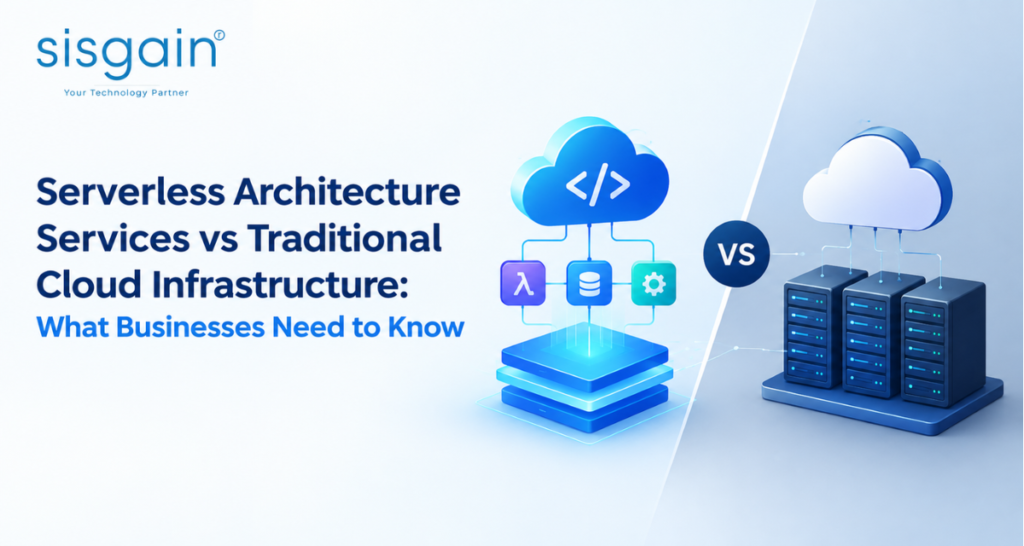
Many businesses that moved to the cloud years ago are now questioning whether their infrastructure still suits the way they build software. Virtual machines offer control, but they demand constant attention to capacity, patching, and configuration. Serverless computing shifts much of that work to the cloud provider so teams can focus on application logic. This article explains how serverless architecture services and traditional cloud infrastructure differ, where each fits, and how to choose between them.
What Are Serverless Architecture Services?
Serverless architecture is a cloud model in which the provider runs, scales, and maintains the servers, and the business pays only for the resources its code consumes. Servers still exist, but teams no longer provision or patch them. Code runs in response to events such as an HTTP request, a file upload, or a scheduled trigger.
Key components include:
- Function as a Service (FaaS): short-lived functions that run on demand
- Managed databases: hosted data stores that scale without manual tuning
- API gateways: managed entry points that route, authenticate, and throttle requests
- Event-driven services: queues, streams, and event buses that connect components
- Managed storage: durable storage with no capacity planning
Serverless is worth considering when traffic is uneven, delivery speed matters, or a small team must run services without a dedicated operations function.
What Is Traditional Cloud Infrastructure?
Traditional cloud infrastructure means renting virtual machines, containers, and dedicated resources that the business configures and operates. The provider supplies the hardware and virtualization layer, while the customer selects instance sizes, installs software, configures networks, and keeps systems updated.
Typical components include virtual machines, load balancers, databases, storage, networking, and monitoring and security tools. Container platforms sit between the two models: managed compute reduces some effort, but teams still manage clusters and scaling rules.
Key Differences

Infrastructure management. Serverless providers handle provisioning, operating system updates, and runtime maintenance. In traditional environments, the IT team owns these tasks, gaining flexibility at the cost of operational load.
Scalability. Serverless platforms scale automatically, even from zero to thousands of requests per second, which suits unpredictable workloads. Traditional infrastructure requires capacity planning, whether through autoscaling rules or deliberate over-provisioning.
Pricing. Serverless billing is typically based on requests and execution time, so idle periods cost little. Traditional infrastructure is usually billed by provisioned capacity, so underused servers still cost money. At sustained high volume, however, a right-sized reserved instance can be cheaper than constant function invocations.
Performance. Serverless functions can experience cold starts, a brief delay when a new execution environment initializes. This is minor for most APIs but may matter for latency-sensitive applications. Persistent infrastructure keeps processes warm and delivers steadier response times when properly tuned.
Development speed. Managed services let developers deploy code without building environments first, shortening release cycles. Traditional setups require provisioning and configuration before code reaches production.
Maintenance and operations. Serverless reduces routine server work, although teams still manage code, dependencies, and configuration. Traditional infrastructure offers deeper operational control, along with responsibility for monitoring, patching, and maintenance windows.
Security and compliance. Both models follow a shared responsibility approach, but the split differs. With serverless, the provider secures the platform while the customer handles code, access management, and data protection. Traditional infrastructure leaves more to the customer, from operating system hardening to network controls, which can be an advantage when regulations require infrastructure-level control.
Comparison at a Glance
| Factor | Serverless Architecture | Traditional Cloud Infrastructure |
| Infrastructure management | Provider-managed | Customer-managed |
| Scaling | Automatic | Configured by the business |
| Pricing | Primarily usage-based | Often capacity-based |
| Deployment | Faster | More infrastructure planning |
| Maintenance | Lower infrastructure maintenance | Higher operational responsibility |
| Resource utilization | Dynamic | Can involve idle capacity |
| Control | Less infrastructure-level control | Greater control |
| Best suited for | Event-driven, variable workloads | Predictable or specialized workloads |
Benefits and Limitations
Serverless benefits include automatic scaling, reduced infrastructure management, faster development, flexible pricing, easy integration with cloud-native services, and natural support for event-driven applications. Its limitations include cold starts, vendor lock-in, harder debugging of distributed systems, execution and memory limits, complex monitoring, unpredictable costs at high scale, and difficulty migrating legacy applications.
Traditional infrastructure offers greater control, predictable performance, flexible configuration, support for long-running workloads, and a better fit for legacy or specialized applications. In return, it demands more management, capacity planning, patching, and operational effort, and it can leave resources underutilized.
Matching Workloads to the Right Model
Serverless works well for REST and GraphQL APIs, event-driven applications, microservices, real-time data processing, scheduled automation, IoT applications, web backends, and lightweight data processing, particularly where traffic varies.
Traditional infrastructure is often better for long-running applications, high-performance computing, persistent processes, highly customized environments, legacy systems, workloads needing specialized hardware, and continuously running workloads with predictable demand.
Serverless for Application Modernization
Serverless can support modernization without a full rewrite. Teams can break monoliths into microservices, move workloads toward event-driven designs, integrate APIs and managed services, and improve scalability while reducing infrastructure management. A common approach is to peel off one function at a time, such as image processing or notifications, rather than replacing an entire legacy application at once.
How to Choose
The right choice depends on several practical factors:
- Architecture and workload characteristics: bursty, event-driven workloads favor serverless; steady, long-running ones favor servers.
- Traffic and performance requirements: consider latency tolerance and peak volumes.
- Budget: compare usage-based and capacity-based costs at realistic volumes.
- Security and compliance: check whether regulations require infrastructure-level control.
- Development resources: small teams benefit from managed services, while teams with strong operations skills may prefer control.
- Existing environment and long-term scalability: weigh current tooling, provider dependencies, and expected growth.
Can Businesses Use Both?
Businesses rarely need to choose one model exclusively. A hybrid architecture assigns each workload to the environment that suits it. For example, an e-commerce platform might run its product database on virtual machines, handle checkout events with serverless functions, and process image uploads through a containerized service. This flexibility lets organizations adopt serverless gradually, protect existing investments, and avoid forcing unsuitable workloads into a single model.
Best Practices for Adopting Serverless
- Start with suitable workloads, such as APIs or scheduled jobs.
- Design applications around events.
- Optimize function execution time and memory settings.
- Streamline API and database interactions to avoid bottlenecks.
- Enforce strong IAM controls with least-privilege permissions.
- Build observability with logs, metrics, and traces, and monitor usage and performance.
- Track cloud spending to catch cost surprises early.
- Avoid unnecessary vendor dependencies by keeping business logic portable.
The Future of Serverless
Serverless is expanding into AI-powered applications, where inference workloads can scale on demand. Serverless containers are blurring the line between the two models, while tighter integration with managed databases and APIs continues to simplify development. FinOps practices and automated cost optimization are also becoming standard as usage grows.

Conclusion
Serverless architecture and traditional cloud infrastructure solve different problems. Serverless delivers automatic scaling, faster delivery, and lower operational overhead, while traditional infrastructure provides control, predictability, and flexibility. Serverless is not a universal replacement. Businesses should evaluate workload patterns, cost, scalability, control, and operational capacity before choosing, and many will find that a combination serves them best.
Frequently Asked Questions
- Is serverless cheaper than traditional cloud infrastructure?
Not always. It is usually more economical for variable or low-volume workloads because idle time is not billed. For steady, high-volume workloads, reserved capacity on traditional infrastructure can cost less. - Does serverless mean there are no servers?
No. Servers still run the code, but the cloud provider manages them, so the business does not provision, patch, or scale them. - How can cold starts be reduced?
Use lightweight runtimes, keep deployment packages small, and take advantage of provisioned concurrency or similar warm-instance features where the provider offers them. - Is serverless suitable for regulated industries?
Often, yes, provided access controls, encryption, and logging are configured correctly and the provider’s certifications meet the relevant requirements. Review the shared responsibility model carefully before deciding. - Can an existing application move to serverless?
Yes, though incremental migration is usually safer than a full rewrite. Start with isolated functions and expand gradually as the team gains experience.