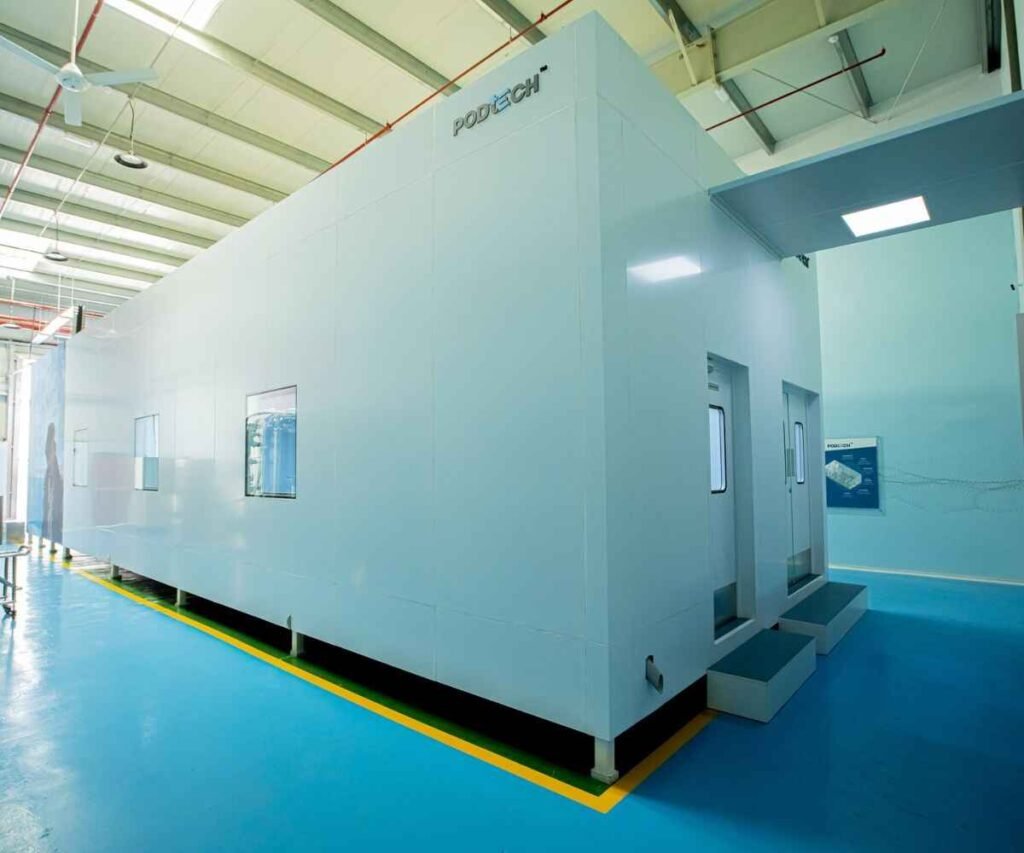
Ask five cleanroom contractors in India what “turnkey” means, and you’ll get five different answers. For some, it’s a marketing word stuck onto a panel-and-HVAC package. For others, it genuinely covers everything from architectural design through validation and handover, certificate in hand. That gap is where most cleanroom projects in India lose time, money, or both.
Why This Matters Right Now
India’s cleanroom sector isn’t a footnote in the construction industry anymore. MarketsandMarkets puts India’s cleanroom technologies market at roughly $275 million in 2024, climbing to around $423 million by 2029 — a 9.0% annual growth rate, driven mainly by pharmaceutical manufacturing and tighter regulatory scrutiny. That growth traces back to two real trends: India positioning itself as a global pharma supplier, and, more recently, as a semiconductor manufacturing base.
Micron’s $2.75 billion assembly and test facility in Gujarat makes the point well. The project includes around 500,000 square feet of cleanroom space, funded through $825 million from Micron and the balance from India’s Modified ATMP scheme and state incentives. A project on that scale, running on a government-backed timeline, has no room for six contractors handling HVAC, panels, flooring, and validation as separate line items. Someone has to own the whole build. That’s exactly the gap dedicated Turnkey cleanroom solutions providers exist to close.
What “Turnkey” Should Actually Include
A cleanroom provider earning the word “turnkey” typically handles four things end to end:
- Design and classification. Working out whether a space needs ISO Class 5, 7, or 8 based on the actual process, rather than copying whatever classification a competitor uses.
- Construction. Modular panels, ceiling grids, flooring, and HVAC delivered as one coordinated build.
- Validation and documentation. Particle counts, airflow testing, and the paperwork a GMP or ISO 14644 audit will actually request.
- Commissioning and handover. A facility that passes inspection on day one instead of after several rounds of remediation.
Drop any of these four and “turnkey” becomes a label rather than a delivery model.
Where the Standards Actually Bite
Two frameworks matter more than most brochures let on. ISO 14644 sets the particle-count classification a cleanroom has to hit and hold under routine operation, well past the day it’s installed. WHO-GMP, which matters enormously for pharmaceutical exporters, goes further: documented environmental monitoring, gowning protocols, and change control procedures that outlast the construction phase entirely.
This is where projects tend to stumble. A room passes its initial classification test, then drifts out of spec within six months because nobody built ongoing monitoring into the original design. A provider who understands the standards designs for the audit that happens eighteen months after handover, and treats commissioning day as the easy part.
Three Buying Mistakes That Keep Repeating
Treating classification as a checkbox. Manufacturers often specify a classification level based on what a competitor uses rather than what their process actually requires. Overspecifying inflates HVAC and energy costs for years; underspecifying fails audits later.
Splitting design from execution. Hiring one firm to design and a different contractor to build sounds like sensible governance. In practice it creates a gap: when airflow calculations don’t match the as-built HVAC system, nobody is on the hook for fixing it.
Skipping the energy math at design stage. Cleanroom HVAC runs around the clock. A facility with poor filtration design or an oversized air-change rate can cost far more to operate over ten years than it cost to build. Very few buyers ask a contractor to model lifetime energy cost before signing anything.
Questions Worth Asking Before You Sign
- Can you show a completed project at this classification level, in this industry?
- If the as-built facility fails initial validation, who’s responsible: the designer, the contractor, or both?
- Does “turnkey” here include monitoring equipment and staff training, or are those add-ons?
- What’s the expected annual energy cost at this classification, and how did you calculate it?
A contractor who can’t give a real answer to that last question is selling construction. Not a turnkey solution.
Read Also: IPTV Packages & Channel Lists for Smarter Streaming Choices
FAQs
How long does a turnkey cleanroom project take in India?
For a standard ISO Class 7 pharmaceutical cleanroom around 5,000 square feet, figure on 12 to 16 weeks from design freeze to validated handover, assuming no import delays on HVAC equipment. Semiconductor-grade builds, given their scale and Class 5 requirements, run considerably longer.
Is turnkey more expensive than hiring separate contractors?
Usually not, once rework gets factored in. Separate contracts look cheaper on paper, but coordination failures between design, construction, and validation are what actually blow budgets.
The Bottom Line
India’s cleanroom demand is growing for concrete reasons: pharmaceutical export requirements, semiconductor investment, and regulation that keeps tightening rather than loosening. “Turnkey” only means something if the provider owns design, build, validation, and how the room performs long after handover. Anything less is a contractor with better marketing.