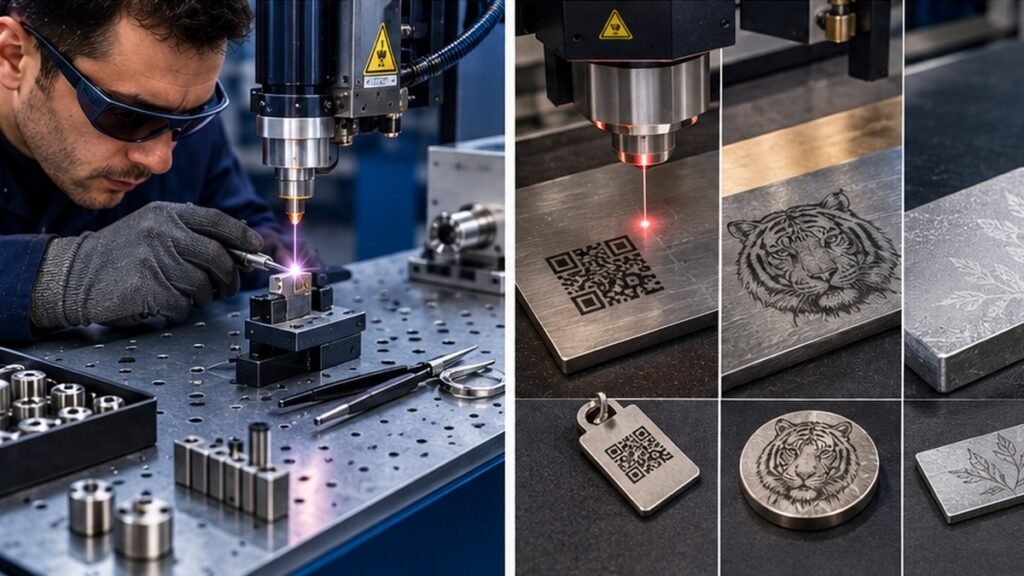
Laser Marking Metal
You have probably seen all three terms thrown around on supplier websites, in engineering specs, and on quote request forms. Laser marking. Laser engraving. Laser etching. They sound like they might mean the same thing, and plenty of people, including some people who should know better, use them as if they do.
They are not the same thing. And getting the wrong one on your drawing or purchase order can mean parts that fail inspection, marks that wear off in service, or traceability codes that do not read correctly under an automated scanner six months after the product ships.
The differences are real, they matter, and they are easy to understand once someone explains them clearly. That is exactly what this guide does. By the end, you will know precisely which process fits your application, what to specify, and what to look for in a shop that actually understands the distinction.
Why These Three Terms Get Confused So Often
1. The Industry Habit of Using Them Interchangeably
The confusion starts in marketing. Laser equipment manufacturers and job shops frequently use all three terms to describe their general laser capability, because buyers search for all three and the shop wants to appear in those results. The practical effect is that “laser engraving” ends up on websites describing what is actually laser marking, and “laser etching” gets applied to processes that are technically neither etching nor engraving in the precise sense.
Walk this confusion into a drawing requirement without clarification and you have a specification gap that produces inconsistent results across suppliers.
2. Why the Distinction Actually Matters for Your Application
If your part needs a 2D data matrix code that a barcode scanner must read reliably after the part has been tumbled, cleaned, passivated, and handled repeatedly in a production environment, you need a mark with specific characteristics. The wrong process produces a mark that either wears off, changes contrast under chemical cleaning, or reads inconsistently under the scanner’s optics.
For regulated industries, the stakes go higher. Medical device UDI requirements, aerospace part marking standards, and defense traceability specifications all describe not just what information must appear on the part but how permanently and legibly it must appear under specific test conditions. Specifying the wrong process means a non-conforming part regardless of how clean the mark looks to the naked eye on the day it was made.
3. The One Question That Separates All Three Processes Immediately
Here is the fastest way to sort these three processes out. Ask this: does the process remove material, and if so, how much? Laser marking removes no material. It changes the surface at or near the molecular level without cutting into it. Laser etching removes a very small amount of material, typically less than 0.001 inches deep. Laser engraving removes material to a meaningful depth, creating a physically recessed feature you can feel with your fingernail or a probe.
That single variable, material removal depth, is the axis that separates all three. Everything else follows from it.
Laser Marking Explained Clearly
1. What Laser Marking Actually Does to the Material Surface
Laser marking metal does not remove material. It delivers controlled laser energy to the surface in a way that changes the optical, chemical, or physical properties of that surface without cutting into it. The result is a visible, permanent mark that sits at the surface level rather than below it.
On stainless steel, the most common laser marking substrate, the process typically works through annealing: controlled oxidation that changes the surface color without disturbing the underlying material structure. The mark appears as a dark, high-contrast feature against the base metal, with no texture change you can feel with your fingers. Under a microscope, the surface profile of a laser mark on stainless steel is essentially flat. No depth, no roughness, just a color and reflectivity change at the surface.
2. Types of Laser Marking: Annealing, Carbon Migration, and Foaming
Annealing is the most common laser marking technique on metals, particularly stainless steel, titanium, and cobalt alloys used in medical and aerospace applications. The laser heats the surface rapidly enough to cause controlled oxide formation, creating a dark mark that is chemically stable, corrosion-resistant, and extremely durable.
Carbon migration marking works on plastics and some coated metals. The laser migrates carbon particles within the material to the surface, creating a dark mark without ablating or cutting the material. Foaming is used on certain plastics and creates a light-colored raised mark by generating micro-bubbles at the surface through rapid local heating. Each variation fits specific materials and contrast requirements, but all share the defining characteristic of no meaningful material removal.
3. Where Laser Marking Is the Right and Only Choice
Why Aerospace and Medical Traceability Depends on Laser Marking
Anywhere that surface integrity cannot be compromised, laser marking is not just preferred, it is mandatory. Surgical instruments that undergo repeated autoclave sterilization cycles need marks that will not trap bacteria, corrode, or compromise the surface finish that contributes to the instrument’s cleanability. A recessed engraved mark creates exactly the kind of crevice that sterilization guidelines aim to eliminate. A flat laser anneal mark has no such crevice.
Laser marking services for aerospace and defense applications face similar constraints. Part surfaces that serve aerodynamic, sealing, or structural functions cannot be disturbed by the marking process. Laser marking delivers the required data matrix codes, serial numbers, and part identifications without touching the functional surface geometry in any way that affects part performance.
Laser Engraving Explained Clearly
1. How Laser Engraving Removes Material and Creates Depth
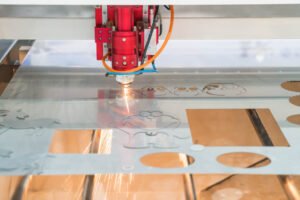
Laser engraving is the most physically aggressive of the three processes. The laser beam removes material from the surface, vaporizing or ablating it away to create a recessed feature with measurable depth. The result is a mark you can physically feel: a groove, a pocket, or a contoured surface depression with defined walls and a floor.
The mechanism is straightforward. Laser energy raises the material at the focal point above its vaporization temperature rapidly enough that the material converts directly to vapor and plasma, which is expelled from the zone by assist gas. What remains is a clean cavity in the material surface. Run the beam across a programmed path repeatedly and the cavity deepens with each pass.
2. Depth Ranges and What Controls Them
Engraving depth is controlled by laser power, scan speed, pulse frequency, the number of passes over the same area, and the material’s ablation threshold and thermal properties. Single-pass engraving on stainless steel at typical industrial parameters produces depths from 0.05mm to 0.3mm. Multiple passes deepen the engraving proportionally.
Deep engraving, sometimes called deep laser engraving in the industry, pushes depths to 1mm or more through repeated passes with parameter adjustments between cycles to maintain clean material removal as depth increases. These deep features are used for mold texturing, tooling identification, and industrial marks that must remain readable after significant surface wear or material removal through machining or grinding.
3. Applications Where Physical Depth Is a Functional Requirement
Industrial and High-Wear Applications That Demand Deep Marks
In environments where parts experience abrasive wear, chemical attack, or physical abrasion in service, surface-level marks disappear. A stamped serial number on a cutting tool shank lasts exactly as long as the surface it sits on. An engraved mark cut 0.3mm deep survives the surface wear and remains readable long after anything shallower would be gone.
Mold makers rely on deep laser engraving to create textures, logos, and part identification in tool steel that must survive thousands of injection cycles at high pressure and temperature. The mark must maintain its geometry through the tool’s full service life, which means depth is not optional. It is a functional specification.
Laser Etching Explained Clearly
1. How Laser Etching Differs from Both Marking and Engraving
Laser etching occupies the middle ground between marking and engraving, though it sits much closer to marking in practical effect. It removes a very thin layer of material from the surface, typically less than 0.001 inches deep, which changes the surface texture and reflectivity in the treated area. The result is a visible contrast mark created by the difference in reflectivity between the etched surface and the surrounding base material.
Unlike laser marking, laser etching does physically alter the surface profile, just at a very shallow level. Unlike laser engraving, the depth created is so minimal that it does not create a structurally significant feature. Think of it as scuffing the surface just enough to change how light reflects from it, rather than cutting into the material with intent to create a cavity.
2. Surface Contrast and Reflectivity Changes in Laser Etching
The contrast in a laser etched mark comes from the change in surface finish within the etched area. The laser’s energy melts the surface micro-structure rapidly and resolidifies it in a different texture, typically rougher and more matte than the surrounding material. On a polished or brushed metal surface, this texture difference creates high visual contrast even though the depth change is almost imperceptible.
On coated or painted surfaces, laser etching removes the coating in the mark area, revealing the base material beneath and creating contrast from the color difference between coating and substrate. This approach is widely used on coated aluminum panels, anodized surfaces, and painted industrial components where a high-contrast mark is needed without physical cutting into the base metal.
3. Where Laser Etching Fits in Real Production Environments
Laser etching is the practical choice when you need visible, reasonably durable marks on surfaces where even the minimal material removal of etching is acceptable but full engraving depth is unnecessary. Decorative marks, product branding on consumer goods, and identification marks on low-wear industrial components are all sensible etching applications.
Where etching falls short is in high-wear or chemically aggressive environments where even the shallow surface change will eventually disappear, and in applications where regulatory standards specifically require marking with no material removal.
Side-by-Side Comparison Across the Factors That Matter
1. Material Removal: None, Shallow, or Deep
This is the foundational comparison. Laser marking removes no material. The surface profile is unchanged. Laser etching removes less than 0.025mm of material, enough to change texture and reflectivity but not enough to create a physically perceptible feature. Laser engraving removes material to depths from 0.05mm to several millimeters depending on process parameters and the number of passes.
Choosing between them on this axis alone, if your application cannot tolerate any material removal, marking is the answer. If wear resistance requires depth, engraving is the answer. If visual contrast without significant depth is adequate, etching covers the middle ground.
2. Permanence and Durability Under Real-World Conditions
Deep laser engraving is the most durable mark in terms of surviving surface wear because it exists below the surface level that abrasion attacks first. As long as material remains, the mark remains. Laser marking durability depends on the chemical stability of the surface change. An annealed oxide mark on stainless steel is extremely durable under most conditions but can be affected by aggressive chemical stripping or heavy abrasive cleaning. Laser etching durability sits below both: the shallow surface texture change is vulnerable to abrasion and aggressive cleaning in ways that deeper processes are not.
3. Speed, Cost, and Production Volume Considerations
Which Process Runs Fastest at Scale
Laser marking is the fastest of the three processes at equivalent mark size. Because it does not remove material, it requires less energy per unit area and completes marks in fewer passes. This translates to higher throughput on automated production lines. Laser etching is close in speed. Laser engraving is the slowest because each pass removes a limited depth of material and multiple passes are needed for any significant depth, multiplying cycle time proportionally.
On high-volume production marking of traceability codes and serial numbers, the speed difference between marking and deep engraving can be substantial enough to affect line throughput and cost per part meaningfully. This is one reason why laser marking dominates traceability applications even when engraving is technically possible.
Choosing the Right Process for Your Specific Part and Industry
1. Regulatory and Traceability Requirements That Drive the Choice
FDA UDI requirements for medical devices specify permanent marking that survives the intended use life of the device, including all cleaning, sterilization, and handling cycles. The FDA does not mandate a specific laser process, but the permanence requirements and the surface integrity constraints of medical instruments together point clearly toward laser annealing marking for most metal surgical and implantable devices.
Aerospace standards including AS9132 describe specific mark depth, contrast, and readability requirements for part identification marks. Defense specifications add their own layer of requirements. Understanding which standard governs your part is the starting point for specifying the right laser process, and any shop you work with should be fluent in the standards that apply to your industry.
2. Material Type and How It Influences Process Selection
Not all processes are available on all materials. Annealing marking works on stainless steel, titanium, cobalt alloys, and similar metals with stable oxide layers. It does not work meaningfully on aluminum, which does not form the same kind of stable color-changing oxide under laser heating. Laser engraving works on almost any material including metals, plastics, wood, ceramics, and composites. Laser etching works on metals, coated surfaces, and many plastics.
Material hardness also affects engraving economics. Very hard materials like tool steel and tungsten carbide require more laser power and more passes to achieve useful engraving depth, which increases cost. For hard materials where traceability marking is the goal, laser marking is often both more practical and more cost-effective.
3. What to Tell Your Shop Before They Start
Before any laser process begins on your parts, your shop needs complete information. Tell them the base material and any surface treatment or coating. Describe the mark content, whether a logo, a serial number, a 2D data matrix code, or a combination. State the required contrast, whether a quantitative contrast ratio is specified or whether visual readability under specific lighting conditions is the standard. Specify any regulatory requirements by standard number. Describe the service environment the marked part will operate in.
With that information in hand, a shop that genuinely understands all three processes will tell you which one fits, run appropriate process development samples, and deliver parts that meet your specification from the first production run.
Conclusion
Laser marking, laser engraving, and laser etching are three distinct processes with real differences in mechanism, depth, durability, speed, and appropriate application. Marking changes the surface without removing material and is the right choice for medical, aerospace, and any application where surface integrity is paramount. Engraving cuts into the material to create durable recessed features for high-wear and deep identification applications. Etching splits the difference, creating contrast through a shallow surface change suited to decorative and moderate-durability applications. Know which one your application actually needs, specify it correctly, and find a shop that understands the distinction. Everything else follows from that.
Frequently Asked Questions
- Which lasts longer, laser marking or laser engraving?
Laser engraving lasts longer in abrasive environments because the mark exists below the surface. Laser annealing marks on stainless steel are extremely durable in most other conditions. - Can laser etching be used on aluminum?
Yes, laser etching works well on aluminum and anodized aluminum surfaces, creating high-contrast marks by removing the anodized layer or altering the base surface texture. - Is laser marking safe for medical implants?
Annealing laser marking is specifically used on implantable devices because it creates no surface crevice, maintains corrosion resistance, and survives sterilization without affecting the implant material. - Which process reads best under a barcode scanner?
Laser marking, particularly annealed marks on stainless steel, typically produces the most consistent 2D data matrix code contrast for automated scanner reading across the widest range of scanning conditions. - Does laser engraving weaken the part?
For structural components, engraving that reduces wall thickness or creates stress concentration in a loaded area requires engineering review. For identification marks at standard depths on non-critical surfaces, the effect on part strength is negligible.