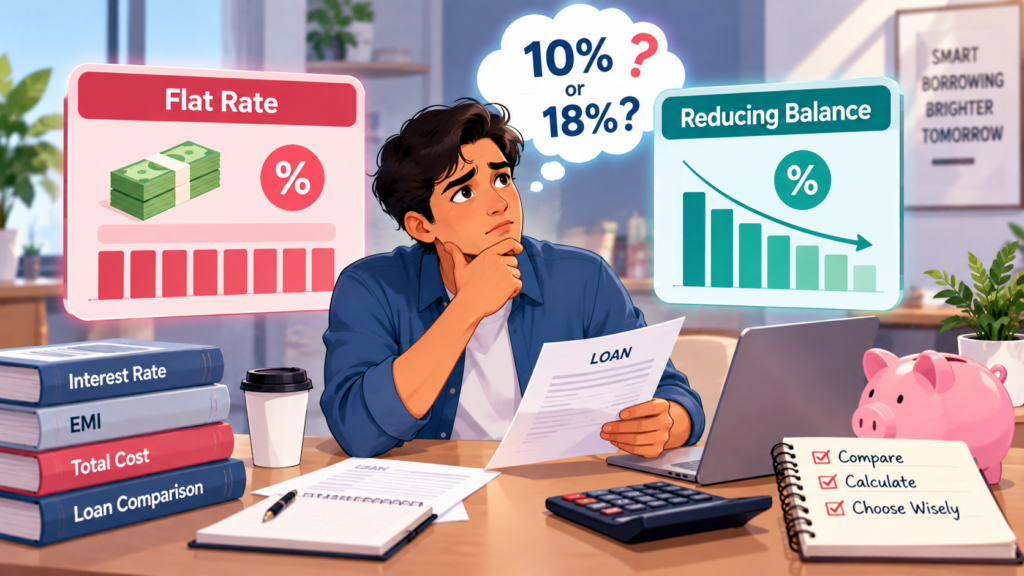
Understand flat rate vs reducing balance interest, how loan costs are calculated, and why a lower advertised rate may not mean a cheaper personal loan.
When a lender says your personal loan is available at 10% interest, it sounds straightforward. But before comparing that offer with another lender quoting 15% or 16%, there is one important question to ask:
Is the interest rate calculated on a flat rate basis or a reducing balance basis?
This distinction can dramatically change the actual cost of borrowing.
A flat interest rate is generally calculated on the original principal for the entire loan tenure. With a reducing balance interest rate, interest is calculated on the outstanding principal, which decreases as you repay the loan.
That means a loan advertised at 10% flat interest may have an effective borrowing cost that is much closer to a conventional reducing-balance rate in the high teens.
Understanding flat rate vs reducing balance interest can help you compare personal loans more accurately and avoid choosing a loan simply because its advertised percentage looks lower.
What Is a Flat Interest Rate?
A flat interest rate means interest is calculated on the original principal amount throughout the loan tenure.
The principal you repay every month does not reduce the amount used for calculating the quoted interest.
The basic formula is:
Total Interest = Principal × Flat Interest Rate × Tenure
For example, suppose you borrow:
- Loan amount: ₹1,00,000
- Flat interest rate: 10% per year
- Tenure: 3 years
Total interest would be:
₹1,00,000 × 10% × 3 = ₹30,000
Therefore:
Total repayment = ₹1,30,000
With 36 monthly instalments:
Monthly EMI = ₹1,30,000 ÷ 36 = approximately ₹3,611
The important point is that the lender is calculating the 10% interest using the original ₹1 lakh throughout the three-year period.
What Is Reducing Balance Interest?
Under a reducing balance method, interest is calculated on the outstanding principal.
Every EMI generally contains two components:
- Interest
- Principal repayment
As you repay the principal, the outstanding loan balance falls. The next month’s interest is therefore calculated on a smaller amount.
For example, if you take a ₹1 lakh loan at a 10% annual reducing balance rate, the first month’s interest is calculated on approximately ₹1 lakh.
After part of the principal is repaid, the next month’s interest is calculated on the new outstanding balance.
This continues throughout the loan.
The reducing-balance method therefore generally results in a lower total interest cost than the same nominal percentage charged on a flat basis.
Flat Rate vs Reducing Balance Interest: The Key Difference
The simplest way to understand the difference is this:
| Feature | Flat Rate | Reducing Balance |
|---|---|---|
| Interest calculated on | Original principal | Outstanding principal |
| Principal reduces for interest calculation? | No | Yes |
| Quoted rate usually looks | Lower | Higher |
| Effective borrowing cost | Usually higher than quoted flat rate | Closer to quoted rate |
| EMI calculation | Relatively simple | More complex |
| Best comparison metric | Total repayment/effective cost | Total repayment/effective cost |
A 10% flat loan should therefore not automatically be considered cheaper than a 15% reducing-balance loan.
You need to compare the actual repayment amount.
Why Can a 10% Flat Rate Be Similar to an 18% Reducing Rate?
This is where many borrowers get confused.
Suppose you borrow ₹1 lakh for three years at 10% flat interest.
Total interest:
₹1,00,000 × 10% × 3 = ₹30,000
Total repayment:
₹1,30,000
Monthly EMI:
₹1,30,000 ÷ 36 = ₹3,611
Now compare this with a loan where interest is calculated on a reducing balance.
Because the outstanding principal falls every month, a reducing-balance loan needs a substantially higher quoted rate to generate a similar repayment pattern.
When the cash flows of the 10% flat-rate loan are converted into an annualized borrowing cost, the equivalent rate can be around the high teens, depending on the tenure and the precise method used.
This is why a borrower may see something like:
10% flat ≈ roughly 18% reducing-balance equivalent
The exact equivalent is not universal. It depends on the loan tenure, EMI structure, payment frequency, fees and other charges.
So the headline “10% interest” is incomplete information unless you know how the interest is calculated.
Example: ₹5 Lakh Loan at 10% Flat Rate
Let’s make the difference more realistic.
Assume:
- Principal: ₹5,00,000
- Tenure: 3 years
- Flat rate: 10% per year
Total flat-rate interest:
₹5,00,000 × 10% × 3 = ₹1,50,000
Total repayment:
₹6,50,000
Monthly EMI:
₹6,50,000 ÷ 36 = approximately ₹18,056
The borrower is paying ₹1.5 lakh in interest.
But the outstanding principal is not actually ₹5 lakh throughout the three years. The borrower is continuously paying down the principal.
That is the fundamental reason a flat rate can make the cost of borrowing look deceptively low.
How Reducing Balance Interest Is Calculated
The standard EMI formula for a monthly reducing-balance loan is:
EMI = P × r × (1+r)^n ÷ [(1+r)^n – 1]
Where:
- P = Principal loan amount
- r = Monthly interest rate
- n = Number of monthly instalments
For example, if the annual reducing interest rate is 18%, the monthly rate is approximately:
18% ÷ 12 = 1.5%
The EMI is then calculated using the outstanding principal and monthly rate.
After every EMI, the principal component reduces the outstanding balance.
This is why the interest component generally declines over time.
What Is a Reducing Balance Interest Calculator?
A reducing balance interest calculator helps you estimate the EMI and total interest payable when interest is charged on the outstanding principal.
Typically, you enter:
- Loan amount
- Interest rate
- Loan tenure
The calculator then estimates:
- Monthly EMI
- Total interest
- Total repayment
- Principal repayment
- Interest component
A calculator is especially useful when comparing two loans with different interest-rate structures.
Instead of asking:
“Which lender has the lowest rate?”
ask:
“Which loan has the lowest total cost for the amount and tenure I need?”
That is a much better comparison.
Flat Interest Rate Explained With a Simple Formula
For a flat-rate loan, you can use:
Flat Interest = Loan Amount × Annual Rate × Number of Years
Then:
Total Repayment = Loan Amount + Total Interest
And:
EMI = Total Repayment ÷ Number of EMIs
For example:
₹2,00,000 loan
10% flat rate
2-year tenure
Interest:
₹2,00,000 × 10% × 2 = ₹40,000
Total repayment:
₹2,40,000
Number of EMIs:
24
Approximate EMI:
₹10,000
This calculation is simple, but it does not mean the actual annualized borrowing cost is only 10%.
Why the Effective Interest Rate Matters
The personal loan effective interest rate gives you a more meaningful way to evaluate the actual cost of borrowing.
Consider a borrower who is offered:
Loan A: 10% flat
and another lender offers:
Loan B: 16% reducing balance
At first glance, Loan A appears dramatically cheaper.
But that comparison is not apples-to-apples.
Loan A calculates interest on the original principal throughout the tenure, while Loan B calculates interest on the declining outstanding balance.
The correct comparison should consider:
- Total interest
- EMI
- Processing fee
- Documentation charges
- Insurance, if applicable
- Prepayment or foreclosure charges
- Other mandatory costs
- Net amount actually received
The Reserve Bank of India has emphasized transparency around lending rates and the overall cost of loans, including applicable charges.
Flat Rate vs Reducing Balance: Which Is Cheaper?
There is no need to judge based only on the advertised percentage.
As a general rule, the same nominal percentage charged on a flat basis is more expensive than the same percentage charged on a reducing-balance basis, because the flat method continues to calculate interest against the original principal.
For example:
10% flat can be more expensive than a 10% reducing balance loan.
However, you cannot conclude that every 15% reducing loan is cheaper than every 10% flat loan without calculating the actual repayment.
The loan amount and tenure matter.
How to Compare Two Personal Loan Offers
Use this five-step method.
Step 1: Check the Interest Type
Ask the lender:
“Is this a flat rate or reducing balance rate?”
Do not assume.
Step 2: Ask for the EMI
Get the exact EMI in writing.
Step 3: Calculate Total Repayment
Multiply:
EMI × Number of EMIs
Then subtract the amount you actually receive.
Step 4: Add Fees
Include processing fees and other mandatory charges.
For example, if the sanctioned loan is ₹2 lakh but ₹6,000 is deducted as a processing fee, your actual cash received may be lower than ₹2 lakh.
Your effective borrowing cost is therefore higher than the interest calculation alone suggests.
Step 5: Compare Effective Cost
Only after completing these calculations should you decide which loan is cheaper.
Don’t Compare Only the Advertised Interest Rate
One of the biggest mistakes borrowers make is comparing loans like this:
Lender A: 10%
Lender B: 15%
Lender C: 18%
and automatically assuming Lender A is the best option.
The calculation method can make those percentages incomparable.
A lender quoting 10% flat may potentially be more expensive than a lender quoting a higher reducing-balance rate.
This is particularly important for:
- Personal loans
- Vehicle loans
- Consumer loans
- Short-term loans
- Digital lending products
Always read the sanction letter and loan agreement to understand how interest is calculated.
Does Loan Tenure Change the Difference?
Yes.
The longer the loan tenure, the more important the calculation method becomes.
With a flat-rate loan, interest continues to be calculated using the original principal.
With reducing balance, the outstanding principal gradually declines.
Therefore, over longer repayment periods, the difference between the quoted flat rate and its effective borrowing cost can become more significant.
This is one reason borrowers should calculate the total interest rather than choosing a loan based solely on the monthly EMI.
What Does “10% Interest” Really Mean?
It depends on the calculation method.
10% flat means something very different from:
10% reducing balance.
The first applies the rate to the original principal throughout the agreed calculation period.
The second applies the rate to the outstanding balance.
Therefore, whenever a lender advertises an attractive rate, ask:
10% on what balance, and calculated how often?
That single question can save a borrower from making a costly comparison mistake.
Questions to Ask Your Lender Before Taking a Loan
Before signing a personal loan agreement, ask:
- Is the interest rate flat or reducing?
- What is the annual interest rate?
- What is the EMI?
- What is the total repayment?
- What is the total interest payable?
- What processing fee will be deducted?
- Are there documentation or other mandatory charges?
- Is there an insurance charge?
- Are there prepayment or foreclosure charges?
- What amount will actually be credited to my account?
- Is the quoted rate the effective annual rate or a flat rate?
- How frequently is interest calculated?
Getting these details before signing can make loan comparison much easier.
Final Takeaway
The biggest lesson from flat rate vs reducing balance interest is simple:
Never compare loan offers using the advertised interest percentage alone.
A 10% flat-rate loan can have an effective borrowing cost in the high teens because interest is calculated against the original principal rather than the declining balance.
A reducing-balance loan may advertise a higher percentage but calculate interest only on the outstanding principal.
Use a reducing balance interest calculator, compare total repayment, include processing fees and other charges, and check the loan agreement before making a decision.
When evaluating a personal loan effective interest rate, the number that matters most is not the prettiest number in the advertisement. It is the total amount that leaves your pocket compared with the amount that actually reaches your account.
Disclaimer: Interest calculations are illustrative. Actual loan costs depend on the lender’s calculation method, tenure, repayment frequency, fees, taxes and other terms. Always verify the rate and charges in the lender’s official loan documents before borrowing.