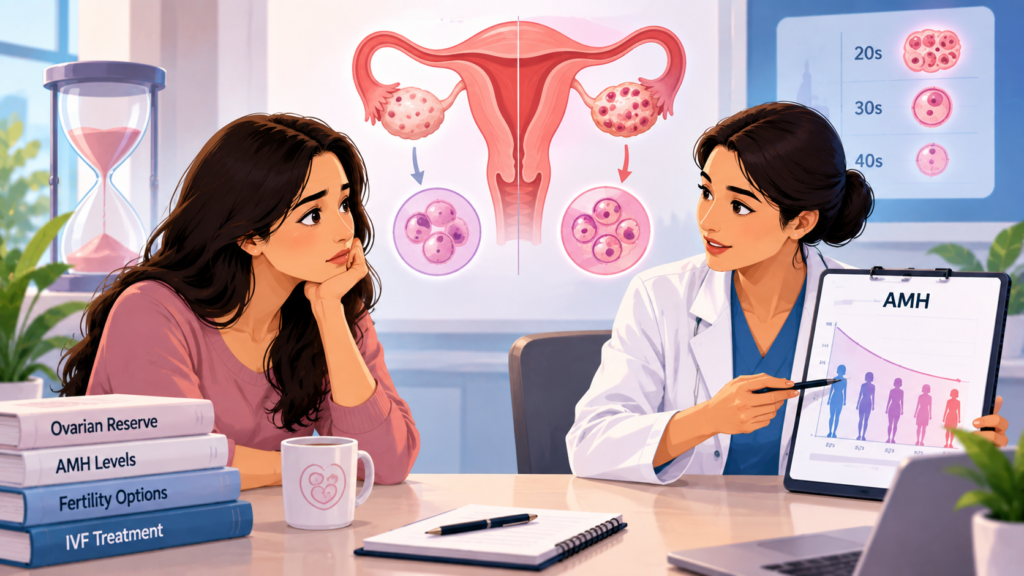
Understanding what AMH levels may indicate about ovarian reserve at age 30 and how fertility specialists evaluate treatment and IVF options.
Being told that you have a low AMH level at 30 can be unsettling, especially when you are thinking about pregnancy or planning fertility treatment. It is easy to see a number on a laboratory report and assume it tells you exactly how fertile you are.
It does not.
AMH, or anti-Müllerian hormone, is primarily a marker of ovarian reserve, meaning an estimate of the remaining pool of recruitable follicles. It can help fertility specialists anticipate how the ovaries may respond to stimulation during IVF, but it does not directly measure egg quality and cannot, by itself, tell you whether you will become pregnant naturally.
For someone searching for information about low AMH at 30, the most important message is that a lower-than-expected result deserves proper evaluation, but it should not automatically be interpreted as infertility.
What Is AMH?
AMH is produced by cells associated with small developing ovarian follicles. Because the number of these follicles generally decreases over reproductive life, AMH levels tend to decline with age.
Unlike some reproductive hormones, AMH can generally be measured at different points during the menstrual cycle. It is commonly used alongside other information, including antral follicle count (AFC), to assess ovarian reserve.
In fertility care, AMH can help answer questions such as:
- How many follicles might respond to ovarian stimulation?
- Could the ovaries respond weakly to IVF medications?
- Is a lower or higher stimulation response expected?
- Should the IVF protocol be adjusted?
- Should additional ovarian reserve testing be considered?
But AMH does not provide a complete picture of fertility.
What Does Low AMH at 30 Mean?
A low AMH result at 30 may suggest that your ovarian reserve is lower than expected for your age.
However, the result needs to be interpreted in context.
ASRM describes diminished ovarian reserve as a reduction in ovarian response to stimulation relative to women of a similar age. It also emphasizes that diminished ovarian reserve does not necessarily mean that a person cannot conceive.
At age 30, a low result may therefore mean:
- You have fewer recruitable follicles than expected.
- You may produce fewer eggs during an IVF stimulation cycle.
- Your fertility specialist may modify your treatment plan.
- Your doctor may recommend additional ovarian reserve assessment.
- It does not automatically mean you are infertile.
The distinction between ovarian reserve and reproductive potential is extremely important.
What Is a Normal AMH Level at 30?
There is no universally applicable AMH number that can be labeled “normal for every 30-year-old.”
AMH results can vary according to:
- Laboratory assay
- Testing method
- Population studied
- Individual biology
- Hormonal contraception
- Polycystic ovary syndrome (PCOS)
- Other medical factors
For that reason, online AMH charts should be treated cautiously.
Rather than asking only, “Is my AMH normal for my age?”, ask your fertility specialist:
“How does my AMH compare with my other ovarian reserve findings and my expected response to treatment?”
ASRM notes that AMH and AFC are among the most sensitive measures of ovarian reserve, but ovarian reserve markers have limited ability to independently predict pregnancy and live birth.
AMH Levels by Age: Why Age Still Matters
Searching for AMH levels by age can be useful for understanding broad trends, but age should not be replaced by an AMH number.
AMH generally decreases as ovarian reserve declines over reproductive life. However, there is considerable variation between women of the same age.
This means two women who are both 30 can have different AMH levels without necessarily having identical fertility outcomes.
Age is particularly important because ovarian quantity and ovarian quality are different concepts.
Ovarian quantity
This refers broadly to the remaining pool of oocytes or follicles.
AMH and AFC are useful indicators of ovarian reserve.
Oocyte quality
This refers to the ability of an egg to contribute to successful fertilization, embryo development and ultimately a healthy pregnancy.
AMH does not directly measure egg quality.
ASRM emphasizes that ovarian reserve tests are primarily useful for predicting quantitative outcomes such as oocyte yield, while their ability to predict qualitative outcomes such as pregnancy and live birth is much weaker.
Low AMH Does Not Mean Low Egg Quality
This is one of the biggest misconceptions surrounding AMH.
A low AMH level does not mean that every remaining egg is poor quality.
It primarily suggests that the number of recruitable follicles may be lower.
At 30, age itself is an important factor when considering reproductive potential. Therefore, a 30-year-old with a low AMH result should not automatically assume that her eggs are of poor quality.
Instead, the result should be combined with:
- Age
- Menstrual history
- Antral follicle count
- FSH and estradiol when clinically indicated
- Previous fertility treatment response
- Medical history
- Family history
- Partner’s fertility evaluation
- Duration of attempts to conceive
How Is Diminished Ovarian Reserve Diagnosed?
AMH is only one part of an ovarian reserve assessment.
A fertility specialist may consider several measurements.
1. AMH
AMH provides an estimate of the ovarian follicle pool and can help predict ovarian response during assisted reproduction.
2. Antral Follicle Count
A transvaginal ultrasound can estimate the number of small antral follicles in both ovaries.
AFC and AMH are commonly used because they provide useful information about ovarian reserve and expected response to stimulation.
3. FSH and Estradiol
FSH and estradiol may provide additional information, particularly when AMH is very low.
ASRM recommends that basal FSH and estradiol be assessed together during the early follicular phase when they are being used as part of an infertility evaluation.
4. Previous IVF Response
If someone has already undergone ovarian stimulation, the actual number of follicles and eggs retrieved can provide valuable information about ovarian response.
This real-world response can sometimes be more informative than repeating multiple reserve tests.
What Causes Low AMH at 30?
A lower AMH level at a younger age can have several possible explanations.
Potential factors include:
- Natural variation in ovarian reserve
- Previous ovarian surgery
- Certain chemotherapy or radiation treatments
- Some genetic conditions
- Endometriosis or ovarian damage
- Smoking
- Certain medical conditions
- Age-related variation
- Unknown or unexplained causes
Sometimes no single cause can be identified.
Importantly, an isolated AMH result should not be used to diagnose the cause of diminished ovarian reserve.
Your medical history and other fertility tests matter.
Does Low AMH Mean You Cannot Get Pregnant Naturally?
No.
This is perhaps the most important point for anyone researching low AMH at 30.
ASRM states that ovarian reserve testing does not reliably predict spontaneous pregnancy in women who have not been diagnosed with infertility. In studies cited by ASRM, women with lower AMH did not necessarily have substantially lower cumulative pregnancy rates than women with higher AMH.
AMH is better understood as a measure of ovarian quantity and expected response to stimulation than as a simple “fertility score.”
Therefore:
Low AMH ≠ no chance of natural pregnancy.
It may, however, be a reason to discuss your reproductive plans and fertility evaluation with an appropriate clinician, particularly if you are experiencing difficulty conceiving or have other risk factors.
Low Ovarian Reserve Treatment: What Are the Options?
There is no treatment that can reliably restore a depleted ovarian reserve to its previous level.
Instead, low ovarian reserve treatment generally focuses on understanding the cause, optimizing the chance of conception and choosing an appropriate fertility strategy.
Depending on the individual situation, treatment may include:
Trying to Conceive Naturally
If there are no other major fertility problems, a doctor may recommend attempting natural conception for an appropriate period based on age, medical history and duration of infertility.
A low AMH result alone does not automatically require IVF.
Ovulation Treatment
If ovulation problems are also present, treatment may focus on improving ovulation.
The appropriate medication depends on the underlying diagnosis.
Intrauterine Insemination
IUI may be considered for selected patients depending on age, ovarian reserve, ovulation, sperm parameters and other fertility factors.
IVF
IVF may be considered when there are additional infertility factors, prolonged infertility, significant ovarian reserve concerns or other clinical indications.
For women with diminished ovarian reserve, the goal may be to obtain an appropriate number of eggs while avoiding unrealistic expectations about the number of eggs retrieved.
Diminished Ovarian Reserve and IVF
Diminished ovarian reserve IVF treatment can require careful planning.
AMH and AFC are useful predictors of how many oocytes may be obtained following ovarian stimulation. However, a low AMH does not mean IVF cannot work.
ASRM specifically states that extremely low AMH values should not be used as a reason to refuse IVF treatment.
During IVF, your fertility specialist may consider:
- Ovarian reserve measurements
- Age
- Previous treatment response
- Gonadotropin dosing
- Number of follicles
- Expected egg yield
- Embryology laboratory factors
- Sperm quality
- Embryo development
The treatment plan should therefore be individualized rather than based on AMH alone.
Can AMH Increase Again?
AMH can fluctuate, and different laboratory assays can produce different results.
A change between two measurements does not necessarily mean that the ovarian reserve has suddenly increased or decreased by the same amount.
Some factors, including hormonal contraceptive use, can affect AMH measurements and should be considered when interpreting results.
If a result seems unexpectedly low, your clinician may consider the overall clinical picture and whether repeat or additional testing is appropriate.
Do not interpret a single AMH number in isolation.
Can Lifestyle Changes Increase AMH?
There is currently no proven lifestyle intervention that can reliably restore a diminished ovarian reserve.
A generally healthy lifestyle can still support overall reproductive and metabolic health.
Useful habits may include:
- Avoiding smoking
- Maintaining a healthy weight
- Eating a balanced diet
- Exercising regularly
- Managing chronic health conditions
- Limiting excessive alcohol consumption
- Getting adequate sleep
- Discussing medications and supplements with your doctor
Be cautious about products marketed as “AMH boosters” or supplements claiming to restore ovarian reserve.
There is no supplement that should be considered a proven way to replenish the ovarian follicle pool.
When Should You See a Fertility Specialist?
Consider discussing your results with a fertility specialist if:
- Your AMH is unexpectedly low for your age.
- You have been trying to conceive without success.
- You have irregular or absent periods.
- You have had ovarian surgery.
- You have a history of chemotherapy or radiation.
- You have endometriosis or another condition affecting the ovaries.
- You are considering fertility preservation.
- You have previously had a poor response to IVF stimulation.
For women aged 35 or younger, ACOG advises fertility evaluation after 12 months of unsuccessful attempts to conceive, although earlier evaluation can be appropriate when there are known risk factors or clinical concerns.
Questions to Ask Your Doctor About Low AMH
If you receive a low AMH result at 30, consider asking:
- What is my exact AMH result and laboratory reference range?
- How does my AMH compare with my AFC?
- Should I have FSH and estradiol testing?
- Could medication or another factor have affected the result?
- Does my result suggest diminished ovarian reserve?
- What does this mean for IVF response?
- Should I consider fertility treatment now?
- Are there other fertility factors we should evaluate?
- Does my age change the interpretation of this result?
- Would fertility preservation be appropriate for my circumstances?
These questions can turn a worrying laboratory number into a more useful clinical discussion.
Low AMH at 30: Key Takeaways
A low AMH result at 30 deserves attention, but it should not be treated as a prediction of your entire reproductive future.
Remember these key points:
- AMH primarily reflects ovarian reserve.
- AMH can help predict response to ovarian stimulation.
- AMH does not directly measure egg quality.
- Low AMH does not automatically mean infertility.
- There is no universal AMH cutoff that defines fertility for every 30-year-old.
- AMH should be interpreted alongside AFC, age, medical history and other fertility information.
- Low ovarian reserve treatment depends on the individual clinical situation.
- Diminished ovarian reserve IVF may still be an option when clinically appropriate.
- Extremely low AMH should not automatically exclude someone from IVF.
- Age remains a major predictor of reproductive potential.
Final Thoughts
Finding out that you have low AMH at 30 can feel like receiving a verdict about your fertility. It is better understood as receiving one piece of information about your ovarian reserve.
AMH can help doctors estimate ovarian response, particularly when planning fertility treatment. It cannot independently tell you whether you will or will not become pregnant.
If your AMH is lower than expected, the next step is not necessarily to panic or immediately pursue treatment. The appropriate next step is to understand the result in context.
A fertility specialist can combine your AMH with AFC, age, menstrual history, medical history and other fertility factors to determine what the result actually means for you.
Medical disclaimer: This article is intended for general educational purposes and does not replace personalized medical advice. AMH results should be interpreted by a qualified fertility specialist in the context of your complete medical and reproductive history.