A Practical Guide to Sample Integrity, Extraction Efficiency and Chromatogram Quality
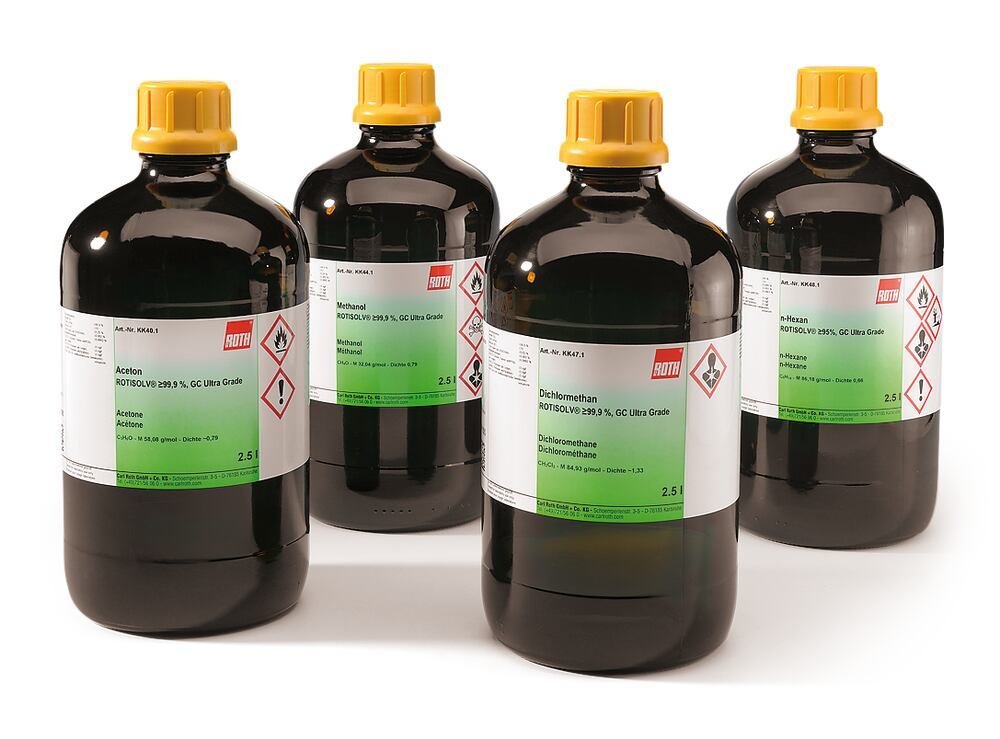
Reliable gas chromatography begins well before a prepared sample reaches the injector. The solvent used during collection, extraction, dilution and transfer can influence analyte recovery, contamination levels and peak behaviour. High-purity Solvents for GC support the preparation of volatile and semi-volatile compounds for environmental, pharmaceutical, food, petrochemical, forensic and industrial testing.
The correct solvent must dissolve the target compounds, remain compatible with the analytical method and produce minimal background interference. Its suitability should therefore be evaluated as part of the complete sample pathway.
What Is the Role of a Solvent in Gas Chromatography?
Gas chromatography uses a carrier gas to transport vaporised compounds through the column. The liquid solvent is not the mobile phase. Instead, it commonly serves as the medium in which analytes are extracted, dissolved, diluted or introduced into the instrument.
After injection, the solvent vaporises in the heated inlet. Its physical properties can influence expansion volume, solvent focusing and the early part of the chromatogram. A poorly selected solvent may contribute to distorted peaks, unexpected background signals or incomplete analyte transfer.
Why Does Solvent Purity Affect Trace Analysis?
Even a small solvent impurity can become significant when the target compounds are present at trace levels. Contaminants may appear as unidentified peaks, elevate the baseline or overlap with compounds of interest. This can make identification and quantification less reliable.
A solvent specification may provide information about:
- Chemical assay
- Water content
- Evaporation residue
- GC-detectable impurities
- Acidity or alkalinity
- Stabiliser content
- Packaging and batch traceability
- Suitability for residue analysis
“High purity” is not a universal analytical grade. Laboratories should compare the actual specification and chromatographic suitability with the sensitivity required by their method.
Why Must Sample Collection Be Controlled?
An analytical result can only represent the material that was collected. Suitable Sampling equipment helps laboratories obtain representative portions of liquids, powders, viscous substances and other materials before GC preparation begins.
The sampler and receiving container must not release interfering compounds, absorb the target analytes or react with the sample. Volatile compounds can also be lost through unnecessary exposure, headspace or unsuitable closures. A documented sampling procedure should define the location, quantity, container, preservation method and transport conditions.
How Does Liquid-Liquid Extraction Support GC Preparation?
Many samples contain water, oils, biological material or other components that should not be introduced directly into a GC system. Liquid-Liquid Extraction (SLE) can separate analytes according to how they distribute between immiscible phases.
Extraction performance depends on solvent polarity, pH, phase ratio, mixing and partition behaviour. The chosen organic solvent should recover the desired compounds while leaving as much unwanted matrix material as possible in the other phase.
Emulsions, incomplete separation and evaporation losses can reduce recovery. These factors should be assessed during method development rather than corrected only after inconsistent results appear.
When Is Solid-Phase Extraction Useful?
Complex samples may require further clean-up or concentration before injection. SPE (Solid Phase Extraction) retains analytes or interfering substances on a selected sorbent, allowing controlled washing and elution.
Solvent choice affects every SPE stage. A conditioning solvent prepares the sorbent, the wash solvent removes matrix components, and the elution solvent releases the retained analytes. Using an elution solvent that is too weak can reduce recovery, while one that is too strong may carry additional contaminants into the final extract.
The final solvent must also remain compatible with the GC injection method.
How Should Polarity and Volatility Guide Selection?
A suitable solvent must dissolve the analytes at their working concentrations and remain stable throughout preparation. Polar compounds may require alcohols, acetonitrile or another compatible polar medium, while non-polar compounds may dissolve more effectively in solvents such as hexane, cyclohexane, isooctane or toluene.
Boiling point also matters. A very volatile solvent can evaporate during open handling and change analyte concentration. A high-boiling solvent may remain in the inlet longer and complicate analysis. Method development should balance solubility, volatility, analyte retention and detector compatibility.
Why Does Injection Technique Matter?
GC injection requires a small, repeatable sample volume. Suitable Microlitre syringes support manual injection and autosampler workflows where accurate delivery is important.
The solvent expands rapidly inside the heated inlet. If the vapour volume exceeds the liner capacity, backflash can move sample vapour into unintended parts of the inlet system. This may produce carryover, poor repeatability or analyte loss.
Injection volume, inlet temperature, pressure, liner dimensions and solvent expansion characteristics must therefore be evaluated together.
How Can Transfer Equipment Influence Contamination?
Products within Syringes And Accessories support precise sample movement, but every wetted component can become a contamination source. Needles, syringe barrels and plungers may retain residues from previous samples if washing is insufficient.
The rinse solvent should dissolve the expected residues without damaging syringe components. Laboratories should define the number and sequence of pre-injection and post-injection washes. A worn plunger, blocked needle or trapped air bubble can also change the delivered volume.
Why Are Blanks and Calibration Solutions Necessary?
A solvent blank can reveal impurities introduced by the solvent, container, extraction materials or handling procedure. A method blank evaluates the full preparation process, while a carryover blank can help determine whether material remains in the injection pathway.
Suitable Calibration Standards help connect detector response with known reference values where their analyte, matrix and documentation match the method. Calibration and quality-control solutions should use a solvent compatible with both the target compounds and the analytical procedure.
Any significant difference between the solvent used for standards and the solvent used for samples should be assessed for its effect on response and peak shape.
What Problems Can an Unsuitable Solvent Cause?
Solvent-related problems may include:
- Unexpected blank peaks
- Rising or unstable baselines
- Split or broadened peaks
- Poor analyte recovery
- Inconsistent injection volumes
- Carryover between samples
- Co-elution with early analytes
- Excessive inlet expansion
- Residue inside the syringe or liner
- Changing concentration through evaporation
Troubleshooting should compare a fresh solvent blank, preparation blank, standard and sample. This sequence helps separate solvent contamination from problems caused by the matrix, instrument or preparation equipment.
What Should Buyers Confirm Before Ordering?
A purchasing review should include:
- Exact solvent identity and CAS number
- GC or residue-analysis grade
- Chemical assay and impurity limits
- Water and evaporation-residue specifications
- Presence of stabilisers
- Analyte solubility
- Boiling point and inlet compatibility
- Detector and column compatibility
- Bottle material and closure
- Certificate of analysis
- Pack size and expected consumption
- Storage and safety requirements
Building a Cleaner GC Sample Pathway
Solvents for GC influence the analytical process from initial extraction to final injection. Effective selection depends on more than purity alone. Solubility, volatility, preparation technique, injection behaviour and contamination control must work together.
By qualifying solvents through blanks, recovery studies and repeatability checks, laboratories can reduce background interference and protect sensitive measurements. A controlled sample pathway creates cleaner chromatograms and more defensible analytical results.