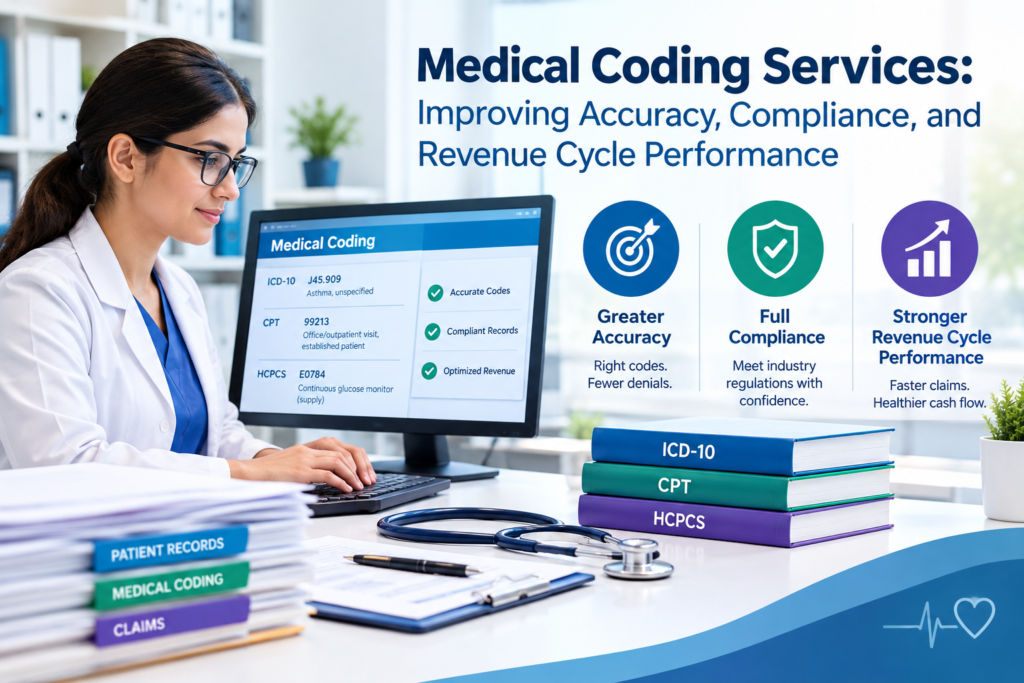
Medical Coding Services Improving Accuracy, Compliance, and Revenue Cycle Performance
Medical coding is one of the most important processes behind successful healthcare billing. Every patient encounter generates clinical information that must eventually be translated into standardized codes for billing, reporting, reimbursement, and recordkeeping. When those codes are incomplete, inaccurate, or inconsistent with the medical documentation, healthcare providers can experience claim denials, delayed payments, compliance concerns, and lost revenue.
This is why many physicians, clinics, hospitals, and healthcare organizations rely on professional Medical Coding Services to manage the complex coding requirements associated with modern healthcare.
Medical coding professionals interpret clinical documentation and assign appropriate diagnosis and procedure codes based on established coding guidelines. These codes help communicate what services were provided and why they were medically necessary. Standardized coding systems are essential for processing healthcare claims consistently across payers.
As coding requirements continue to evolve, professional coding support can help practices maintain accuracy while allowing physicians and administrative teams to focus more on patient care.
What Are Medical Coding Services?
Medical Coding Services involve converting information from patient records, clinical notes, operative reports, and other healthcare documentation into standardized medical codes.
Coders review documentation and identify the diagnoses, procedures, treatments, and services that need to be represented on a healthcare claim. Depending on the type of service, coding may involve systems such as ICD-10-CM, CPT, and HCPCS.
For example, ICD-10-CM is used to report diagnoses, while CPT codes are primarily used to identify medical services and procedures provided by physicians and other healthcare professionals. HCPCS Level II codes are used for certain products, supplies, and services not included within CPT.
Professional coding is therefore much more than simply selecting a code from a database. It requires an understanding of clinical documentation, coding guidelines, payer requirements, modifiers, medical necessity, and specialty-specific procedures.
Why Accurate Medical Coding Matters
Accurate coding directly affects multiple areas of healthcare revenue cycle management.
A claim begins with documentation. The documentation supports the services provided, while the assigned codes communicate those services to the payer. If the codes do not accurately reflect the documentation, the claim may be rejected or denied.
Some common consequences of coding errors include:
- Claim denials and rejections
- Delayed reimbursement
- Incorrect reimbursement
- Compliance risks
- Increased administrative workload
- Lost revenue
- Additional claim corrections
- Difficulty maintaining accurate patient records
Healthcare organizations process enormous volumes of claims. CMS notes that insurers process billions of healthcare claims annually, making standardized coding systems essential for orderly claim processing.
Even a small coding problem repeated across hundreds or thousands of claims can create a significant financial impact.
Common Medical Coding Challenges for Healthcare Practices
Medical coding can become particularly challenging when practices manage multiple providers, specialties, procedures, and insurance plans.
1. Constant Coding Updates
Medical codes are not static. Coding systems are regularly updated to reflect changes in medical technology, procedures, diagnoses, and healthcare practices.
For example, CMS publishes annual ICD-10-CM and ICD-10-PCS updates. The 2027 ICD-10 files include code updates applicable beginning October 1, 2026.
Keeping internal staff updated on these changes requires ongoing education and monitoring.
2. Specialty-Specific Coding
Different medical specialties have different documentation and coding requirements.
A cardiology practice may deal with complex diagnostic procedures, while an orthopedic practice may frequently code surgical procedures and musculoskeletal conditions. Behavioral health, dermatology, neurology, gastroenterology, and primary care all have their own coding considerations.
Using a generic approach can increase the possibility of coding mistakes.
3. Documentation Gaps
Coders can only code what is properly supported by documentation.
If a physician’s note does not contain enough information to support a diagnosis or procedure, the coder may need clarification. Missing documentation can contribute to incomplete claims and reimbursement problems.
4. Modifier Selection
Modifiers can provide additional information about how, where, or under what circumstances a service was performed.
Incorrect modifier use can lead to claim problems, incorrect reimbursement, or compliance concerns. Professional coders carefully review documentation and payer requirements before assigning applicable modifiers.
5. Payer-Specific Requirements
Different insurance companies may have different policies regarding medical necessity, authorization, coding combinations, and claim submission.
A coding approach that works for one payer may not necessarily work for another. This makes payer awareness an important component of effective medical coding.
Key Types of Medical Coding
Professional Medical Coding Services may involve several coding systems depending on the healthcare setting and services provided.
ICD-10-CM Coding
ICD-10-CM is commonly used to report diagnoses and health conditions.
It provides a standardized classification system that allows healthcare organizations and payers to communicate diagnoses consistently.
CMS states that ICD-10 applies to entities covered by HIPAA and is used for services provided under the applicable coding requirements.
CPT Coding
Current Procedural Terminology, commonly known as CPT, is used primarily to identify medical services and procedures provided by physicians and other healthcare professionals.
CPT is part of HCPCS Level I, and the AMA maintains and updates the CPT code set.
HCPCS Level II Coding
HCPCS Level II codes are primarily used for products, supplies, and services that are not included within CPT.
Examples can include certain durable medical equipment, ambulance services, prosthetics, orthotics, and supplies.
Understanding the distinctions among these code sets helps healthcare organizations submit more complete and accurate claims.
How Professional Medical Coding Services Work
A professional coding workflow generally follows a structured process.
Step 1: Review Patient Documentation
The coding team reviews relevant clinical documentation, including physician notes, procedure reports, diagnoses, treatment details, and other supporting records.
Step 2: Identify Billable Services
Coders determine which diagnoses, procedures, and services are supported by the documentation.
Step 3: Assign Appropriate Codes
The coder selects applicable ICD-10-CM, CPT, HCPCS, and other relevant codes based on the documentation and applicable guidelines.
Step 4: Review Modifiers and Code Relationships
The coding team evaluates whether modifiers are necessary and checks for potential coding conflicts, bundling issues, or other claim-related concerns.
Step 5: Verify Documentation Support
Each selected code should be supported by the patient’s medical record. This helps create a stronger connection between the clinical documentation and the submitted claim.
Step 6: Coordinate With Billing
Once coding is completed, the information can move into the billing process for claim preparation and submission.
This connection between coding and billing is important because accurate coding provides the foundation for a cleaner revenue cycle.
Benefits of Outsourcing Medical Coding Services
For many healthcare organizations, maintaining an internal coding department can be expensive and challenging.
Recruiting experienced coders, providing continuing education, monitoring performance, and keeping up with coding updates can require significant resources.
Outsourcing Medical Coding Services can provide several advantages.
Improved Coding Accuracy
Professional coders focus specifically on reviewing documentation and assigning appropriate codes. A dedicated coding team can help reduce avoidable mistakes and improve consistency.
Reduced Administrative Workload
Physicians and office staff already have demanding responsibilities. Outsourcing coding can reduce the amount of time internal employees spend reviewing codes and resolving coding-related issues.
Better Claim Quality
Accurate coding helps create claims that better reflect the services documented in the patient’s record. This can support a more efficient billing workflow.
Access to Specialized Expertise
Professional coding teams can support different specialties and coding scenarios, giving healthcare organizations access to expertise without having to build a large internal department.
Scalability
A growing medical practice may process more patients and claims over time. Outsourced coding support can make it easier to scale operations without proportionally increasing internal administrative staff.
Ongoing Coding Updates
Coding systems change regularly. An experienced coding partner can monitor relevant updates and incorporate them into established workflows.
Medical Coding and Revenue Cycle Management
Coding is not an isolated administrative task. It is an important part of the broader revenue cycle.
The process often begins with patient registration and eligibility verification, continues through documentation and coding, and then moves into charge entry, claim submission, payment posting, denial management, and accounts receivable follow-up.
If coding errors occur early in this process, the impact can continue throughout the revenue cycle.
For example, an incorrect diagnosis code could affect medical necessity. An incorrect procedure code could affect reimbursement. A missing modifier could result in a denied or incorrectly processed claim.
This is why practices often benefit from integrating coding with their overall billing strategy.
SybridMD describes its healthcare revenue cycle approach as connecting coding with billing, claims management, denial management, reporting, and other revenue cycle functions.
Medical Coding Services for Different Specialties
Every specialty presents unique coding requirements.
Professional coding support can be particularly useful for practices that handle complex or high-volume services.
Primary Care
Primary care practices may handle preventive visits, chronic disease management, office consultations, diagnostic testing, and a wide range of common medical conditions.
Cardiology
Cardiology coding can involve diagnostic testing, procedures, consultations, and complex cardiovascular conditions that require careful documentation review.
Orthopedics
Orthopedic practices often deal with injuries, musculoskeletal conditions, imaging, injections, and surgical procedures.
Neurology
Neurology coding may involve complex neurological diagnoses, evaluations, testing, and treatment plans.
Psychiatry and Behavioral Health
Behavioral health coding requires attention to diagnosis documentation, evaluation and management services, therapy services, and applicable payer requirements.
Multi-Specialty Practices
Multi-specialty organizations face additional challenges because different departments may follow different coding workflows.
A centralized professional coding team can help standardize processes while maintaining specialty-specific expertise.
SybridMD highlights specialty-focused coding and billing workflows across areas including cardiology, neurology, ophthalmology, pediatrics, nephrology, and other healthcare specialties.
How Coding Errors Can Affect Revenue
A coding error may appear small, but its financial consequences can accumulate.
Consider a practice that submits hundreds of claims every month. If recurring coding mistakes cause even a small percentage of claims to be rejected or denied, staff members may need to spend additional time researching, correcting, and resubmitting those claims.
This creates a chain reaction:
Coding error → claim issue → payment delay → additional staff work → slower cash flow
Professional coding support can help identify potential issues earlier in the billing process.
Rather than waiting for a payer to reject a claim, practices can implement coding review processes designed to catch errors before submission.
Compliance and Medical Coding
Healthcare organizations operate within a highly regulated environment. Coding must be based on documentation and applicable coding requirements rather than simply selecting codes that produce higher reimbursement.
The goal should be accurate representation of the care provided.
CMS explains that standardized coding systems provide a common language for medical, surgical, and diagnostic services and are important for consistent healthcare claim processing.
A structured coding process can therefore support both financial performance and compliance objectives.
Regular coding audits and reviews can also help practices identify patterns that may require additional education or workflow improvements.
Choosing the Right Medical Coding Partner
Not every coding company provides the same level of support. Healthcare organizations should evaluate potential partners carefully.
Consider factors such as:
- Experience with your specialty
- Coder qualifications
- Knowledge of ICD-10-CM and CPT
- Understanding of payer requirements
- Quality assurance processes
- Compliance procedures
- EHR and practice management compatibility
- Reporting capabilities
- Communication and support
- Ability to scale with your practice
The right partner should function as an extension of your revenue cycle team rather than simply performing isolated coding tasks.
Why Choose SybridMD for Medical Coding Support?
SybridMD provides healthcare organizations with integrated billing and revenue cycle support, including professional coding assistance.
Its approach connects coding with the broader billing process, helping practices address claim accuracy, denials, reimbursement workflows, and revenue cycle performance. SybridMD states that its team includes certified AAPC coders and supports specialty-focused physician billing workflows.
For practices dealing with coding backlogs, inconsistent coding, growing claim volumes, or administrative workload, outsourced coding support can provide a practical way to strengthen internal operations.
Rather than requiring physicians and office staff to manage every coding responsibility internally, a specialized team can handle the detailed work while the practice focuses on patient care.
Final Thoughts
Accurate medical coding is fundamental to an efficient healthcare revenue cycle. It connects clinical documentation with billing, reimbursement, reporting, and compliance.
As coding systems continue to evolve, healthcare organizations must stay current with code updates, documentation requirements, specialty-specific rules, and payer expectations. CMS continues to publish updates to ICD-10 and HCPCS code sets, making ongoing coding knowledge increasingly important.
For growing practices, outsourcing Medical Coding Services can provide access to specialized expertise while reducing administrative pressure on internal teams.
The right coding partner can help improve documentation-to-claim accuracy, support cleaner billing workflows, identify recurring coding issues, and contribute to a more organized revenue cycle.
If your practice is looking for dependable coding support, explore SybridMD’s Medical Coding Services to learn how professional coding assistance can fit into your healthcare revenue cycle strategy.
Accurate coding is not just about choosing the right code—it is about creating a reliable connection between patient care, documentation, billing, and reimbursement.