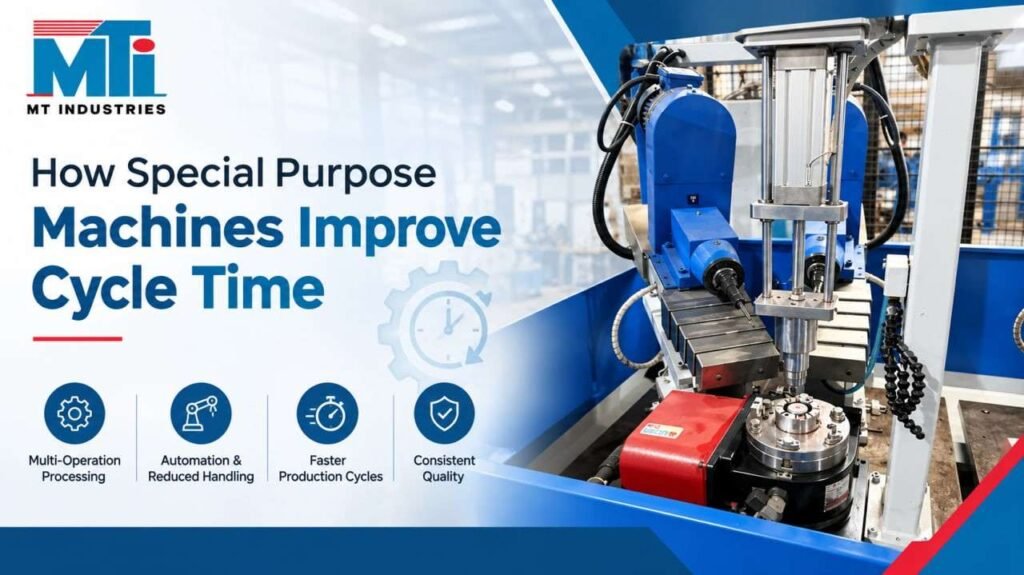
In modern manufacturing, improving production speed is not simply about running machines faster. Increasing spindle speed, feed rate, or operator workload can sometimes create new problems such as tool wear, quality variation, machine downtime, and inconsistent output.
A more practical approach is to examine the cycle time of the entire manufacturing operation and identify where unnecessary movement, handling, positioning, or repeated operations are taking place.
This is where Special Purpose Machines (SPMs) can make a significant difference. Designed around a specific component or manufacturing process, an SPM can combine multiple operations into a controlled and repeatable production cycle.
For manufacturers producing components in medium or high volumes, working with an experienced Special Purpose Machines Manufacturer can help transform a time-consuming sequence of individual operations into a more streamlined process.
What Is Cycle Time in Manufacturing?
Cycle time is the total time required to complete one production cycle for a particular component or product.
Depending on the process, cycle time may include:
- Component loading and unloading
- Workpiece positioning
- Clamping and unclamping
- Drilling, tapping, milling, or other machining operations
- Tool movement
- Indexing or transfer between stations
- Inspection or process verification
- Operator handling
For example, suppose a component requires drilling at several locations. On a conventional setup, an operator may need to position the component multiple times or move it between different machines.
A properly designed SPM can perform several of these operations within one integrated cycle. The result is not merely faster machining—it can also mean fewer handling steps and less non-productive time.
How Special Purpose Machines Reduce Cycle Time
The biggest advantage of an SPM is that its design is based on a specific production requirement.
Instead of adapting a general-purpose machine to perform many unrelated tasks, an SPM can be engineered around the component geometry, operation sequence, production volume, and required output.
Here are some of the main ways it can improve cycle time.
1. Combining Multiple Operations
One of the most effective ways to reduce cycle time is to perform multiple operations during the same production cycle.
A Special Purpose Machine may combine processes such as:
- Drilling
- Tapping
- Reaming
- Milling
- Facing
- Chamfering
- Part transfer
- Inspection
For instance, a component requiring multiple holes can potentially be processed using multiple drilling heads instead of completing each hole individually on separate setups.
This reduces repeated loading, positioning, and unloading.
2. Reducing Workpiece Handling
Material handling can consume a surprising amount of production time.
Every time a component is moved from one machine to another, additional time is required for loading, unloading, alignment, transportation, and repositioning.
An SPM can bring several operations together, reducing the number of times the workpiece needs to be handled.
This is particularly useful in high-volume manufacturing, where even a few seconds saved per component can produce a substantial improvement in daily output.
3. Minimizing Setup and Positioning Time
Correct positioning is essential for machining accuracy. However, repeated positioning can increase cycle time.
SPMs can use dedicated fixtures and workholding arrangements designed specifically for the component.
A well-designed fixture can help:
- Locate the component consistently
- Reduce manual alignment
- Improve repeatability
- Shorten loading time
- Maintain the required machining position
The benefit comes from designing the fixture and machine sequence together rather than treating workholding as a separate consideration.
4. Using Multi-Spindle and Multi-Head Configurations
Multi-spindle and multi-head arrangements can allow several machining operations to take place simultaneously or in a coordinated sequence.
For example, instead of drilling four holes sequentially with a single spindle, a suitable multi-spindle arrangement may allow multiple holes to be processed together.
The actual cycle-time improvement depends on factors such as:
- Number of operations
- Material
- Hole diameter
- Cutting parameters
- Tool selection
- Machine configuration
- Component geometry
- Required accuracy
Therefore, simply adding more spindles does not automatically guarantee a particular percentage reduction. The machine must be engineered around the actual process.
5. Automating Repetitive Movements
Manual loading, positioning, transfer, and unloading can become bottlenecks in repetitive production.
An SPM can incorporate automation for selected stages of the process, depending on the application.
Possible automation features include:
- Automatic component loading
- Pneumatic or hydraulic clamping
- Automatic indexing
- Part transfer mechanisms
- Automatic tool movement
- Component ejection
- In-process inspection
The objective is to create a predictable sequence in which each production cycle follows the same defined process.
6. Improving Process Consistency
Cycle time is not only about the fastest possible production cycle. Consistency is equally important.
Consider a manual operation where one operator completes a component in 45 seconds while another requires 55 seconds. The average cycle time may appear acceptable, but production planning becomes difficult.
A properly engineered SPM can establish a more consistent operating sequence.
This helps manufacturers achieve:
- More predictable output
- Better production planning
- Stable takt-time performance
- Consistent machining cycles
- Reduced operator-dependent variation
For this reason, an SPM Machines Manufacturer needs to consider the complete production process rather than focusing solely on machine speed.
7. Reducing Non-Productive Time
Not every second of a production cycle adds value to the component.
Non-productive activities can include:
- Manual repositioning
- Waiting for another operation
- Excessive tool travel
- Component transfer
- Repeated clamping
- Manual inspection
- Unnecessary machine movement
A good SPM design attempts to reduce these activities without compromising safety, quality, or tool life.
This is one reason why process mapping should be performed before designing the machine.
How to Calculate Cycle Time Improvement
Manufacturers can compare the existing process with the proposed SPM process using a simple calculation.
Cycle Time Reduction (%) =
(Old Cycle Time − New Cycle Time) ÷ Old Cycle Time × 100
For example, if the existing process takes 60 seconds per component and the redesigned process takes 40 seconds:
(60 − 40) ÷ 60 × 100 = 33.3%
So the cycle time has been reduced by approximately 33.3%.
However, cycle time should not be evaluated in isolation. Manufacturers should also consider machine availability, tool changes, quality rejection, maintenance requirements, operator involvement, and actual production demand.
What Should Manufacturers Evaluate Before Choosing an SPM?
Selecting an SPM should begin with the production problem, not with the machine itself.
Before approaching a Special Purpose Machines Manufacturer in India, document the current manufacturing process.
Important information includes:
Current Cycle Time
Measure the actual time required to produce one acceptable component.
Production Volume
Determine the required hourly, daily, monthly, or annual output.
Number of Operations
Identify which operations could potentially be combined.
Component Specifications
Consider material, dimensions, tolerances, hole patterns, surface requirements, and component geometry.
Existing Bottlenecks
Find out where production is losing time. The bottleneck may not always be machining. It could be loading, inspection, transfer, or fixture changeover.
Quality Requirements
Faster production is useful only when quality remains within specification.
Tool Life
Cutting parameters should be selected with tool life and process stability in mind rather than maximum speed alone.
The Role of an Experienced SPM Manufacturer
Designing an SPM is different from purchasing an off-the-shelf machine.
An experienced SPM Machines Manufacturer in India generally evaluates the application before determining the machine architecture. This may involve studying the component drawing, operation sequence, production target, tooling requirements, fixture concept, automation requirements, and available shop-floor space.
For example, MT Industries works around the principle that the machine configuration should follow the manufacturing requirement. Depending on the application, this can involve multi-operation, drilling, tapping, or other customized arrangements.
The right engineering approach can also make future maintenance easier by considering accessibility, tooling, lubrication, component replacement, and machine controls during the design stage.
SPMs and Overall Production Efficiency
Reducing cycle time is only one part of improving manufacturing efficiency.
A machine that produces components quickly but experiences frequent breakdowns may not deliver the expected output.
Manufacturers should therefore consider Overall Equipment Effectiveness (OEE) along with cycle time.
OEE generally considers:
Availability × Performance × Quality
An SPM can contribute to all three when appropriately designed:
- Availability: Reliable machine design can reduce unnecessary downtime.
- Performance: Optimized sequences can improve production rate.
- Quality: Dedicated fixtures and controlled processes can improve repeatability.
This broader perspective is important when evaluating the long-term value of an SPM.
Why Cycle Time Should Be Optimized, Not Just Reduced
The fastest possible cycle is not necessarily the best cycle.
Excessive cutting speeds or aggressive feeds may shorten machining time but increase tool wear, heat generation, vibration, or rejection rates.
A better objective is optimized cycle time—the point at which production speed, quality, tool life, machine reliability, and operating cost are properly balanced.
For manufacturers, this approach usually provides a more sustainable improvement than simply attempting to maximize machine speed.
Practical Steps to Reduce Cycle Time With an SPM
Manufacturers considering an SPM project can follow these steps:
- Measure the current cycle time accurately.
- Break the cycle into individual operations.
- Identify non-value-added movements and delays.
- Determine which operations can be performed simultaneously.
- Review fixture and workholding requirements.
- Evaluate multi-spindle or multi-head configurations where appropriate.
- Consider automation for repetitive handling tasks.
- Optimize cutting parameters without sacrificing tool life.
- Define quality and inspection requirements.
- Compare expected output with actual production requirements.
This process helps ensure that the machine is solving a measurable production problem rather than simply adding automation.
Conclusion
Special Purpose Machines can improve cycle time by combining operations, reducing workpiece handling, minimizing setup time, automating repetitive movements, and creating a more consistent production sequence.
The greatest gains generally come when the machine is designed around the actual component and manufacturing process.
Whether a manufacturer is evaluating a drilling application, tapping operation, multi-operation process, or automated production line, the right Special Purpose Machines Manufacturer should first understand the existing process and identify where time is being lost.
For companies evaluating customized production equipment, MT Industries is one example of an engineering-focused manufacturer working with application-specific SPM requirements. The important consideration, however, is not simply the manufacturer name—it is whether the proposed machine can demonstrably improve cycle time while maintaining quality, reliability, and maintainability.
Ultimately, the best SPM is not necessarily the machine that runs the fastest. It is the machine that delivers the required output with a stable, repeatable, and economically sustainable production cycle.
Frequently Asked Questions
1. How do Special Purpose Machines reduce cycle time?
Special Purpose Machines reduce cycle time by combining multiple operations, minimizing component handling, reducing positioning time, and automating repetitive production activities. The exact improvement depends on the application and machine configuration.
2. Can an SPM perform multiple operations simultaneously?
Yes. Depending on the component and process, an SPM can be configured with multiple spindles, heads, stations, or machining units so that selected operations can occur simultaneously or in a coordinated sequence.
3. How do I choose a Special Purpose Machines Manufacturer?
Look for a manufacturer that can understand your component, production volume, cycle-time target, tooling, fixture, automation, accuracy, and maintenance requirements. A good Special Purpose Machines Manufacturer should be able to explain how the proposed machine addresses your specific production bottlenecks.
4. Are SPMs suitable for high-volume production?
Yes. SPMs are particularly useful for repetitive, medium- to high-volume production where dedicated tooling, consistent cycles, and reduced manual intervention can provide measurable advantages.
5. What information should I provide to an SPM manufacturer?
Provide the component drawing, material, required tolerances, current cycle time, production volume, existing process sequence, tooling details, quality requirements, and desired output. This information helps the manufacturer evaluate the application and develop a suitable machine concept. MT Industries can use such production information to understand the required SPM configuration rather than relying on a generic machine setup.
For More Information Click Here:- https://mtindustries.in/service-spm