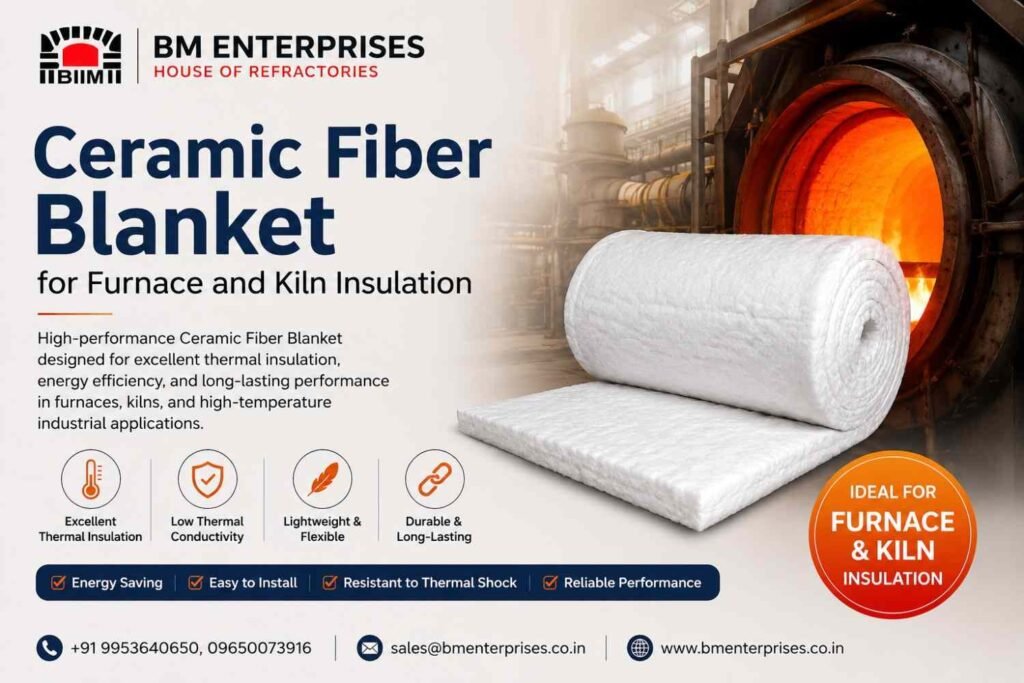
For furnace and kiln applications, the blanket acts like a thermal barrier between the hot interior and the equipment shell. Instead of allowing a large amount of heat to migrate through the furnace wall, the fibrous structure slows heat movement and helps maintain the desired internal temperature. This can improve thermal efficiency and reduce unnecessary energy loss. Ceramic insulation blankets are also useful for fast heating and cooling cycles because their low thermal mass means less energy is required to heat the insulation itself. BM Enterprises supplies ceramic fiber insulation products for industrial furnaces, kilns, boilers, and related high-temperature equipment, including Shree Cera ceramic fiber blankets with a stated density of 128 kg/m³ and a classification temperature of 1260 °C.
*The specifications may differ depending on the manufacturer. Always ensure you check the technical specification data sheet before purchasing. The current ShreeCera stock shows 128 kg/m³ density and 1260°C temperature grade.
What Is a Ceramic Fiber Blanket?
Ceramic blankets are flexible thermal insulators that are useful in high-temperature environments like furnaces, kilns, boilers, ovens, and heat treatment machines. Their fibrous structure provides low thermal conductivity and low heat storage, helping reduce heat loss while allowing equipment to heat and cool relatively quickly. Different types of ceramic blankets are available, varying in density and thickness as per industrial requirements. In the field of industrial insulation, ceramic fiber insulation blankets have become popular because of the properties of flexibility and thermal shock resistance. These blankets can easily be cut and fitted into the furnace walls, doors, roofs, corners, and expansion joints. BM Enterprises offers ceramic fiber insulation for industries, including 128 kg/m³ blankets.Why Use Ceramic Fiber Blankets for Furnace Insulation?
Efficient insulation is required for the proper functioning of a furnace by maintaining the temperature inside and avoiding excess heat from leaking through the walls of the furnace. The use of ceramic blankets provides a lightweight insulation material that can be employed for furnace lining or as insulation backing. Their lower thermal mass can also help in saving energy in case of heating-cooling cycles.Key Benefits
- Lightweight and flexible structure
- Low thermal conductivity
- Low heat capacity
- High resistance to thermal shock
- Simple cutting and installation
- High-temperature insulation material
- Can be made in varying thickness and density
Ceramic Fiber Blanket for Kiln Insulation
The insulation blanket for kiln insulation is widely used in ceramic, refractory, heat treatment, and industrial processing kilns. The blanket can be fitted in the walls, roof, doors, and as backup insulation material behind other refractory materials in the kiln. The flexible nature of the blanket allows for easy installation on non-flat surfaces compared to rigid insulators. For instance, some commercially available ShreeCera blankets have a density of 128 kg/m³, a temperature rating of 1260°C, a width of 610 mm, and thicknesses of 6 mm, 12 mm, 20 mm, 25 mm, and 50 mm.Ceramic Fiber Blanket 128 kg/m³ Specifications
Ceramic Fiber Blanket Density 128 Kg/M³ has been one of the popular industrial insulator specifications. The definition of density means the quantity of the fiber material in a particular volume, and this can have an effect on the strength of the blanket. Another important specification by BHEL is the ceramic insulating blanket density of 128 kg/m³.Important Technical Properties
| Property | Typical Specification |
| Density | 128 kg/m³ |
| Temperature Grade | 1260°C* |
| Thermal Conductivity | Around 0.15 W/mK* |
| Width | 610 mm* |
| Thickness | 6, 12, 20, 25 & 50 mm* |
| Form | Roll |
Common Applications
Furnace and Kiln Applications
The ceramic refractory blanket material is ideal for the walls, doors, roofs, expansion joints, and backing insulation in industrial furnaces and kilns. It is also ideal for equipment that uses heat treatment with thermal cycling.Other Industrial Applications
Other applications include:- Boilers
- Ovens
- Ducts and pipes
- Heat-treatment equipment
- Furnace doors
- Expansion joints
- High-temperature equipment
- Fire-protection insulation