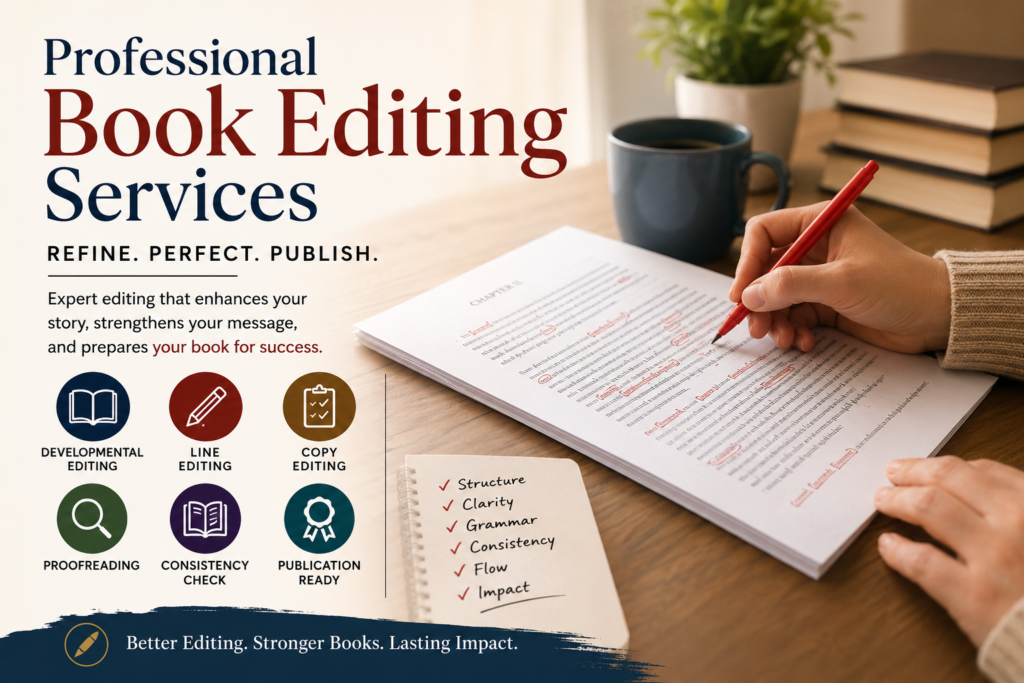
Why Professional Book Editing Services Are Essential for a Publication-Ready Manuscript
Writing a book is a major achievement. Whether you are working on a novel, memoir, business book, self-help guide, biography, or another form of nonfiction, completing the manuscript is only one part of the publishing journey. Before your book reaches readers, it needs to be reviewed, refined, and prepared to meet professional publishing standards.
This is where Book Editing Services can make a significant difference.
Even experienced writers can overlook grammar mistakes, inconsistencies, weak transitions, repetitive language, or structural problems in their own manuscripts. After spending months or years working on the same material, authors naturally become familiar with their words, making it difficult to identify problems objectively.
Professional editing provides a fresh perspective. An experienced editor can examine your manuscript carefully, identify areas that need improvement, and strengthen the writing while respecting your unique voice.
What Are Book Editing Services?
Book Editing Services are professional editorial solutions designed to improve a manuscript before publication. Depending on the condition of the manuscript and the author’s goals, editing may involve correcting language errors, improving sentence structure, strengthening the overall flow, or addressing larger structural issues.
Book editing is not simply about finding spelling mistakes. Professional editors look at the manuscript from the perspective of its intended readers.
For example, a fiction editor may examine:
- Character development
- Plot structure
- Dialogue
- Pacing
- Narrative consistency
- Point of view
- Scene transitions
For nonfiction, an editor may focus on:
- Organization of ideas
- Logical progression
- Clarity
- Tone
- Accuracy and consistency
- Reader engagement
- Repetition and unnecessary content
Professional editors can therefore help transform a rough manuscript into a clearer, more polished, and more engaging book.
Why Authors Should Not Rely Only on Self-Editing
Self-editing is an important part of the writing process. Authors should always review their manuscripts before sending them to an editor. However, relying exclusively on self-editing can create problems.
When you write a manuscript, you already know what you intended to say. Your brain can automatically fill in missing words or overlook mistakes because it recognizes the intended meaning rather than carefully processing every sentence.
A professional editor approaches the manuscript differently.
Instead of knowing what you meant, the editor evaluates what is actually written on the page. This objective perspective can reveal problems that the author may have missed.
For example, you might understand why a character behaves a certain way because you know their entire backstory. However, if the reader has not received enough information, the character’s actions may appear confusing. An editor can identify this gap and recommend a solution.
The same principle applies to nonfiction. You may understand a complex subject extremely well, but your readers may not have the same knowledge. An editor can help ensure that explanations are accessible without unnecessarily simplifying your ideas.
Different Types of Book Editing
Not every manuscript needs the same level of editing. Professional Book Editing Services can include several different stages, depending on the author’s needs.
1. Developmental Editing
Developmental editing focuses on the big picture.
At this stage, the editor evaluates how effectively the entire manuscript works. In fiction, this may involve examining the plot, characters, pacing, conflicts, themes, and overall story structure.
For nonfiction, developmental editing may examine the organization of chapters, arguments, explanations, supporting information, and the logical progression of ideas.
Developmental editing can be particularly valuable when an author has completed a first draft but knows that the manuscript still needs significant improvement.
2. Line Editing
Line editing focuses more closely on the actual writing.
A line editor examines sentences and paragraphs to improve readability, rhythm, tone, clarity, and overall style.
The goal is not necessarily to change the author’s personality or writing style. Instead, a good editor works to make the author’s existing voice more effective.
For example, an editor may identify sentences that are unnecessarily complicated and suggest clearer alternatives. They may also remove repetition or improve transitions between paragraphs.
3. Copy Editing
Copy editing focuses heavily on correctness and consistency.
A professional copy editor may review:
- Grammar
- Spelling
- Punctuation
- Sentence structure
- Capitalization
- Word usage
- Formatting consistency
- Terminology
- Style consistency
Copy editing is particularly important for long manuscripts because inconsistencies can easily appear over dozens of chapters.
For instance, a character’s name might accidentally be spelled differently in different chapters. A nonfiction author might use two different terms for the same concept. An editor can identify and correct these issues.
4. Proofreading
Proofreading is generally performed near the end of the publishing process.
It is the final opportunity to identify surface-level mistakes before publication. A proofreader may look for typographical errors, punctuation mistakes, formatting inconsistencies, missing words, or other small problems that remain after editing.
It is important to understand that proofreading and editing are not the same thing. Proofreading is not intended to replace developmental editing or copy editing.
A manuscript with significant structural or language problems may require editing before it reaches the proofreading stage.
How Professional Editing Improves a Book
A professionally edited manuscript can provide several advantages for authors.
Improves Readability
Readers expect books to be easy to follow. Confusing sentences, unnecessary repetition, poor transitions, and inconsistent language can interrupt the reading experience.
An experienced editor can identify these problems and make the manuscript smoother and easier to understand.
Strengthens the Author’s Voice
Some writers worry that hiring an editor means losing their personal writing style.
A skilled editor should not rewrite a manuscript simply to make it sound like their own work. Instead, editing should help the author’s voice become clearer and more consistent.
Whether your writing style is humorous, emotional, conversational, academic, dramatic, or formal, the editing process should respect your intended tone.
Identifies Inconsistencies
Long manuscripts often contain continuity issues that authors fail to notice.
In fiction, these might include:
- Changes in character names
- Conflicting timelines
- Incorrect ages
- Inconsistent locations
- Changes in character descriptions
In nonfiction, inconsistencies might involve terminology, dates, formatting, or repeated information.
Professional Book Editing Services can help identify these issues before readers discover them.
Creates a More Professional Manuscript
Readers notice quality.
A book containing frequent grammatical errors, awkward sentences, or inconsistent formatting may appear unfinished. This can affect how readers perceive the author’s professionalism.
Professional editing helps create a manuscript that feels carefully prepared and reader-focused.
Book Editing Services for Fiction Authors
Fiction requires more than grammatically correct sentences. A novel needs to keep readers interested from the first page to the final chapter.
Editors working on fiction can evaluate whether the story maintains momentum and whether the characters develop naturally.
For example, a developmental editor might notice that the opening chapters contain too much background information before the main conflict begins. They may recommend restructuring the opening so readers become engaged sooner.
Editors can also examine dialogue. Conversations should sound natural while contributing to characterization, conflict, or story progression.
Pacing is another important consideration. A thriller may require fast pacing and escalating tension, while a literary novel may intentionally use a slower rhythm. The editor’s role is to understand the genre and the author’s intentions rather than apply the same formula to every manuscript.
Book Editing Services for Nonfiction Authors
Nonfiction authors have different editorial requirements.
A business book, memoir, self-help book, biography, or educational guide needs to communicate ideas clearly and logically.
An editor can help determine whether chapters are organized effectively and whether readers can easily follow the author’s argument.
For example, if a chapter introduces a concept that is only explained several chapters later, readers may become confused. An editor can identify this issue and suggest reorganizing the material.
Editors can also help eliminate unnecessary repetition. Authors sometimes repeat important points because they want readers to remember them, but excessive repetition can make a book feel longer than necessary.
The goal is to preserve valuable information while presenting it in the clearest possible way.
How to Choose the Right Book Editing Service
Choosing an editor is an important decision because every manuscript is different.
Before hiring a provider, consider the following factors.
Look for Relevant Experience
An editor experienced in romance novels may not necessarily be the best choice for an academic book. Similarly, an editor specializing in business nonfiction may approach a children’s story differently.
Look for editorial experience that matches your genre and goals.
Understand What Is Included
Ask exactly what the service includes.
Does it cover developmental editing, copy editing, line editing, proofreading, or a combination? Understanding the scope prevents confusion later.
Consider Communication
Good communication can make the editing process much easier.
Authors should be able to explain their goals, preferences, concerns, and expectations. Professional editorial teams should also be able to communicate clearly about the work being performed.
Ask About Editing Style
Different editors follow different editorial styles and conventions. If you are preparing a manuscript for a particular market or publisher, consistency is especially important.
Consider Your Publishing Goals
The editing approach should depend partly on what you plan to do with the manuscript.
A book intended for self-publishing may have different requirements from a manuscript being submitted to literary agents or traditional publishers.
Understanding your publishing objective helps your editor determine what should be prioritized.
What Happens During the Book Editing Process?
Although the process can vary between providers, professional Book Editing Services generally follow a structured workflow.
The process may begin with a manuscript assessment. The editor reviews the project and determines what type of editorial support it requires.
The manuscript then moves through the agreed editing stage. Depending on the project, this may involve structural recommendations, sentence-level improvements, copy editing, or proofreading.
Authors may receive tracked changes, comments, or editorial notes that allow them to understand proposed revisions.
After reviewing the editor’s suggestions, the author can make decisions about which changes to accept.
This collaborative approach is important because the book ultimately belongs to the author. Editing should strengthen the manuscript without taking away the author’s creative ownership.
Why Editing Matters for Self-Published Authors
Self-publishing gives authors greater control over their books, but it also places more responsibility on them.
Traditionally published authors may have access to editorial teams during the publishing process. Self-published authors often have to arrange professional services themselves.
That makes professional editing especially important.
A self-published book competes for readers’ attention alongside traditionally published titles. A polished manuscript can help an independent author present their work professionally.
Editing cannot guarantee sales or positive reviews, but it can help eliminate avoidable problems that may negatively affect the reader’s experience.
Common Mistakes Authors Make Before Publishing
Many authors make similar mistakes when preparing a manuscript.
One common mistake is publishing immediately after completing the first draft. A first draft is rarely the final version.
Another mistake is asking friends or family members to perform all the editing. Feedback from people you trust can be useful, but professional editing requires specialized skills and an objective perspective.
Some authors also focus entirely on grammar while ignoring structure. Correct grammar cannot fix a weak plot, confusing organization, or poor pacing.
Finally, some writers treat proofreading as a substitute for editing. Proofreading is important, but it should normally happen after the manuscript has been properly edited.
The Value of Investing in Professional Editing
Hiring an editor is an investment in the quality of your book.
Writing a manuscript can take months or years. After investing that much time into a project, publishing an unfinished version can undermine the work that went into it.
Professional Book Editing Services provide an opportunity to refine the manuscript before readers see it.
A good editor can act as a second set of expert eyes—someone who understands writing, publishing, reader expectations, and the importance of consistency.
The result is not simply a manuscript with fewer spelling mistakes. It is a book that communicates more effectively and provides a better reading experience.
Give Your Manuscript the Professional Attention It Deserves
Your book represents your ideas, creativity, knowledge, and effort. Before sharing it with the world, give it the editorial attention it deserves.
Whether you need developmental guidance, line editing, copy editing, proofreading, or a combination of services, choosing the right editorial support can help move your manuscript closer to publication.
For authors looking for professional support in the UK, Wright Book Associates provides a range of editorial solutions designed to help authors refine their manuscripts. Their team offers proofreading, copy editing, developmental editing, and editorial assessment, allowing authors to select support based on their individual manuscript needs.
You can learn more about their Book Editing Services and discuss your manuscript requirements with their team.
Final Thoughts
A great book is not created simply by finishing a first draft. It develops through writing, revision, feedback, editing, and careful preparation.
Professional Book Editing Services can provide the objective perspective needed to identify weaknesses, strengthen language, improve consistency, and prepare a manuscript for its intended audience.
Whether you are a first-time novelist, an experienced author, a business professional, or a self-published writer, professional editing can help ensure that your ideas are presented in the strongest possible way.
Your story deserves more than simply being finished. It deserves to be refined, polished, and ready for readers.