Deciding to hire a CRM developer can feel like a leap of faith. You review resumes, conduct interviews, and compare portfolios, but there’s still a lingering question: what if the developer isn’t the right fit?
CRM projects often involve customer data, sales workflows, integrations, and automation. If the wrong person handles these areas, the consequences can extend beyond missed deadlines. You could end up with a system that creates more problems than it solves.
This is one reason money-back guarantees have gained attention in developer hiring services. They provide an additional layer of confidence and reduce the risk that often comes with bringing someone new onto a project.
The Real Risks of Hiring a CRM Developer
Most people don’t think about what can go wrong until it already has. A CRM project touches your sales data, your customer records, your entire revenue pipeline — so a bad hire isn’t just an inconvenience, it’s expensive in ways that aren’t always obvious upfront.
CRM work looks simple from the outside, but it isn’t. A developer can look great on paper — certifications, portfolio, glowing LinkedIn recommendations — and still be a poor fit for your actual workflow. Here’s where things usually fall apart.
Skill Mismatch on the Actual Platform
Maybe they’ve never worked with your specific platform’s quirks. Maybe they’re strong on Salesforce but weak on integrations, or they know the basics of Zoho but have never touched Deluge scripting. Certifications don’t always translate into hands-on comfort with your setup.
Poor Communication and Vanishing Progress
Maybe the communication style just doesn’t click, and three weeks go by with barely any real progress. This is especially common with solo freelancers who have no one checking in on their output.
No Real Vetting Behind the Profile
Freelance platforms make this worse because there’s often no real vetting behind the profile you’re looking at — anyone can list “CRM expert” on a bio.
Money Already Spent, No Way Out
Once you’ve paid upfront or locked into a monthly retainer, walking away usually means walking away with nothing to show for it. That’s the risk nobody talks about enough when you decide to hire CRM developer resources without a safety net in place.
How a Money-Back Guarantee Protects Your Investment
Choosing a CRM developer shouldn’t feel like a gamble.
A money-back guarantee creates accountability because the service provider has confidence in the talent being offered. It shows they are willing to stand behind their hiring process instead of simply assigning a developer and moving on.
A guarantee also gives clients an opportunity to evaluate the working relationship under real project conditions. Interviews can only reveal so much. Actual project work provides a much clearer picture of technical ability, communication style, responsiveness, and overall fit.
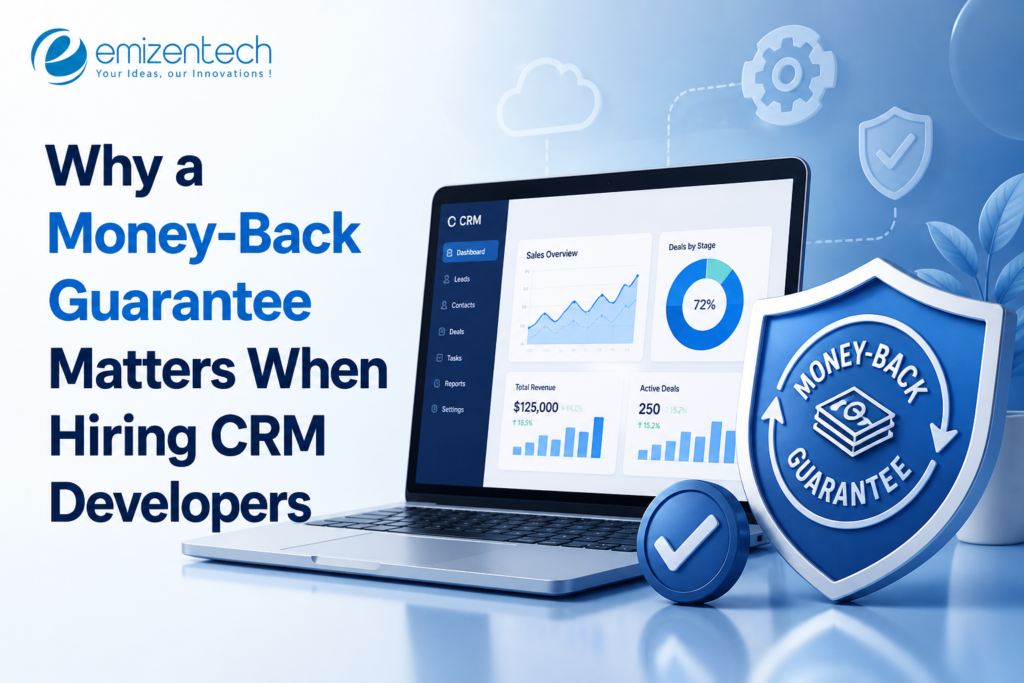
Some hiring providers, including EmizenTech’s CRM developer service, offer a 14-day money-back guarantee that allows clients to assess a developer’s performance during the initial engagement period. If the developer isn’t the right fit during those first 14 days, the client can receive a full refund rather than being limited to a replacement option.
This type of protection significantly reduces the uncertainty that often comes with technical hiring.
Instead of committing to a long engagement immediately, clients can move forward knowing there is a safety net in place if expectations aren’t met.
Key Benefits of Hiring CRM Developers With a Money-Back Guarantee
Beyond the obvious “get your money back” part, there’s a ripple effect. It changes how you approach the whole hiring process, honestly — with a lot less anxiety and a lot more willingness to actually test the fit.
- Lower financial risk — you’re not gambling a month’s budget on an unproven relationship.
- Faster decision-making — teams stop over-analyzing every candidate because the downside is capped.
- Better accountability — developers and the agencies behind them tend to perform better when there’s a real consequence attached to underdelivering.
- More honest trial period — you get to actually watch someone work on your project before committing long-term, which is far more useful than any interview.
- Peace of mind for non-technical founders — if you don’t have an in-house CTO to judge code quality, a guarantee acts as a built-in safety check.
This is really the core reason so many founders now specifically search out ways to hire CRM developer teams that offer this kind of protection instead of just going with whoever responds first.
What to Look for in a Money-Back Guarantee
Not every guarantee is created equal, and honestly, some are written vaguely on purpose. Read the fine print before you get excited about the headline number. A few things are worth checking every single time.
The Time Window
Is it 7 days, 14 days, 30 days? A window that’s too short doesn’t give you enough real working time to judge fit.
“No Questions Asked” — Really?
Check whether the refund is genuinely no-questions-asked or if there’s a list of conditions buried somewhere that make it hard to actually claim.
Refund vs. Store Credit
Ask whether it covers a full refund or just credit toward another hire, because those are very different things when you’re the one out of pocket.
Instant Replacement Option
Check if there’s a replacement bundled in too, since sometimes what you need isn’t your money back — you just need someone better, fast, without restarting the search from zero.
How to Evaluate CRM Developers Beyond the Guarantee
A guarantee is a safety net, not a substitute for actually doing your homework. Don’t let it lull you into skipping the basics. Here’s what actually matters when you’re checking someone out.
- Platform-specific project history — Salesforce experience doesn’t automatically translate to Zoho or HubSpot fluency, and the scripting languages are genuinely different underneath the hood.
- Code samples or a paid test task — ask for one before committing to anything bigger; it tells you more than a résumé ever will.
- Communication during the interview — if getting a straight answer feels like pulling teeth now, it won’t improve later.
- Oversight and accountability — check whether the company backs its developers with code reviews or a delivery manager; a lone freelancer with zero structure is a different risk profile than someone on an actual team.
- AI capability — ask directly if your roadmap includes lead scoring, predictive workflows, or CRM copilots, since plenty of developers who list “CRM experience” have never touched that side of the platform.
Conclusion
Hiring the wrong CRM developer costs more than money — it costs momentum, and sometimes it costs customer trust if your data gets mishandled along the way. A solid money-back guarantee doesn’t eliminate every risk, but it does shift the burden back onto the company doing the hiring, which is exactly where it belongs. If you’re ready to hire CRM developer talent without gambling your budget on a maybe, it’s worth working with a partner that puts its money where its mouth is. EmizenTech backs every CRM developer hire with a 14-day, no-questions-asked refund policy, so you get real working time to judge the fit before you’re locked in for good.
FAQ
1. What exactly does a 14-day money-back guarantee cover?
It typically covers the trial period during which you can evaluate the developer’s work on your actual project. If things aren’t working out within that window, you get your payment back instead of being stuck in a contract.
2. Is a replacement the same as a refund?
No. A replacement swaps in a new developer, which helps if the issue was just a bad personality or skill match. A refund actually returns your money, which matters more if you’ve decided the timing or budget isn’t right anymore.
3. Does a money-back guarantee mean the developer is automatically good?
Not on its own. It’s a safety net, not a quality certification. You still need to check portfolios, run test tasks, and evaluate communication before hiring.
4. Can startups with small budgets benefit from this kind of guarantee?
Arguably more than anyone else. Startups usually don’t have the cash cushion to absorb a bad hiring decision, so a refund window protects exactly the budget they can least afford to lose.
5. How do I confirm a company’s guarantee is legitimate and not just marketing?
Ask to see the actual written terms, not just the homepage banner. A trustworthy company will have a dedicated terms page spelling out the conditions clearly, rather than leaving it vague.