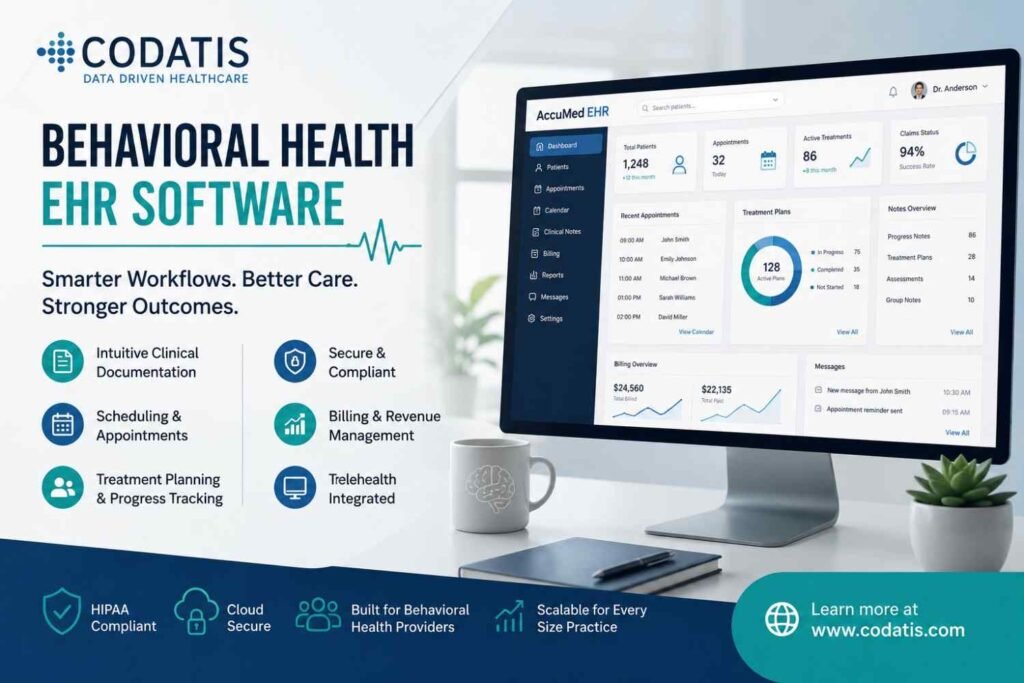
Finding the right electronic health record is one of the most important technology decisions a behavioral health practice can make. Therapists, psychiatrists, counselors, substance-use treatment providers, and larger behavioral health organizations do not all work the same way. A solo therapist may need simple documentation and scheduling, while a multi-provider organization may require advanced billing, reporting, telehealth, treatment workflows, and stronger administrative controls.
There is no single EHR that is automatically the best for every practice. Current industry comparisons consistently emphasize that the right choice depends on practice size, specialty, care model, documentation requirements, billing complexity, and scalability. For organizations considering AccuMed EHR, the key question is not simply whether it has many features. The better question is whether its capabilities match the way your behavioral health organization actually operates.
What Makes an EHR Good for Behavioral Health?
Behavioral health documentation is different from many other medical specialties. Providers may create recurring progress notes, treatment plans, assessments, outcome measurements, group-session documentation, and long-term patient records.
A strong behavioral health EHR should therefore support the complete workflow rather than focusing only on electronic charting.
Important areas include:
- Clinical documentation
- Treatment planning
- Appointment scheduling
- Insurance billing
- Revenue-cycle management
- Telehealth
- Patient communication
- Electronic prescribing
- Reporting
- Security and access controls
- Integrations
- Custom workflows
Recent behavioral health EHR research also highlights documentation, billing, telehealth, patient portals, reporting, interoperability, and security as major areas to evaluate before purchasing software.
Best EHR by Type of Behavioral Health Practice
Instead of asking which platform is universally best, practices should first determine what type of organization they operate.
Best for Solo Therapists
Solo therapists usually need simplicity. Their priorities may include:
- Fast note creation
- Easy scheduling
- Client communication
- Telehealth
- Basic billing
- Online intake
- Simple reporting
A complicated enterprise platform may create unnecessary administrative work for a provider who only needs a focused outpatient workflow.
Best for Group Practices
Group practices have additional requirements because several clinicians may share administrative resources.
A suitable system should provide:
- Multi-provider scheduling
- User permissions
- Shared patient records
- Billing coordination
- Provider reporting
- Automated reminders
- Scalable administration
As the number of clinicians increases, administrative controls become increasingly important.
Best for Psychiatry Practices
Psychiatry practices often need capabilities beyond traditional therapy documentation. Medication management, electronic prescribing, clinical assessments, appointment management, and insurance billing may become central parts of the workflow.
When comparing accumedic emr options with alternatives, psychiatric practices should specifically test prescribing, documentation, coding, and medication-related workflows.
Best for Substance-Use Treatment
Substance-use treatment organizations have particularly specialized requirements. They may need structured assessments, treatment planning, authorization workflows, level-of-care documentation, medication-related processes, billing, and regulatory controls.
General therapy software may not provide enough functionality for these organizations. Current industry guidance specifically recommends evaluating specialized requirements such as ASAM-related workflows and confidentiality requirements when substance-use treatment is involved.
Clinical Documentation Should Be a Top Priority
A behavioral health EHR should make documentation easier rather than adding more administrative work.
Providers may use SOAP, DAP, BIRP, narrative, or organization-specific documentation styles. Treatment plans also need to evolve as the patient’s care progresses.
During an EHR evaluation, ask:
- Can templates be customized?
- Can clinicians document quickly?
- Can treatment plans be updated efficiently?
- Can previous information be reviewed easily?
- Can supervisors review documentation appropriately?
- Can the organization maintain consistent workflows?
A feature may look impressive during a demonstration but still be inconvenient in daily use. The best test is to ask clinicians to complete realistic documentation tasks.
Billing and Revenue Cycle Management
An EHR should also support the financial side of behavioral healthcare.
Billing workflows can involve insurance eligibility, authorizations, claims, payments, denials, coding, and patient balances. Documentation and billing must work together because incomplete or inconsistent information can create downstream administrative problems.
When evaluating accumed ehr, practices should ask how clinical information flows into billing and whether staff have to manually duplicate information.
A good system should reduce unnecessary administrative steps while providing sufficient visibility into outstanding claims and financial performance.
Telehealth and Virtual Care
Telehealth is now an important component of many behavioral health practices. A useful EHR should make virtual care part of the overall workflow rather than forcing staff to manage it separately.
Evaluate:
- Appointment integration
- Patient access
- Video quality
- Documentation after sessions
- Communication
- Scheduling
- Security
- Follow-up workflows
For practices where virtual care represents a significant portion of appointments, telehealth should be tested during the product demonstration.
Patient Portal and Engagement
Patient engagement can affect both the patient experience and administrative workload.
A patient portal may allow patients to complete intake information, communicate with the practice, manage appointments, or access relevant information.
Practices should determine which patient-facing functions they actually need instead of choosing software based only on the existence of a portal.
Reporting and Analytics
As a behavioral health organization grows, administrators need more than individual patient charts.
Useful reporting can provide insight into:
- Appointment activity
- Provider productivity
- Patient volume
- Billing performance
- Claims
- Financial trends
- Clinical outcomes
- Operational performance
Reporting requirements can vary significantly between a small private practice and a larger behavioral health organization.
Cloud Access and Scalability
Cloud-based EHR technology can be useful for organizations with multiple locations or providers working in different environments.
When researching acclaimed cloud, organizations should look at accessibility as well as security, user permissions, authentication, system availability, and administrative controls.
Searches such as accumed cloud login are focused on accessing the system, but buyers should look at the bigger picture: how easily authorized employees can access the platform, and can the system support the organization’s future growth?
Security and Privacy
Behavioral health records can contain highly sensitive information, making privacy and security essential considerations.
Before choosing an EHR, organizations should ask about:
- Role-based access
- User authentication
- Audit trails
- Data protection
- Backup procedures
- Privacy controls
- Record-sharing permissions
- Regulatory requirements
For substance-use treatment organizations, privacy requirements can be especially important, so the technology should be evaluated against the organization’s specific legal and operational obligations.
Integration Capabilities
Modern behavioral health practices rarely operate with one application alone.
An EHR may need to connect with:
- Clearinghouses
- Payment systems
- Telehealth services
- Laboratories
- Pharmacies
- Accounting platforms
- Patient communication tools
- External reporting systems
Integration requirements should be identified before purchasing. A platform that looks affordable initially can become more expensive if essential workflows require additional manual processes.
How to Compare AccuMed With Other EHRs
A practical comparison should use the same evaluation criteria for every platform.
Create a scorecard covering:
| Category | What to Evaluate |
| Documentation | Templates, treatment plans, progress notes |
| Scheduling | Multi-provider and recurring appointments |
| Billing | Claims, payments, authorizations |
| Telehealth | Virtual appointments and workflow integration |
| Patient engagement | Portal, messaging, intake |
| Reporting | Clinical and financial reports |
| Security | Permissions and audit controls |
| Integrations | External healthcare and business systems |
| Usability | Ease of everyday navigation |
| Scalability | Ability to support future growth |
| Support | Training and technical assistance |
| Cost | Complete cost of ownership |
This makes the buying process more objective.
Don’t Choose an EHR Based on Price Alone
The cheapest EHR may not necessarily be the most affordable long term.
Consider the total cost of ownership, including:
- Subscription or licensing
- Implementation
- Data migration
- Training
- Support
- Additional modules
- Integrations
- Telehealth
- Electronic prescribing
- Billing services
- Customization
Organizations researching accumedic emr Pricing should compare the complete package rather than looking at one number.
Test the Software Before Making a Decision
A demonstration is one of the most valuable steps in the selection process.
Rather than asking a vendor to provide a general presentation, create real-world scenarios.
For example:
Scenario 1: Register a new patient.
Scenario 2: Schedule an appointment.
Scenario 3: Complete a behavioral health progress note.
Scenario 4: Create or update a treatment plan.
Scenario 5: Submit a claim.
Scenario 6: Generate an administrative report.
Scenario 7: Conduct a telehealth appointment.
This approach reveals how the software performs in the situations your team actually encounters.
Common Mistakes When Choosing Behavioral Health EHR Software
Practices can make expensive mistakes when selecting healthcare software.
Choosing Too Many Features
More features do not automatically mean better software. Unused functionality can make a system harder to learn.
Ignoring Clinician Feedback
Providers are the people who will use the system every day. Their feedback should be included in the decision.
Focusing Only on the Monthly Price
Implementation, integrations, training, and add-ons can change the actual cost considerably.
Forgetting Future Growth
A system that works for five clinicians may not work equally well for fifty.
Not Testing Real Workflows
A polished demonstration is not enough. Staff should test realistic scenarios before making a final decision.
Final Verdict
The best EHR software for behavioral health practices is the platform that fits the organization’s clinical model, administrative structure, patient population, billing requirements, and growth plans. Solo therapists may prioritize simplicity, group practices may need stronger multi-provider management, psychiatry practices may require prescribing and medication workflows, while larger treatment organizations often need specialized reporting, billing, compliance, and program-management capabilities.
AccuMed EHR can be considered as part of this evaluation when a behavioral health organization needs technology that can support more than basic electronic charting. However, the final decision should come from comparing real workflows, required features, implementation needs, scalability, security, and total cost.
For organizations evaluating healthcare technology, Codatis can help provide guidance on the important capabilities to consider when selecting an EHR for behavioral health operations.
FAQ’s
What is the best EHR for a small behavioral health practice?
The best option is usually a system that provides easy documentation, scheduling, billing, telehealth, patient communication, and straightforward administration without unnecessary complexity.
What features are most important in a behavioral health EHR?
Clinical documentation, treatment planning, scheduling, billing, telehealth, patient engagement, reporting, security, integrations, and specialty-specific workflows are among the most important areas to evaluate.
Is a general EHR suitable for behavioral health?
It can be, but specialized behavioral health workflows may require features that general medical systems do not handle particularly well. Practices should test their actual documentation and billing requirements before deciding.
How much should an EHR cost?
There is no universal price. Costs depend on providers, users, features, implementation, integrations, training, support, and other requirements.
Should clinicians participate in the EHR selection process?
Absolutely. Clinicians understand the daily documentation and patient-care workflow, so their input can help identify usability problems that may not be obvious to administrators.
What should I ask during an EHR demo?
Ask the vendor to demonstrate real workflows such as patient intake, documentation, treatment planning, scheduling, billing, telehealth, reporting, and user management instead of providing only a general feature presentation.